Real Focusmate Review: Is Virtual Body Doubling Worth It?

I have a folder of things that I only ever finish when someone else is in the room. Tax forms. A landlord email. The blog post you are reading right now, if I'm honest.
So when people ask me whether Focusmate works for ADHD, my first answer is "annoyingly, yes." My second answer is longer, and it's the rest of this post.
This is a Focusmate review written for ADHD brains specifically. I'll cover what a session actually looks like, what it costs, who it's bad for, and how to set it up so it doesn't become one more subscription you feel guilty about.
Quick answer: is Focusmate good for ADHD?
Focusmate is a strong pick for adults with ADHD who struggle to start tasks and do better with light social accountability. You book a 25, 50, or 75-minute video session, get paired with one stranger, say your goal out loud, and work with cameras on. The free plan gives you 3 sessions a week. Plus costs $12/month, or $8/month billed annually, for unlimited sessions (Focusmate pricing).
- Best for: task initiation, boring admin, remote workers, students, people who already know body doubling helps them.
- Not great for: anyone with strong camera anxiety, work that needs to happen on your phone, or people who need a coach rather than a witness.
- Evidence status: body doubling is widely reported to help by neurodivergent people, but I could not find a randomized controlled trial testing Focusmate or body doubling for ADHD. Treat it as a practical tool, not a treatment.
If you want the bigger picture on the technique itself first, I wrote a full guide to body doubling for ADHD.
What is Focusmate, exactly?
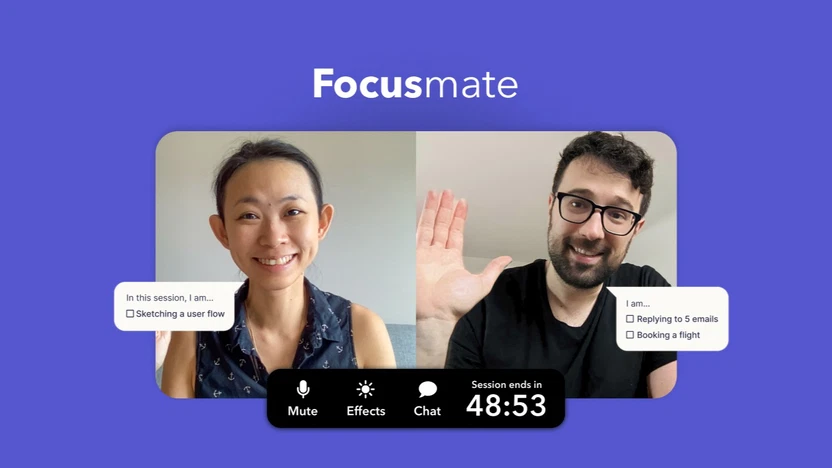
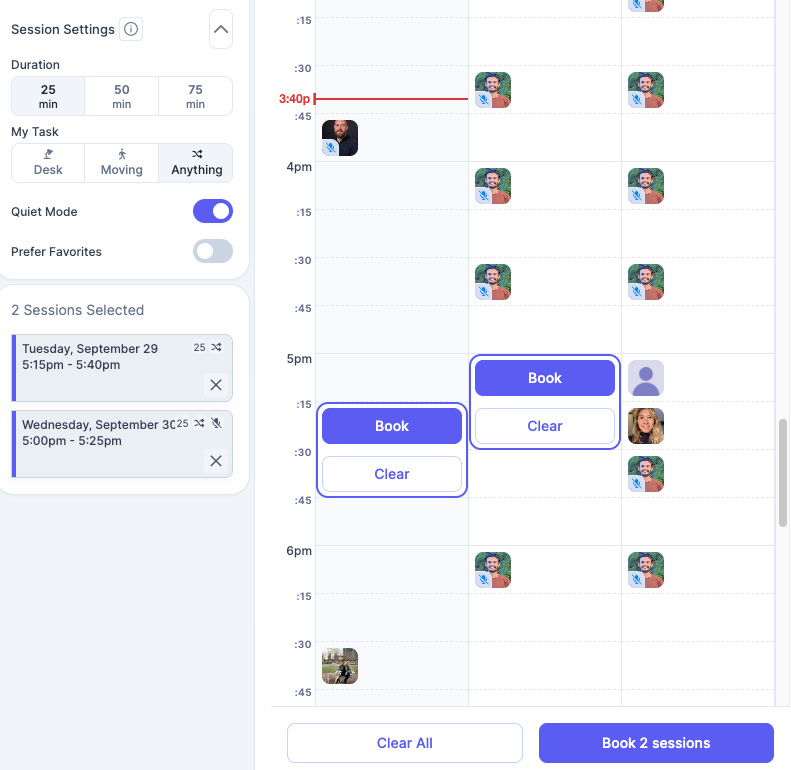
Focusmate is a virtual coworking site. It pairs you with one other person over video so you each work on your own thing while the other one is there. That's it. No shared project, no chat room, no leaderboard.
A session goes like this:
- You book a time slot on the calendar.
- You pick a length: 25, 50, or 75 minutes (Focusmate features).
- At start time, the video opens in your browser. You say hi and state your goal in one sentence.
- You both mute (usually) and work.
- At the end you report back. "Done." "Half done." "I reorganized my desktop icons and I'm ashamed."
What settings does Focusmate have?
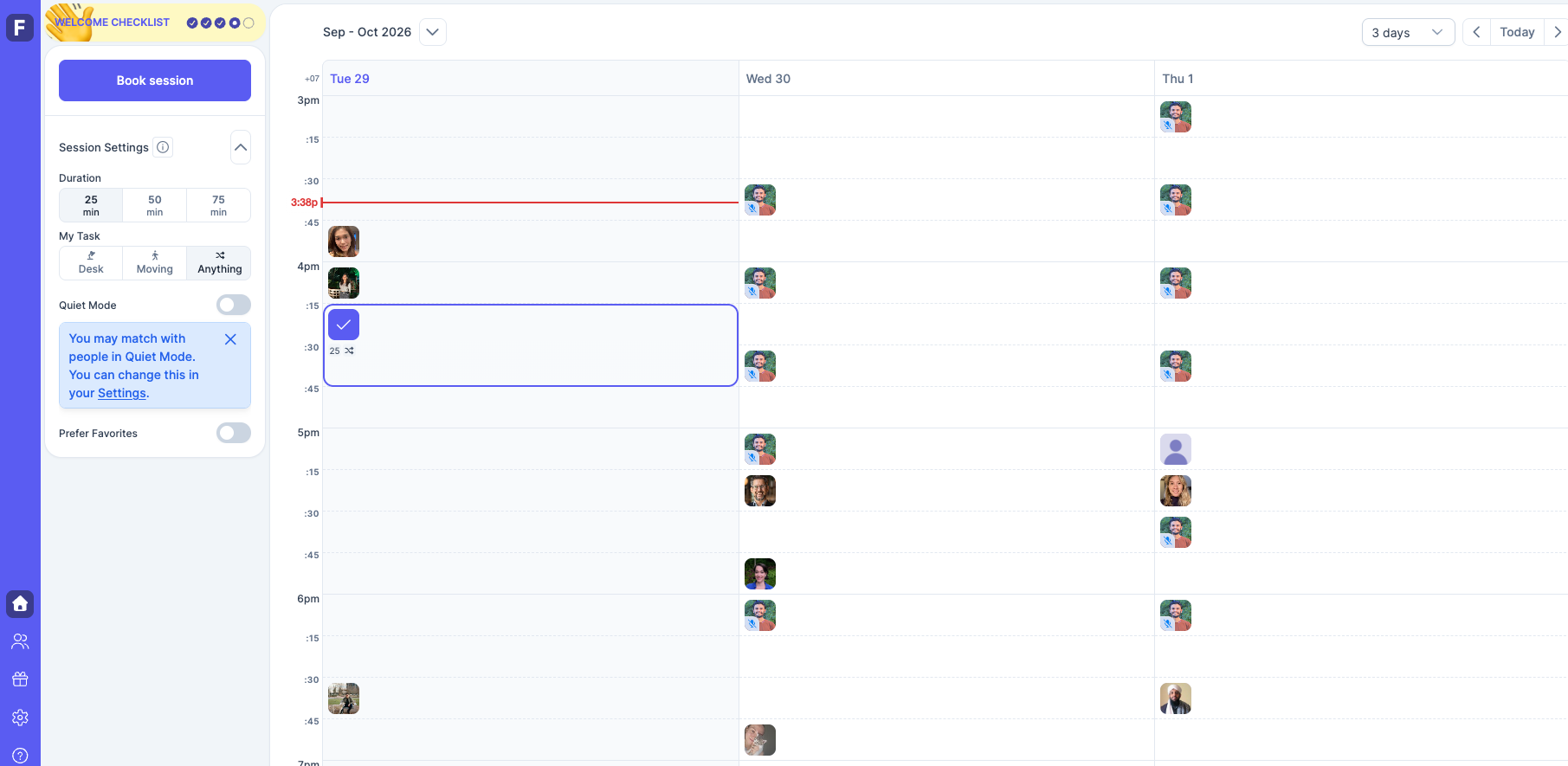
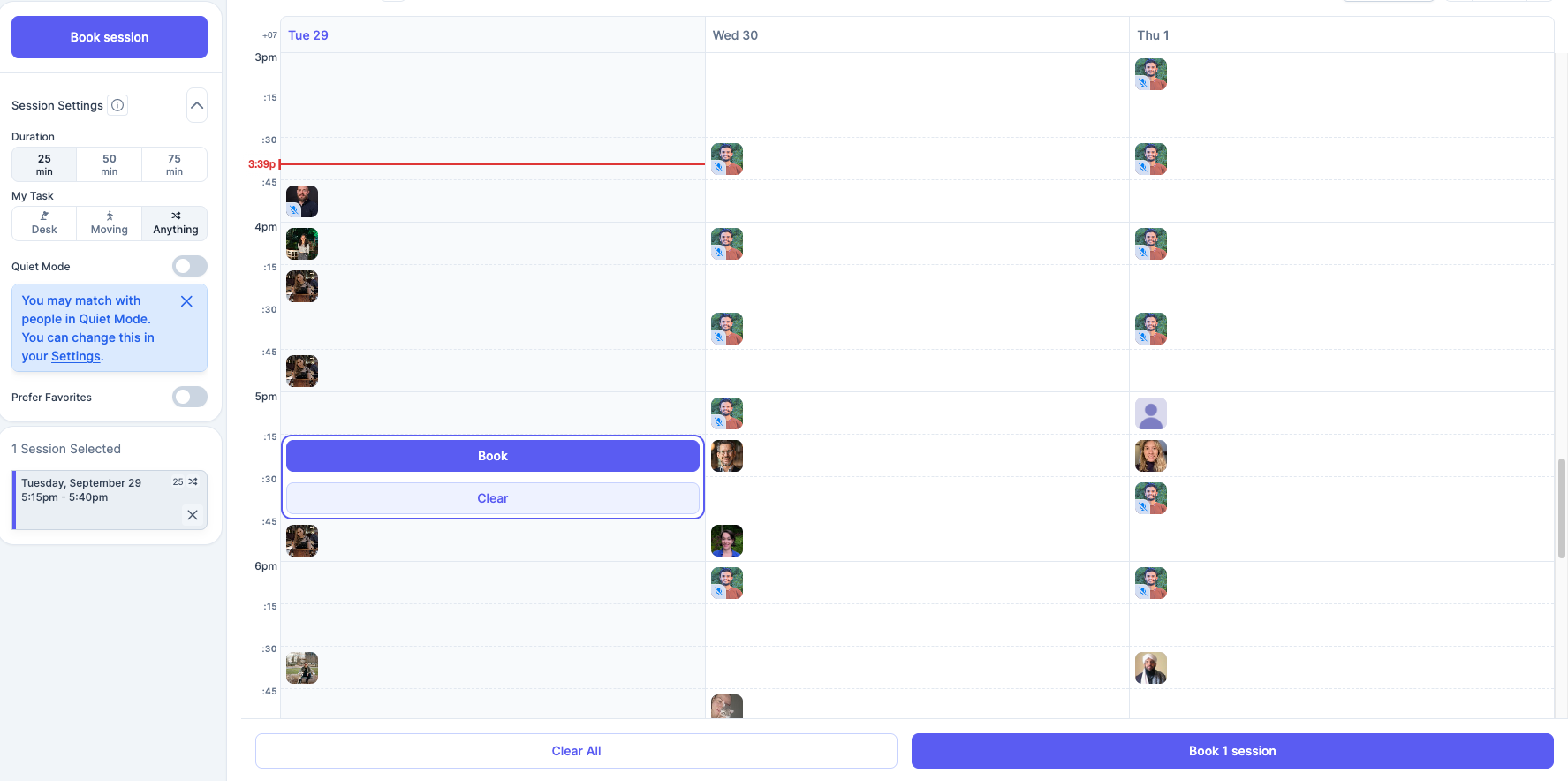
- Task mode. You choose Desk (writing, email, coding), Moving (workouts, chores, active tasks), or Anything (still deciding). Focusmate tries to match you with someone who picked the same mode (Focusmate support: session settings).
- Quiet Mode. You talk through text chat instead of your mic. Handy in a library, a shared flat, or an open office.
- Favorites. You can mark partners you liked and ask to be matched with them first, or only with them.
- Gender matching is listed among the matching preferences on the features page.
- Calendar invites and integrations with Google, Apple, and Outlook calendars, plus Beeminder.
How much does Focusmate cost in 2026?
| Plan | Price | Sessions | Notes |
|---|---|---|---|
| Free | $0 | 3 per week | No credit card required |
| Plus (monthly) | $12/month | Unlimited | Cancel anytime |
| Plus (annual) | $8/month, billed yearly | Unlimited | Cheapest per session if you use it |
| Business | Custom | Unlimited | For teams and organizations |
Source: focusmate.com/pricing. Taxes may apply at checkout.
Is the free plan enough?
For a lot of people, yes. Three sessions a week covers the tasks you've been dodging, which is usually the whole point. Here's my rule of thumb:
- Stay free if you only need help with a few "dreaded" tasks per week.
- Pay monthly once you hit the 3-session wall two weeks in a row. That means you're actually using it.
- Pay annually only after two or three months of steady use. ADHD and annual subscriptions have a complicated relationship.
>>I wrote a whole post about the ADHD tax, and forgotten yearly renewals are a big line item in it.
Why does Focusmate work for some ADHD brains?
Here's what I think is going on:
- A start time someone else is waiting for. Most ADHD procrastination is about starting, which I cover in detail in my post on ADHD task initiation. A booked session turns "sometime today" into "3:00 pm, with Priya from Lisbon."
- Saying the goal out loud. A spoken, specific plan looks a lot like an if-then plan. In a study of children with ADHD, if-then plans (implementation intentions) improved response inhibition on a lab task, and they worked best alongside stimulant medication (Gawrilow & Gollwitzer, 2008, Cognitive Therapy and Research). That was kids and a lab task, not adults and email. I'm borrowing the idea, not the result.
- A visible clock. The session has an end. For people who wrestle with time blindness, a hard edge on the work block matters.
What I like about Focusmate
- It kills the "I'll start in five minutes" loop. Booking a session is a tiny, low-effort action you can do while still avoiding the task. Then the session starts and the avoiding is over.
- It's boring. No gamification, no avatars, no streak fireworks. For me that's a feature. Every dopamine-slot-machine productivity app I've tried eventually becomes the thing I procrastinate with.
- The Moving mode is great for chores. Put your phone on a shelf, pick Moving, and clean your kitchen while a stranger folds laundry in Ohio. It sounds ridiculous. It works. If chores are your wall, pair this with my ADHD cleaning guide.
- Rematching. If your partner doesn't show, Focusmate tries to offer a rematch after about a minute, and it says you'll get a partner "99% of the time" if you book a few minutes ahead (Focusmate support: no-shows). =
- Clear rules. Cameras stay on for the whole session, you stick to work talk, and late arrivals and no-shows are tracked automatically (Focusmate community rules). It feels more like a quiet library than a social app.
What I don't like (and who should skip it)
- There's no native mobile app. Focusmate says so directly. You can add the site to your home screen, which gives you an app-like shortcut, but it's still the browser (Focusmate support: mobile). Fine for chores. Clunky for anything else on a phone.
- Cameras on is non-negotiable. Some ADHD folks also deal with social anxiety or rejection sensitivity. Showing your face to a stranger can feel like a lot. Quiet Mode helps with talking. It doesn't help with being seen.
- No-show guilt. The rules ask you to treat each session like a meeting with an important client. Good for accountability. Bad if you book five sessions on a hopeful Sunday night and bail on three. Book less than you think you need.
- It doesn't tell you what to do. Focusmate is a witness, not a planner. If you arrive with "work on project" as your goal, you'll spend 50 minutes staring at the project. If that's you, read the section on session goals below, or try an AI tool to break down tasks before you log on.
- It won't fix a burnout week. If you're running on empty, stacking more accountability on top can make it worse. Rest first. Book sessions later.
How do I set up Focusmate so it sticks?
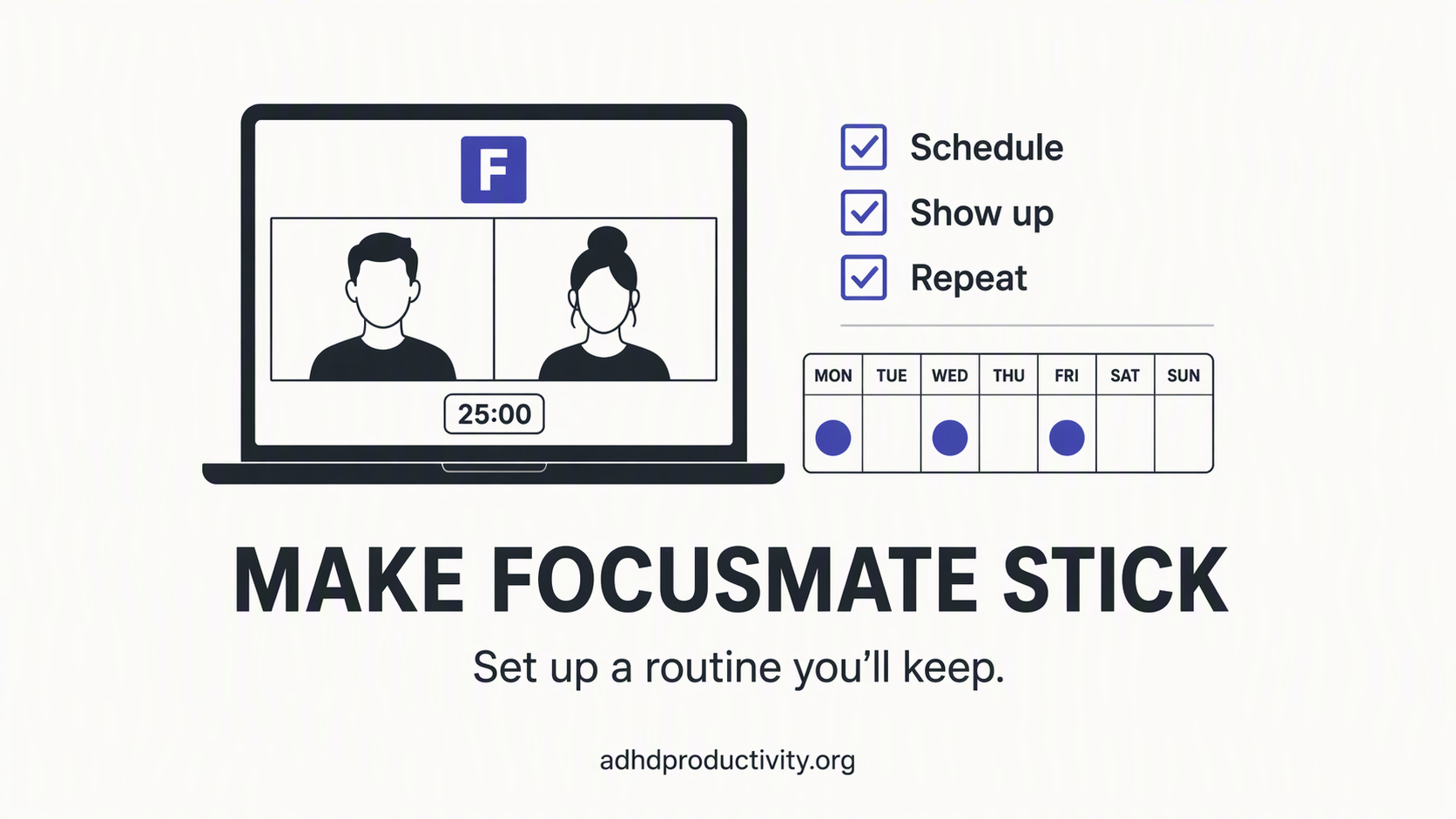
Here's the setup I gave to my friend. It takes about 15 minutes.
Step 1: Book two sessions for this week, not ten
Pick the two tasks you're most avoiding. Book one 25-minute session and one 50-minute session. The short one is your low-stakes trial. The long one is where real work happens.
Step 2: Turn on calendar invites
Connect your calendar so each session shows up next to your meetings. A session that lives only inside the Focusmate site is a session your ADHD brain will forget exists.
Step 3: Write a goal a stranger could check
Bad goal: "Taxes."
Better goal: "Find last year's 1099s and put them in one folder."
The test is simple. Could your partner tell, at the end, whether you did it? If not, make it smaller.
Step 4: Prep the first action before the session
Have the doc open. Have the email drafted in your head. The first two minutes set the tone. If you spend them hunting for a password, you'll spend the next 48 minutes in a tab spiral.
Step 5: Pick the right mode
- Desk for screen work.
- Moving for chores, cooking prep, packing, a workout you keep skipping.
- Anything if you're splitting the block.
Step 6: Favorite the good partners
When someone's calm, on time, and brief, favorite them. Over a few weeks you build a small bench of reliable coworkers without ever making small talk. Introvert heaven.
Step 7: Review after two weeks
Ask yourself three honest questions:
- Did I finish things I'd been avoiding?
- Did I dread the sessions, or just the task?
- Am I hitting the free limit?
If the answer to the first one is no, Focusmate may not be your tool. That's fine. Plenty of people do better with the Pomodoro method or a hard website blocker.
What should I work on during a Focusmate session?
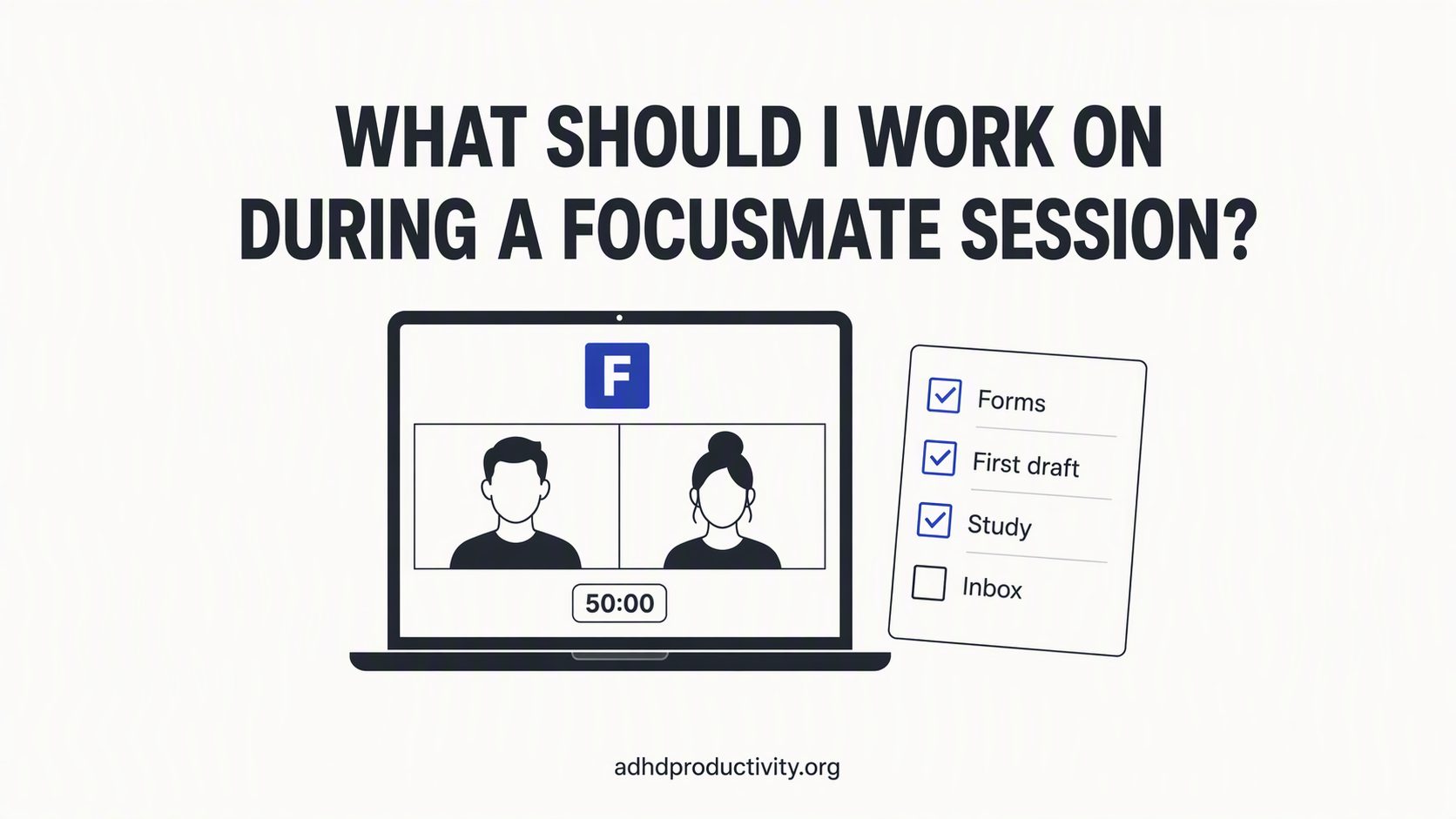
Great fits:
- Admin you've dodged for weeks: forms, bills, insurance calls, expense reports.
- The first draft of anything.
- Study blocks. My guide on how to study with ADHD pairs well with 50-minute sessions.
- Inbox triage with a clear finish line ("inbox to under 20").
- Chores in Moving mode.
Poor fits:
- Deep creative work where you need to pace, mutter, or stare at a wall for 20 minutes. Some people are fine with this on camera. I'm not.
- Tasks with no defined end ("research stuff").
- Anything that needs your phone as the main screen.
Focusmate vs. alternatives: which body doubling tool should you use?
Focusmate is one-on-one and scheduled. Some people want a group, a host, or something free. Here's how it compares:
| Tool | Format | Price (checked Sept 2026) | Best for |
|---|---|---|---|
| Focusmate | 1:1 video, 25/50/75 min, scheduled | Free (3/week), Plus $12/mo or $8/mo annual | Starting dreaded tasks, strict accountability |
| Flow Club | Hosted groups up to 9 people, music, 30 min to 3 hours | $40/mo or $400/year, 50% off for students and nonprofit workers | People who like a host and a room feel |
| Focusmate Group Sessions (Labs) | Hosted groups up to 8, 50/75 min | Early experiment, limited access | Focusmate users who want less 1:1 pressure |
| YouTube "study with me" videos | Recorded, no interaction | Free | Camera-shy folks, low-stakes days |
| A friend on a video call | Whatever you agree | Free | People with a reliable, patient friend |
My blunt ranking for most ADHD adults: start with Focusmate free. If the 1:1 part stresses you out, try a recorded video next, because it's free and nothing's at stake. Try Flow Club only if you've confirmed you like the group vibe, since it costs over three times as much as Focusmate Plus monthly.
If you mostly get distracted rather than stuck at the start, a body double is the wrong fix. You want a blocker. My best focus apps for ADHD roundup covers those.
What should I use with Focusmate?
Focusmate handles the "sit down and start" part. It does nothing for the "what am I even starting" part. I use Saner.ai as the place where my brain dump goes before a session: I dump the messy list of everything, pull out the one task I'll do in the next 50 minutes, and paste that as my Focusmate goal. Any notes app or paper list can do this job. What matters is that the goal is chosen before the timer starts.
Frequently asked questions
Is Focusmate free?
Yes, partly. The free plan gives you 3 sessions per week with no credit card. Unlimited sessions need Focusmate Plus, which costs $12/month or $8/month billed annually (pricing).
How does Focusmate work?
You book a 25, 50, or 75-minute slot, get matched with one partner, share your goal on video, work quietly, and check in at the end. If your partner doesn't show, Focusmate tries to rematch you after about a minute.
Is Focusmate safe?
Focusmate has five community rules, including keeping your camera on and not asking for personal information, plus a reporting feature. It says it bans users when there's a pattern of disrespect (community rules). As with any site where you meet strangers, don't share personal details, and report anyone who makes you uncomfortable.
Does Focusmate have an app?
Not a native one. Focusmate runs in your browser, and on phones you can add it to your home screen for an app-like shortcut.
Do I have to talk during Focusmate sessions?
Only briefly, at the start and end. With Quiet Mode on, you can use text chat instead of your mic. Your camera still needs to stay on.
Is body doubling scientifically proven for ADHD?
No, not yet. A 2024 survey of 220 neurodivergent people found body doubling is common and used across many kinds of tasks (Eagle et al., 2024), but I couldn't find a randomized controlled trial showing it improves ADHD outcomes. Many people find it helpful. That's different from "proven."
What's a good Focusmate alternative?
Flow Club if you want hosted groups, recorded "study with me" videos if you want free and camera-free, or a friend on a video call. See the comparison table above.
Your next three steps
Don't turn this into a project. Do this today:
- Make a free account and connect your calendar.
- Book one 25-minute session within the next 24 hours for the task you've avoided longest.
- Write a goal a stranger could check, and have the first action ready before you join.
After two weeks, decide whether to pay. If you haven't hit the free limit, you don't need Plus. If you have, the $8/month annual plan is the better deal, as long as you put a renewal reminder in your calendar. I'll be over here, finishing that landlord email. With a witness.
Matt Elior is not a clinician. This review is for information only and isn't medical advice. See my medical disclaimer and editorial policy.