The ADHD Tax: How to Pay Less of It

You forgot to cancel the free trial. Again. Forty dollars, gone, for an app you used twice. The library book is three weeks late. There's a parking ticket in the glovebox you meant to pay and now it's doubled. None of these things are expensive on their own. Stacked up over a year, they are.
There's a name for this pile of small, dumb, avoidable costs: the ADHD tax. It's not an actual tax, obviously, nobody's collecting it. It's the informal term for the extra money, time, and stress that people with ADHD pay because of the very traits that come with the condition: forgetfulness, time blindness, impulsivity, decision fatigue. If you've ever bought a second phone charger because you couldn't find the first one, you already know what this is.
I'm Matt, and I've paid this tax so many times. Late fees on bills I fully intended to pay. A gym membership I kept for eleven months without going once. So this post is what I've actually found works, plus a couple of studies that explain why this happens in the first place.
What the ADHD tax looks like
It shows up in a few predictable categories. Recognizing them is most of the battle, because you can't fix a leak you haven't found yet.
- Late fees and penalties. Credit cards, utility bills, library fines, parking tickets. Not because you don't have the money. Because the bill got buried under something else on the counter.
- Impulse purchases. The 11pm Amazon order. The gadget that promised to fix your whole life and is now in a drawer.
- Duplicate purchases. Buying scissors, chargers, or tape because you couldn't find the ones you already own.
- Subscription creep. Streaming services, apps, and memberships you forgot to cancel, sometimes for years.
- The "getting started" tax. Paying someone else to do something you're capable of doing, because task paralysis made starting it yourself impossible.
- Convenience spending. Takeout instead of the groceries already in the fridge, because deciding what to cook and then doing it felt like too many steps.
A 2020 study published in PLOS One looked at financial decision-making in adults with and without ADHD symptoms and found something worth sitting with: only 19.6% of the group with ADHD symptoms was actively saving for retirement, compared to 41.5% of the control group, and the ADHD group also scored significantly higher on impulsive buying (Sarver et al., PLOS One, 2020). That's more than double the gap in retirement savings.
>> This is a brain-wiring problem that shows up on your bank statement, and blaming your willpower for it has never once fixed it.
Why this happens
Three ADHD traits do most of the damage here, and it's worth naming them so you stop assuming you're just bad with money.
- Time blindness makes due dates feel abstract until they're urgent. A bill due in three weeks doesn't register as real until it's due tomorrow, and by then the grace period's gone.
- Working memory gaps mean "I'll deal with it later" often just means "I will forget this exists by dinner." Not because you don't care. The information doesn't stick around in the part of your brain that's supposed to hold it for later. It slides right off.
- Impulsivity and decision fatigue push you toward the choice that requires the least mental effort right now, even when it costs more later. Ordering dinner is one decision. Cooking is fifteen.
How to cut the ADHD tax down
For bills and late fees

- Autopay everything you can. Not "budget better." Autopay. If the money leaves your account without you having to remember anything, the late fee has nowhere to attach itself.
- One inbox for bills, physical or digital, not a pile that migrates around the kitchen. A single tray, a single folder, it doesn't matter which, as long as there's only one.
- Set reminders for the reminder. A calendar alert three days before a due date, not the day of. You need lead time to act, because "noticing" a bill the day it's due is a different skill than paying it.
For impulse and duplicate spending
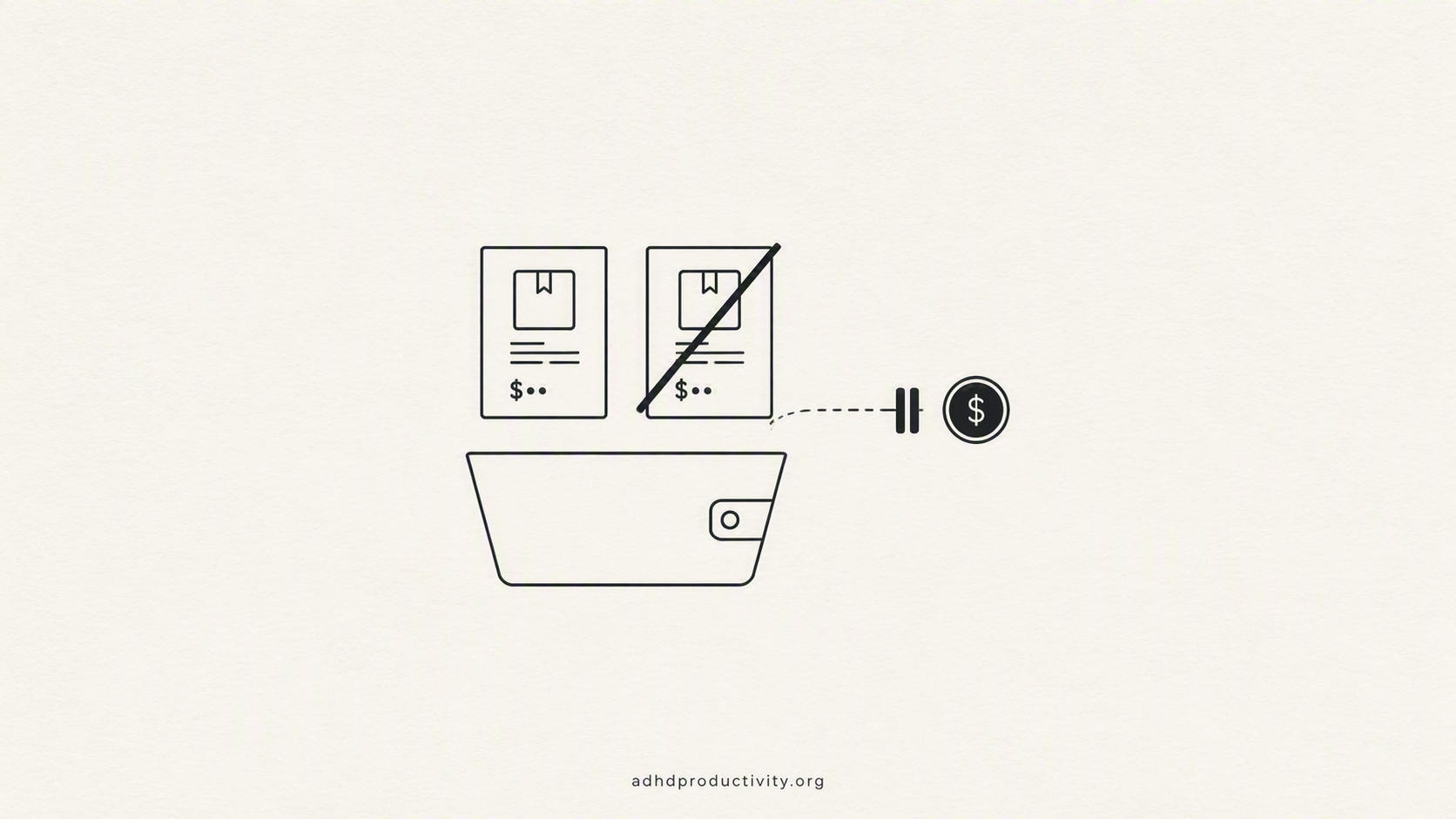
- Add a 24-hour rule for anything over a set dollar amount. Put it in the cart, close the tab. If you still want it tomorrow, buy it tomorrow.
- Keep a running "things I own" list for items you tend to rebuy: tape, chargers, scissors, batteries. Check it before you buy, not after.
- Delete saved payment info from shopping apps. Friction is crucial. If checkout takes an extra ninety seconds, some purchases just won't survive it.
For subscription creep
- Do a subscription audit once a quarter. Pull up your bank statement, highlight every recurring charge, ask "did I use this in the last thirty days." Cancel anything you can't answer yes to.
- Use one place to actually capture "cancel this" the moment you think it, instead of trusting yourself to remember at some undefined future point. I use saner.ai to dump these thoughts the second they cross my mind, because "I'll remember to cancel that" is exactly the kind of promise an ADHD brain doesn't keep 🤣 the tool turns that to a reminder automatically for me
For the "getting started" tax
- Lower the first step until it's stupidly small. Not "clean the kitchen." Just "put three things away." Momentum does the rest more often than not.
- Body double it. Do the task while on a call with a friend, or sit in a coffee shop. Something about another person's presence (even virtual) makes starting easier for a lot of ADHD brains. Nobody's fully sure why. It just works often enough to keep doing it.
Where this doesn't fully work
I still pay a version of this tax. Less than I used to, but not zero. I'm aiming for fewer leaks and smaller ones, not a perfect system, and that's genuinely been enough to change how money-related stress feels day to day.
Quick-answer: your ADHD tax action plan
- Automate every bill you can onto autopay this week.
- Consolidate all incoming bills into one physical or digital spot.
- Add friction to impulse spending. Delete saved cards. Add a 24-hour rule.
- Audit subscriptions quarterly, on a set calendar date.
- Capture "cancel this" thoughts immediately, somewhere you'll actually see them again.
- Shrink the first step on anything you're avoiding starting.
If your finances have felt like a maze of missed deadlines and mystery charges, you're not careless. You've got the same three or four ADHD traits everyone in this post has. Now you know where to point the fixes so they stop draining your account.
Questions you may have
What is the "ADHD tax"?
It's an informal term (not a real tax) for the extra money, time, and stress people with ADHD end up paying because of traits like time blindness, forgetfulness, and impulsivity — late fees, duplicate purchases, forgotten subscriptions, and similar recurring costs.
Does research actually support this idea?
Yes, in substance if not in name. A 2020 study in PLOS One found adults with ADHD symptoms showed significantly higher impulsive buying and were far less likely to be saving for retirement than adults without ADHD symptoms (source).
What's the single best first step to reduce it?
Put every recurring bill you can on autopay. It removes the one step (remembering) where most of the damage happens.