ADHD Task Initiation: How to start a task when you have ADHD

Quick answer: Starting is hard because ADHD affects the systems that turn an intention into an action, not the systems that understand why the task matters. The techniques with the most direct research support are if-then plans (specifying exactly when, where, and how you'll start), shrinking the first step until it's almost too small to refuse, and putting the cue outside your head where you'll actually trip over it. Motivation is not the lever. The starting conditions are.
You know what the task is. You know the deadline. You know, in some abstract way, that it will take twenty minutes and that the twenty minutes will feel fine once you're in them.
You still don't start.
That gap is the thing nobody explains well. Most productivity writing treats getting started as a motivation problem, and then hands you a motivation solution: think about your why, visualise the finished product, remember your goals. If that worked on you, you would not be reading this.
Why is starting a task so hard with ADHD?
Because ADHD is, at its core, a disorder of doing what you know rather than knowing what to do.
Russell Barkley made this argument in Psychological Bulletin in 1997, building a model in which ADHD comprises a deficit in behavioural inhibition, and that deficit knocks on into four executive functions that depend on it: working memory, self-regulation of motivation and arousal, internalised speech, and the ability to break down and recombine behaviour. Barkley's own summary of the evidence found it strongest for behavioural inhibition, working memory, motivation regulation, and motor control. Knowledge was never the missing piece.
There's a second mechanism running alongside it. Edmund Sonuga-Barke proposed in Behavioural and Brain Research in 2002 that ADHD also involves delay aversion, a motivational style oriented toward escaping or avoiding delay, and that this coexists with poor inhibitory control as a separate characteristic rather than a symptom of it. That's his dual pathway model.
Read that second one again and think about what an unstarted task actually is. It's a delay with your name on it. Every minute of work sits between you and the payoff. If the negative feeling attached to waiting is stronger for you than it is for most people, then avoiding the start isn't irrational. It's the fastest available route out of an unpleasant state.
Which is why the guilt is misplaced. You are not failing to care.
Is procrastination actually an ADHD symptom?
Not officially. It isn't in the DSM criteria.
But Hannah Niermann and Anouk Scheres looked at this in the International Journal of Methods in Psychiatric Research in 2014, studying 54 students with varying levels of self-reported ADHD behaviours. What they found is worth knowing: inattention symptoms correlated with general procrastination, while hyperactivity and impulsivity did not. The quiet, drifting, can't-get-traction version of ADHD is the one most tied to delay.
Later work has replicated the association. A 2023 study in Heliyon found that ADHD symptoms strengthened the link between steep temporal discounting and procrastination, but only in the reward condition, and the authors concluded that interventions for procrastination in ADHD-prone adults need to attend specifically to reward responses. Mareike Altgassen, Anouk Scheres and Marc-Andreas Edel found in 2019 that prospective memory partially mediates the link between ADHD symptoms and procrastination, which is a technical way of saying that some of what looks like avoidance is actually forgetting to remember at the right moment.
That distinction matters for what you do about it. Forgetting-to-remember and can't-tolerate-the-delay need different fixes.
What actually helps you start? The techniques with real evidence
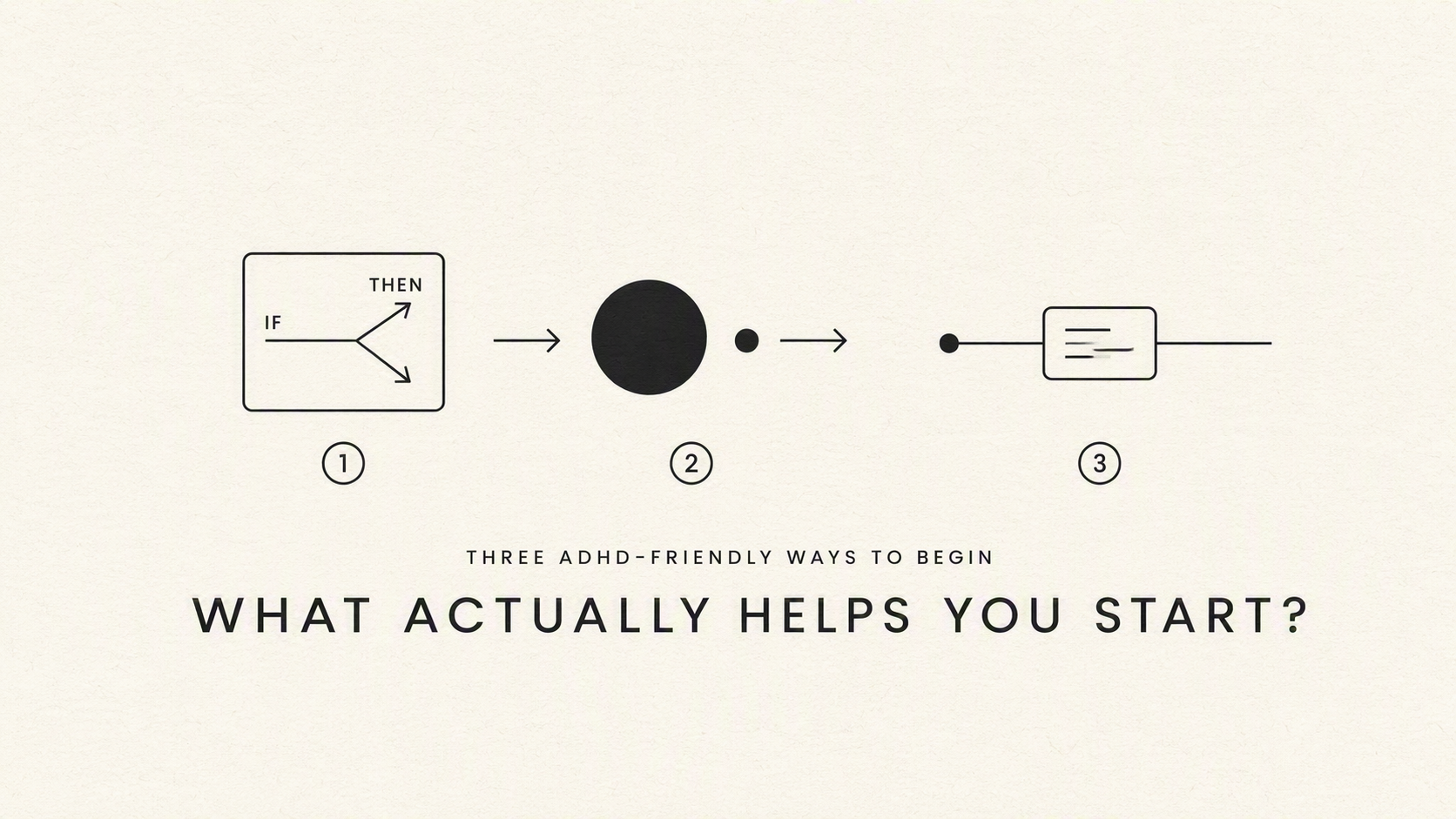
I've ordered these by how much direct ADHD research sits behind them, not by how good they sound.
1) If-then plans, which are the best-evidenced thing on this list
An implementation intention is a plan in the form "if situation X happens, then I will do Y." It sounds trivially simple. It performs far better than it looks.
Caterina Gawrilow and Peter Gollwitzer tested this in children with ADHD and published in Cognitive Therapy and Research in 2008. Children with ADHD who furnished a suppression goal with an if-then plan improved their inhibition on a Go/No-Go task to the same level as children without ADHD. A second study found that if-then plans combined with stimulant medication produced the highest suppression performance of any condition tested. Gawrilow, Gollwitzer and Oettingen followed this in 2011 with two samples showing improved delay of gratification in children with ADHD.
Here's the detail I find most interesting. A 2026 systematic review and meta-analysis in the British Journal of Psychology by Breitwieser and colleagues noted that in the original Gawrilow and Gollwitzer study, only the children with ADHD benefited from the intervention. The children without ADHD didn't. This technique appears to be doing something specific for brains that struggle with action control, not offering a general productivity boost.
Now the honest limit, because it's a real one. APSARD, the professional association for ADHD research, notes that implementation intentions have not yet been studied in adults with ADHD. The evidence base is in children. I use them anyway and I think you should too, since the downside is thirty seconds of planning, but you should know you're extrapolating.
What this looks like in practice:
- Not "I'll work on the report tomorrow" but "if it's 9:15 and I've sat down at my desk, then I open the report file and write the first heading."
- Name the trigger as something that will physically happen to you. A time, a place, a completed action.
- Specify one action, not a session. The plan ends at "open the file," not "finish the draft."
The trigger is the whole trick. You're outsourcing the decision to start from your brain to your environment.
2) Shrink the first step until refusing it feels stupid
Structured skills-based CBT is the psychosocial treatment with the strongest trial evidence in adult ADHD, and task breakdown is one of its core components. Steven Safren and colleagues ran the landmark trial, published in JAMA in 2010, randomising 86 medication-treated adults with persistent ADHD symptoms to either CBT or relaxation with educational support. The CBT group showed greater improvement in ADHD symptoms, and the gains held at twelve-month follow-up.
The mechanism is not mysterious. A task you can hold in working memory is a task you can begin. "Do taxes" cannot be held. "Open the folder where the receipts are" can.
My rule is that if I've read a task on my list twice without starting it, the task is written wrong. Not the wrong task. Wrong wording. So I rewrite it smaller until the first physical action is obvious, and then I write only that action.
3) Put the cue where you'll trip over it
Given that prospective memory partially mediates the ADHD-procrastination link (Altgassen and colleagues, 2019), a portion of not-starting is a failure of the reminder to arrive at the moment when action is possible.
This is fixable in a way most of ADHD is not. Anything that moves the cue out of your head and into the physical or digital world is doing real work: the file left open on the screen overnight, the running shoes by the door, the calendar block that fires as a notification rather than sitting quietly in a grid you'll never look at.
The failure mode is putting the reminder somewhere sensible. Sensible places get filtered out. Put it somewhere mildly annoying.
4) Move first, if you have fifteen minutes and the option
Anna Mehren and colleagues published a study in Frontiers in Psychiatry in 2019 in which 23 adults with ADHD and 23 matched controls completed a flanker task after either 30 minutes of moderate stationary cycling or a control condition. Exercise significantly improved reaction times in the adults with ADHD, and did not do so in the healthy controls.
Temper this with the broader picture. A 2025 systematic review and meta-analysis of physical activity interventions for core ADHD symptoms in adults found that acute interventions produced a small but significant reduction in symptoms, with a Hedges' g of -0.191, while chronic interventions did not reach significance. Small. Real, but small.
So: worth doing before a hard start, not worth treating as the answer.
5) Body doubling, with an evidence label
Working alongside another person is the most enthusiastically recommended ADHD strategy on the internet, and the evidence for it is much thinner than the enthusiasm suggests.
The first real academic treatment came from Tessa Eagle, Leya Breanna Baltaxe-Admony and Kathryn Ringland at ASSETS in 2023, who surveyed neurodivergent participants and proposed a two-part model of body doubling as a continuum of space/time and mutuality. Their own framing acknowledged that little empirical evidence supported its use. A 2025 EEG study at ASSETS found no statistically significant group-level effects, though it reported no negative impacts and promising individual-level trends, and its authors described it as preliminary groundwork.
I still recommend trying it, because the cost is nothing and a lot of people report it works. I'm just not going to tell you it's evidence-based when the researchers themselves are calling their own work preliminary. If someone else does, check whether they've read the papers.
What if none of this works today?
Some days the machinery is just offline. That's not a character event.
Two things I'd suggest, neither of which is a technique. First, lower the target to the smallest unit that still counts, and let that be the whole day's win. Second, notice whether this is a bad week or a bad six months, because persistent inability to start on things you care about, at a level that's damaging your work or relationships, is worth taking to a clinician rather than to another blog post. Structured treatment exists and the trial evidence for it in adults is decent.
👉 You may like this post on how to increase productivity with ADHD
Frequently asked questions
Why can I hyperfocus for six hours but not start a ten-minute task? Because the two situations place different demands on the systems ADHD affects. Sustained engagement with something intrinsically rewarding requires little self-initiated action control. Starting something boring requires exactly that, and Barkley's 1997 model locates the deficit in behavioural inhibition and the executive functions dependent on it, including self-regulation of motivation.
Does the five-minute rule work for ADHD? It's a reasonable application of task shrinking, which appears as a component in CBT protocols with trial evidence in adult ADHD. But I could not find a study testing the five-minute rule specifically in an ADHD population, so treat it as a plausible technique rather than a validated one.
Is task initiation difficulty a real ADHD symptom or just procrastination? Procrastination is not a diagnostic criterion for ADHD. The association is well documented though, and Niermann and Scheres found in 2014 that it tracks with inattention symptoms specifically rather than with hyperactivity or impulsivity.
Do stimulant medications help with getting started? That's a question for your prescriber, and effects vary. What the trials show is that psychosocial strategies add something on top of medication rather than replacing it. Safren's 2010 JAMA trial recruited adults who were already medicated and still had significant symptoms, and CBT improved their outcomes further.
Why does the task feel physically unpleasant to approach? Sonuga-Barke's delay aversion account, published in 2002, describes a motivational disposition to escape or avoid the negative affective state that delay itself evokes. Under that model the discomfort isn't imaginary and isn't laziness. It's the delay being genuinely aversive.
Is time blindness making this worse? Probably, though the adult evidence is messier than most articles admit. Christian Mette's 2023 review in the International Journal of Environmental Research and Public Health concluded that studies on time perception in adult ADHD are very scarce, with some showing clear deficits in time estimation and reproduction and others failing to find a clear association.
Sources
- Barkley, R.A. (1997). Behavioral inhibition, sustained attention, and executive functions: constructing a unifying theory of ADHD. Psychological Bulletin, 121(1), 65–94. doi:10.1037/0033-2909.121.1.65
- Sonuga-Barke, E.J.S. (2002). Psychological heterogeneity in AD/HD: a dual pathway model of behaviour and cognition. Behavioural Brain Research, 130(1–2), 29–36. doi:10.1016/s0166-4328(01)00432-6
- Niermann, H.C.M., & Scheres, A. (2014). The relation between procrastination and symptoms of attention-deficit hyperactivity disorder (ADHD) in undergraduate students. International Journal of Methods in Psychiatric Research, 23(4), 411–421. doi:10.1002/mpr.1440
- Gawrilow, C., & Gollwitzer, P.M. (2008). Implementation intentions facilitate response inhibition in children with ADHD. Cognitive Therapy and Research, 32, 261–280. doi:10.1007/s10608-007-9150-1
- Gawrilow, C., Gollwitzer, P.M., & Oettingen, G. (2011). If-then plans benefit delay of gratification performance in children with and without ADHD. Cognitive Therapy and Research, 35, 442–455. doi:10.1007/s10608-010-9309-z
- Breitwieser and colleagues (2026). The effectiveness of implementation intentions in children: a systematic review and meta-analysis. British Journal of Psychology. doi:10.1111/bjop.70065
- Safren, S.A., Sprich, S., Mimiaga, M.J., Surman, C., Knouse, L., Groves, M., & Otto, M.W. (2010). Cognitive behavioral therapy vs relaxation with educational support for medication-treated adults with ADHD and persistent symptoms: a randomized controlled trial. JAMA, 304(8), 875–880. doi:10.1001/jama.2010.1192
- Altgassen, M., Scheres, A., & Edel, M.-A. (2019). Prospective memory (partially) mediates the link between ADHD symptoms and procrastination. PMID: 30927231
- Mehren, A., et al. (2019). Acute effects of aerobic exercise on executive function and attention in adult patients with ADHD. Frontiers in Psychiatry, 10, 132. doi:10.3389/fpsyt.2019.00132
- Dahlberg, M., Vessonen, T., Finell, J., Söderberg, P., Aunio, P., Vanhala, A., & Korhonen, J. (2025). The effects of physical activity interventions on the core symptoms of ADHD in adults: a systematic review and meta-analysis. Mental Health and Physical Activity, 29, 100725. doi:10.1016/j.mhpa.2025.100725
- Eagle, T., Baltaxe-Admony, L.B., & Ringland, K.E. (2023). Proposing body doubling as a continuum of space/time and mutuality: an investigation with neurodivergent participants. ASSETS '23. doi:10.1145/3597638.3614486. Open-access PDF
- Reading between the lines: exploring body doubling in ADHD using EEG (2025). ASSETS '25. doi:10.1145/3663547.3759743
- Mette, C. (2023). Time perception in adult ADHD: findings from a decade, a review. International Journal of Environmental Research and Public Health, 20(4), 3098. doi:10.3390/ijerph20043098
- Moderating effect of ADHD tendency on the relationship between delay discounting and procrastination in young adulthood (2023). Heliyon. PMID: 37025860
If you're struggling to function day to day, please talk to a clinician. CHADD and ADDitude both maintain directories of ADHD-informed professionals.