How to Use AI to Break Down Overwhelming Tasks (When You Have ADHD)

Key takeaways
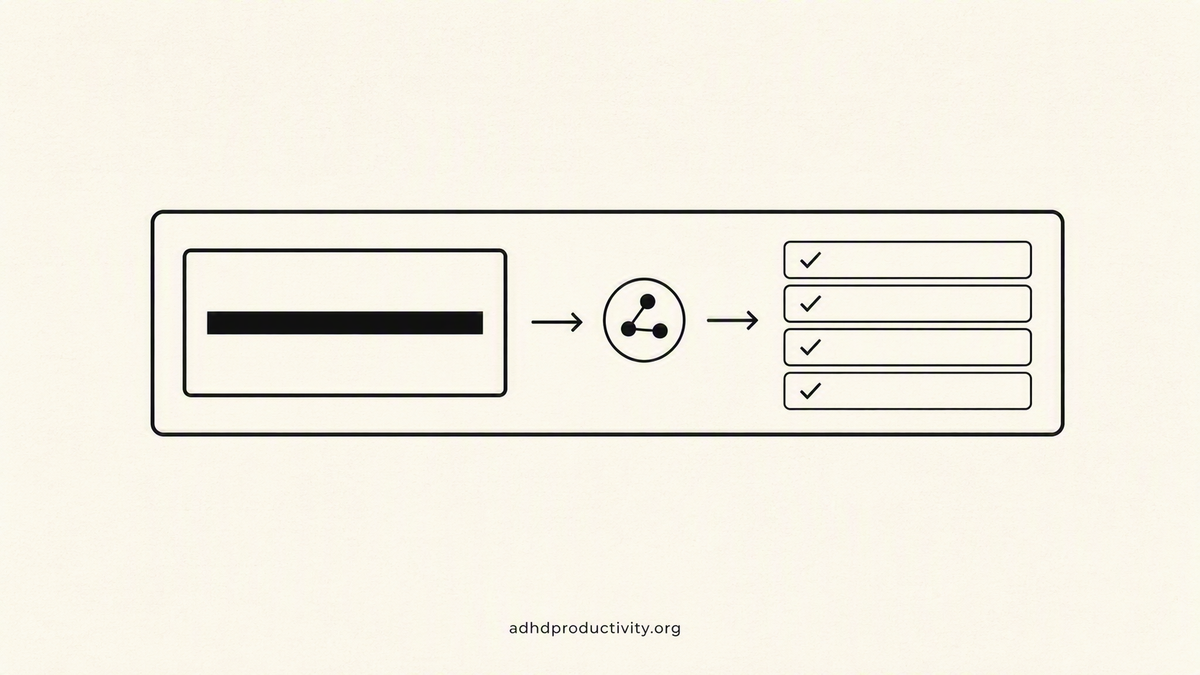
- Breaking large tasks into smaller steps isn't a productivity hack. It's a documented component of the CBT protocol for adult ADHD that beat an active control in a JAMA randomized trial (Safren et al., 2010).
- AI is very good at the mechanical part of decomposition and very bad at knowing where you will stall. That's the part you have to supply.
- A step is small enough when refusing to do it would feel ridiculous.
- Best AI tools for task breakdown are Saner.AI, chatGPT, and Goblin Tools
I once spent an entire Tuesday morning building a beautiful project plan for a task I never started. Fourteen steps. Colour-coded. Genuinely lovely.
The task is still not done.
That's the failure mode this post is about. AI makes task breakdown almost frictionless, which means it also makes fake progress almost frictionless. Below is how I actually use it, what the research supports, and where I keep getting it wrong.
Why do big tasks break an ADHD brain specifically?
A large task isn't one problem. It's four, and ADHD makes each one harder.
| The problem | What it feels like | What the evidence says |
|---|---|---|
| Holding the plan | "I know what to do but I can't keep it in my head" | Meta-analysis of 38 studies found moderate working memory deficits in adults with ADHD across verbal and visuospatial domains (Alderson et al., 2013) |
| Starting | "I'll do it after this one thing" | Higher ADHD symptom levels were associated with more frequent procrastination in a survey of 470 adults (Kamimura et al., 2021) |
| Judging how long | "This will take twenty minutes" (it takes four hours) | Meta-analytic evidence of altered perceptual timing across multiple paradigms in ADHD (Marx et al., 2022) |
| Wanting to | "I just cannot make myself care about this" | Meta-analysis of case-control studies found steeper monetary delay discounting in ADHD (Jackson & MacKillop, 2016) |
There's one more finding that matters here. Piers Steel's meta-analysis of 691 correlations found task aversiveness among the strongest and most consistent predictors of procrastination (Steel, 2007).
>> Aversiveness predicts delay. A vague, enormous task is maximally aversive. Chopping it into pieces isn't just organisational tidiness. It lowers the thing that's actually stopping you.
This is also why the "just try harder" advice fails.
👉 If you want the longer version of that argument, I wrote it up separately: executive dysfunction vs. laziness.
Key takeaway: The research supports decomposition as a mechanism.
Is AI actually better than doing this yourself?
Sometimes. Not always.
Where AI wins:
- It produces the list at zero cost to your working memory. You don't have to hold fourteen things while sorting them.
- It doesn't get bored on step nine.
- It'll go to a level of granularity you'd feel embarrassed or lazy (🤣) writing down yourself. "Open the laptop" is a legitimate step. AI will write it without judging you.
- It reorders and reshuffles instantly when the plan turns out to be wrong, which it always is.
Where it's worse than you:
- It doesn't know your job, your calendar, or which specific step contains the phone call you've been avoiding for months.
- It agrees with you. Bring it a bad plan confidently and you'll get a refined bad plan.
- Its steps are generic by default, which means they're plausible and useless in equal measure.
The peer-reviewed evidence on AI tools for ADHD is thin. A seven-day diary study plus interviews with 13 adults with ADHD who use ChatGPT regularly found they used it to support executive function and emotional regulation (Pinto et al., 2025). That's 13 people. It's descriptive, not causal. Treat it as encouraging, not as proof.
The five AI prompts to break down tasks
They're the ones I use 💪
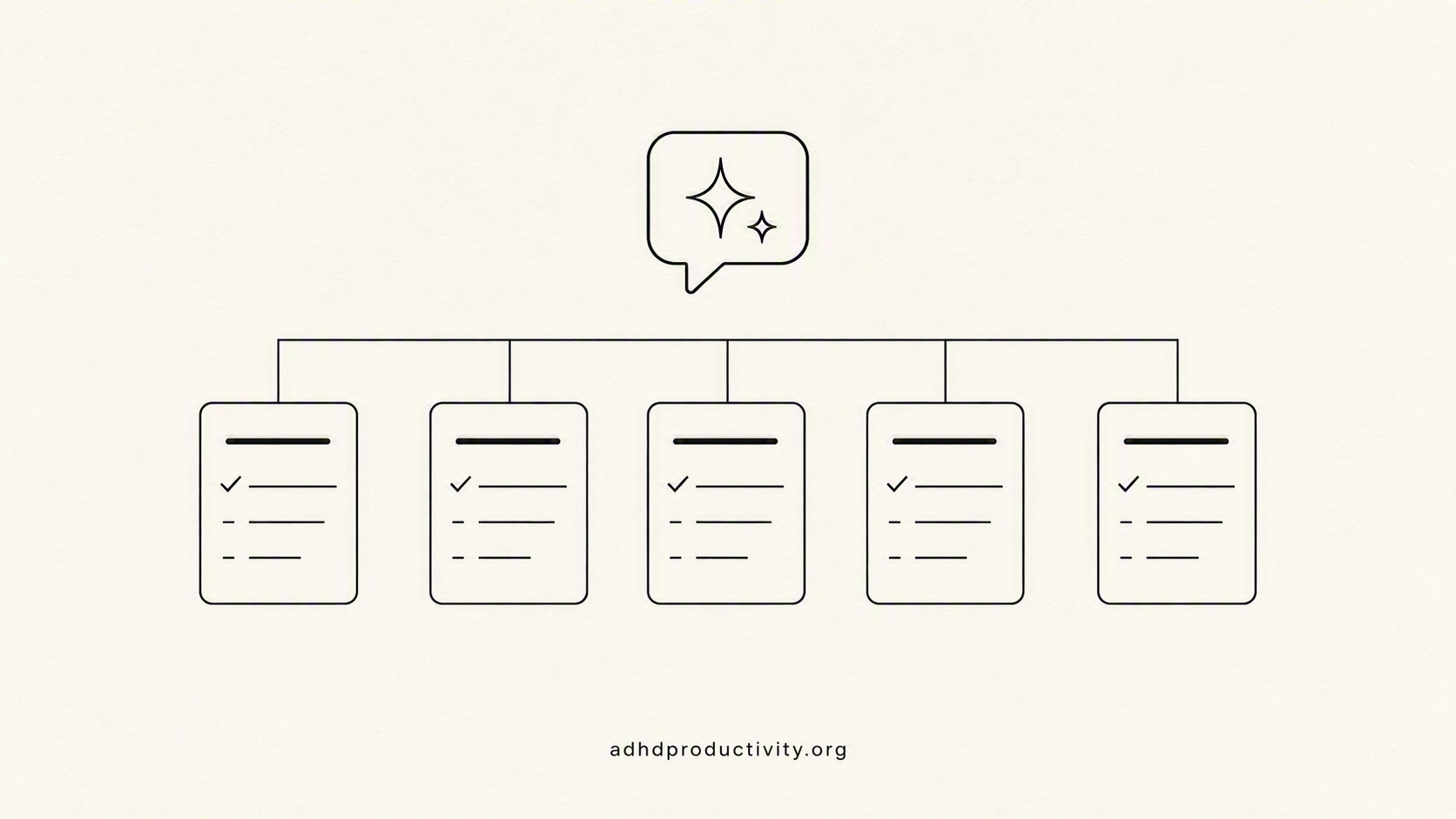
1. The decomposition
Generic prompts give generic steps. Context is the entire difference.
I have ADHD and I'm stuck on this task: [describe it in one messy sentence]. Break it into steps small enough that each one takes under 15 minutes. For context: [what you already know, what you don't, who else is involved, what the deadline is]. Don't give me advice or encouragement. Just the steps.
The "don't give me advice" line is important. Without it you get a paragraph of reassurance and then the steps, and by the time you've read the reassurance you've forgotten what you want to do in the 1st place.
2. The stall-point finder
Here are the steps you gave me. For each one, tell me what would have to be true for me to do it in the next 10 minutes. Flag any step that depends on information I don't have, a decision I haven't made, or another person.
Most breakdowns fail at exactly one step, and it's almost always a hidden decision or a dependency on someone else. Finding it before you start saves the afternoon.
3. The shrink-it-again
Step 3 still feels too big. Break just that step into smaller pieces. Keep going until the first piece takes under 2 minutes.
You can ask for humiliating granularity without explaining yourself to a human being.
4. The time-reality check
For each step, give me a realistic time estimate assuming I get distracted at least once. Then tell me what a version of this task looks like that takes half the total time and is still acceptable.
Two things happen here. You get an external duration estimate, which helps given the timing research above. And you get permission to do the smaller version, which is often the only version that's going to exist.
5. The first-move prompt
Give me only step one. Nothing else. Then give me a specific if-then plan for it in the format: "If [time and place], then I will [action]."
That format isn't arbitrary. More on it below.
How do you know a step is small enough?
My rule: if refusing to do it would feel absurd, it's small enough.
"Write the report" is refusable. "Open the doc and type the title" is not refusable without feeling silly, and feeling silly is a much weaker force than feeling overwhelmed.
Some checks:
- Can you picture yourself physically doing it? If you can only picture the outcome, it's still a goal, not a step.
- Does it contain a decision? Decisions are their own step. Split them out.
- Does it require finding something? Finding is a step.
- Under two minutes for step one. Under fifteen for everything else.
Nobody stalls on "open the laptop." People stall on "start the thing," which is not a step, it's a mood.
The part most people don't know: attach a trigger
Here's where a list of steps becomes actual behaviour.
Gollwitzer and Sheeran's meta-analysis of 94 independent tests with more than 8,000 participants found that if-then plans produced a medium-to-large improvement in goal attainment over holding a goal alone (d = 0.65), with the effect specifically strong on the problem of failing to get started (Gollwitzer & Sheeran, 2006).
So don't stop at the list. Turn step one into a sentence with a time, a place, and an action:
- Bad: "I'll start the report tomorrow."
- Better: "I'll start the report in the morning."
- Actually works: "If it's 9:15 and I'm at my desk with coffee, then I will open the doc and type the three section headings."
Ask AI to write it for you if you can't be bothered. It's good at this format, because the format is rigid and rigid is what language models are for.
👉 If you want the fuller treatment of the starting problem, that's ADHD task initiation.
When does AI-assisted breakdown make things worse?
Four failure modes. I've hit all of them.
- Planning as procrastination. The most common one by a distance. Building the plan feels like work, produces a visible artifact, and costs you the morning. My Tuesday project plan lives on as a monument to this.
- List paralysis. Fourteen steps on a screen can be more overwhelming than one vague task. If that happens, ask for step one only and hide the rest.
- Re-prompting instead of doing. If you've asked for a better breakdown three times, the breakdown was never the problem. Close the tab.
- Outsourcing the thinking you needed to do. Sometimes the reason a task is hard is that you don't actually know what you want. AI will paper over that with a confident list, and you'll discover the gap at step nine.
Key takeaway: If you've spent more than ten minutes breaking down a task, you're no longer breaking down a task.
Which AI tools to break down tasks?
Three, for three different situations. All have free tiers.
Goblin Tools — when you just need the list, now. No signup, no account, no configuration. Paste the task, drag the spiciness slider, get steps. It's free, and the Pro tier is $3/month. Its limitation is: it hands you the list and walks away. For a lot of us the list was never the hard part.
ChatGPT or Claude — when the task needs context. Better than Goblin Tools when the breakdown depends on details about your specific job, project, or constraints, because you can actually explain them. Voice mode is the lowest-friction way to do this if typing is the barrier. But you can end up ranting with it all day and forget to do the work 😅
Saner.AI — when the breakdown needs to be on your calendar. It's the only one of the three where breaking down a task and then scheduling the pieces happens in the same place. You can chat to split a task and the resulting steps land in your calendar as time blocks rather than in a chat window you'll close. That matters because the step-to-schedule handoff is where my own breakdowns usually die. Where it breaks: if all you need is a quick list it's far more setup than Goblin Tools. Free plan available, paid from $8/month billed yearly.
👉 For the wider comparison, including what each one is bad at, see the best AI tools I use for my ADHD and the best ADHD apps.
Try this in the next ten minutes
- Pick the task you've been avoiding longest. Not the most important one. The most avoided one.
- Open any AI tool. Paste prompt #1 above with two sentences of real context.
- Run prompt #2 to find the stall point. Fix or remove that step.
- Delete everything except step one.
- Write the if-then sentence with an actual clock time.
- Close the AI tool. This step is not optional.
👉 If you get to step six and still can't start, the breakdown wasn't the blocker. Body doubling is usually the next thing to try.
FAQ
Can AI break down tasks for ADHD? Yes, and it's fast at it. Task decomposition appears in the CBT protocol for adult ADHD that outperformed an active control in a JAMA randomized trial (Safren et al., 2010). AI automates the mechanical part. It can't tell you which step you'll avoid, so supply that context yourself.
What's a free AI tool for breaking down tasks? Goblin Tools. No account, no setup, no cost, and its granularity slider goes further than most people expect.
How small should each step be? Small enough that refusing it would feel silly. Under two minutes for the first step, under fifteen for the rest.
Why do I still not start after breaking the task down? Usually because there's no trigger attached. Add a specific if-then plan with a time and a place. That format has meta-analytic support for the specific problem of failing to get started (Gollwitzer & Sheeran, 2006).
Is using AI this way a treatment for ADHD? No. It's a support for a documented deficit, in the same category as a calendar or an alarm. See the full medical disclaimer.
Sources
Alderson RM, Kasper LJ, Hudec KL, Patros CHG (2013). Attention-deficit/hyperactivity disorder (ADHD) and working memory in adults: a meta-analytic review. Neuropsychology, 27(3), 287–302.
Gollwitzer PM, Sheeran P (2006). Implementation intentions and goal achievement: a meta-analysis of effects and processes. Advances in Experimental Social Psychology, 38, 69–119.
Jackson JNS, MacKillop J (2016). Attention-deficit/hyperactivity disorder and monetary delay discounting: a meta-analysis of case-control studies. Biological Psychiatry: CNNI, 1(4), 316–325.
Kamimura E, Ebihara K, Sano K, et al. (2021). The moderating effect of ADHD symptoms on the relationship between procrastination and internalizing symptoms in the general adult population. Frontiers in Psychology, 12:708579.
Marx I, Cortese S, Koelch MG, Hacker T (2022). Meta-analysis: altered perceptual timing abilities in attention-deficit/hyperactivity disorder. JAACAP, 61(7), 866–880.
Pinto A, Quilter E, Vasikaran J, et al. (2025). "A little bit of a life raft": exploring the use and experiences of ChatGPT as a support tool among adults with ADHD. Proceedings of OzCHI 2025, 50–67.
Safren SA, Sprich S, Mimiaga MJ, et al. (2010). Cognitive behavioral therapy vs relaxation with educational support for medication-treated adults with ADHD and persistent symptoms: a randomized controlled trial. JAMA, 304(8), 875–880.
Steel P (2007). The nature of procrastination: a meta-analytic and theoretical review of quintessential self-regulatory failure. Psychological Bulletin, 133(1), 65–94.
Related: ADHD Productivity: The Complete Guide · Best Planner Apps for ADHD Adults · Glossary