How to Clean With ADHD: My practical system

My kitchen has two states. Spotless, or archaeological.

There is no middle. I have never once achieved the middle.
What finally worked was uglier and much less photogenic. It also works, which beats photogenic.
The short answer: How to Clean with ADHD
Cleaning with ADHD fails when it depends on remembering, deciding, and finishing. Build a system that removes all three. Use physical containers instead of categories, work in timed sweeps of fifteen to twenty minutes instead of whole-room cleans, keep supplies in the room where they get used, and accept a permanently imperfect house. Consistency beats depth here.
Why is cleaning so hard when you have ADHD?
Because cleaning is not one task. It is roughly forty tasks in a trench coat. You have to sequence them yourself, in real time, while standing in the mess.
A 2013 study in PLOS ONE compared 45 adults with ADHD against 45 controls on complex everyday tasks and found a large impairment in task planning specifically, at an effect size of d = 1.60. Recall of the plan, self-initiation, and execution showed only negligible to small differences. That reframes everything.
You are bad at writing the cleaning plan while the cleaning is happening.
This matches what I hear from basically every ADHD adult I have ever talked to about housework. Hand them a numbered list and a timer and they will out-clean anyone. Put them in a messy living room with no list and they will reorganise one drawer for ninety minutes and then sit down.
A few other things are working against you:
- Working memory. A meta-analysis of 38 studies found moderate-magnitude working memory deficits in adults with ADHD across both phonological and visuospatial domains, and those deficits persist into adulthood. Holding "put the mug away, then the post, then wipe the counter" in your head while also noticing a magazine you forgot about is a working memory task, and yours is running a smaller buffer.
- Time estimation. A 2022 meta-analysis in the Journal of the American Academy of Child & Adolescent Psychiatry pooled 55 studies and found consistent timing deficits in ADHD, including patterns the authors describe as an accelerated internal clock. So your estimate of "this will take ten minutes" is not a lie you tell yourself. It is a genuinely faulty instrument. More on that in our piece on time blindness.
- Clutter accumulation. This one is uncomfortable and worth knowing. Research published in the Journal of Psychiatric Research found that around 20% of adults in an ADHD clinic sample showed clinically significant hoarding symptoms, against about 2% of controls, and that inattention was the only statistically significant predictor of hoarding severity within the ADHD group.
The advice that does not work, and why
"Just build a habit, it only takes 21 days"

The 21-day number is fiction. It comes from a plastic surgeon's observation in the 1960s about patients adjusting to their new faces, and it escaped into self-help and never came back.
The actual research is less convenient. Lally and colleagues tracked 96 volunteers adopting new daily behaviours over 12 weeks and found that the time to reach 95% of maximum automaticity ranged from 18 to 254 days. That study used simple behaviours like drinking a glass of water after breakfast. Cleaning is not a simple behaviour.
"Break it into small steps"
Half right, and the half that is wrong causes real damage.
Small steps help enormously. Writing the small steps yourself, at 7pm, in the messy room, is the exact skill Fuermaier's team found most impaired. Asking your weakest system to fix the problem is a strange plan. Write the list once, when the house is calm and you are not the one who has to act on it in five minutes.
>> My guide on using AI to break down tasks covers how to offload that step entirely.
"You just need to care more"
You care. That is why you are reading a 2,000 word article about tidying at whatever hour it currently is. The gap between caring and doing is the thing we call executive dysfunction, and it is not laziness.
The "object permanence" thing
You have seen the TikToks. ADHD gives you no object permanence, so anything in a drawer ceases to exist.
Object permanence is a developmental milestone that babies acquire around eight months old. You have it. What you actually have is a prospective memory and attention problem, which produces a similar-looking result.
The 5-step system to clean with ADHD
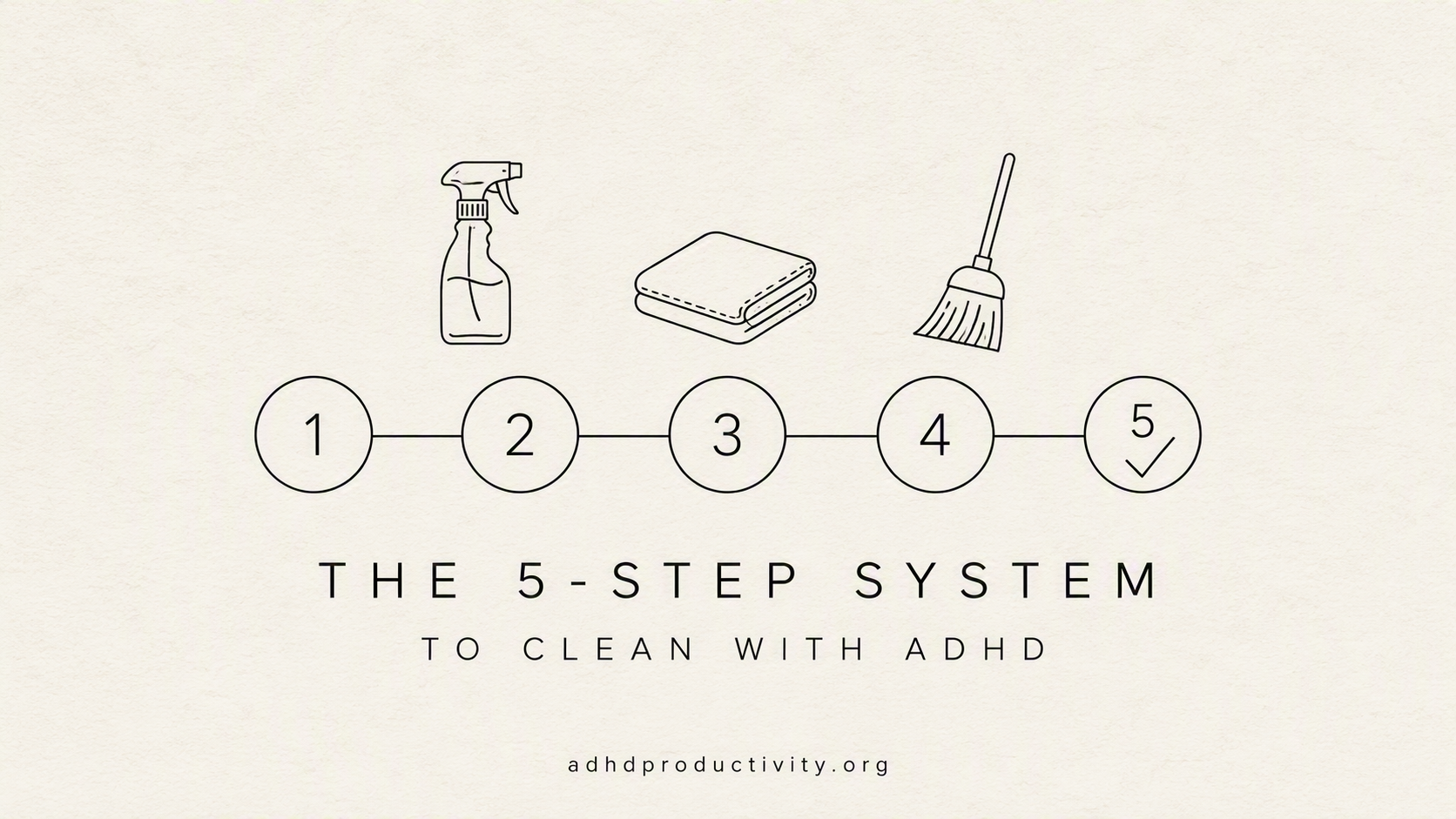
Step 1: Buy five bins, not five categories
Categories live in your head. Bins live in the hallway. Bins win.
Get five open containers, laundry baskets are fine, and label them by destination rather than by type:
- Upstairs
- Kitchen
- Bin (actual rubbish)
- Elsewhere (anything with no home, deal with it later)
- Donate
Now cleaning stops being a decision problem. Every object has exactly one question attached to it: which bin. You are not deciding whether to keep the cable. You are deciding it goes in Elsewhere.
Step 2: Set a timer for fifteen minutes
Fifteen.
Twenty-five minute blocks come from Pomodoro, which was designed for knowledge work by a man with a tomato. Cleaning has a different shape. Fifteen minutes is short enough that starting does not feel like a commitment, and it is long enough to visibly change a room.
Put the timer somewhere you can see it. Phone timers get dismissed and then you are on Instagram and the sweep is over. I use a physical kitchen timer that cost four pounds lol
Step 3: Sweep in one direction, and do not leave the room
This is the rule that matters most and the one everybody breaks.
Start at the door. Move clockwise. Every item goes in a bin. You do not walk the mug to the kitchen. You do not put the book on the shelf where it belongs. The bin is the destination for now.
Leaving the room is how a fifteen minute sweep becomes a two hour reorganisation of the spare bedroom.
Step 4: Empty the bins at the end
Timer goes off. Now you carry the bins to their destinations and dump them. Quickly. Do not sort the Kitchen bin into the correct cupboards. Put the things roughly where they go.
Elsewhere gets a permanent home in a cupboard. You will deal with it on some Saturday. You probably will not. The house is still tidier than it was, which is the point.
Step 5: Write down what you did not finish
One line on a phone note or a scrap of paper. "Living room done, hallway not started."
You are not relying on memory to know where you got to, which means a sweep can happen on Tuesday, then Thursday, then not for nine days, and the system does not collapse.
How do you start when the room is already a disaster?
Do not use the bins yet.
When the mess has crossed the threshold where looking at it triggers ADHD paralysis, the goal is not tidiness. The goal is getting the room below the panic line so the normal system can run again.
Do these in order, and stop whenever you want:
- Rubbish only, one bag, ten minutes. Nothing else. No decisions, no sorting. Anything obviously rubbish goes in the bag. Rooms drop a whole category of overwhelming the moment the packaging is gone.
- All dishes to the sink, five minutes. You do not have to wash them. Just get them out of the room.
- Clear one horizontal surface. One. The coffee table, or the half of the desk you use. Everything on it goes into a single box. The surface being visible does something psychological that I cannot explain but rely on constantly.
- Stop. Genuinely. Sit down. You have done more than you would have done.
If you cannot do step one, you are probably not lazy, you are probably depleted. Read our piece on ADHD burnout and be kinder to yourself than I usually manage to be.
Calling a friend to sit on video while you do this helps more than it has any right to. The evidence for body doubling is still thin and mostly preliminary, so I will not pretend it is proven. It works for me. Those are different claims and I am not going to blur them.
How do you keep it clean without a rigid routine?
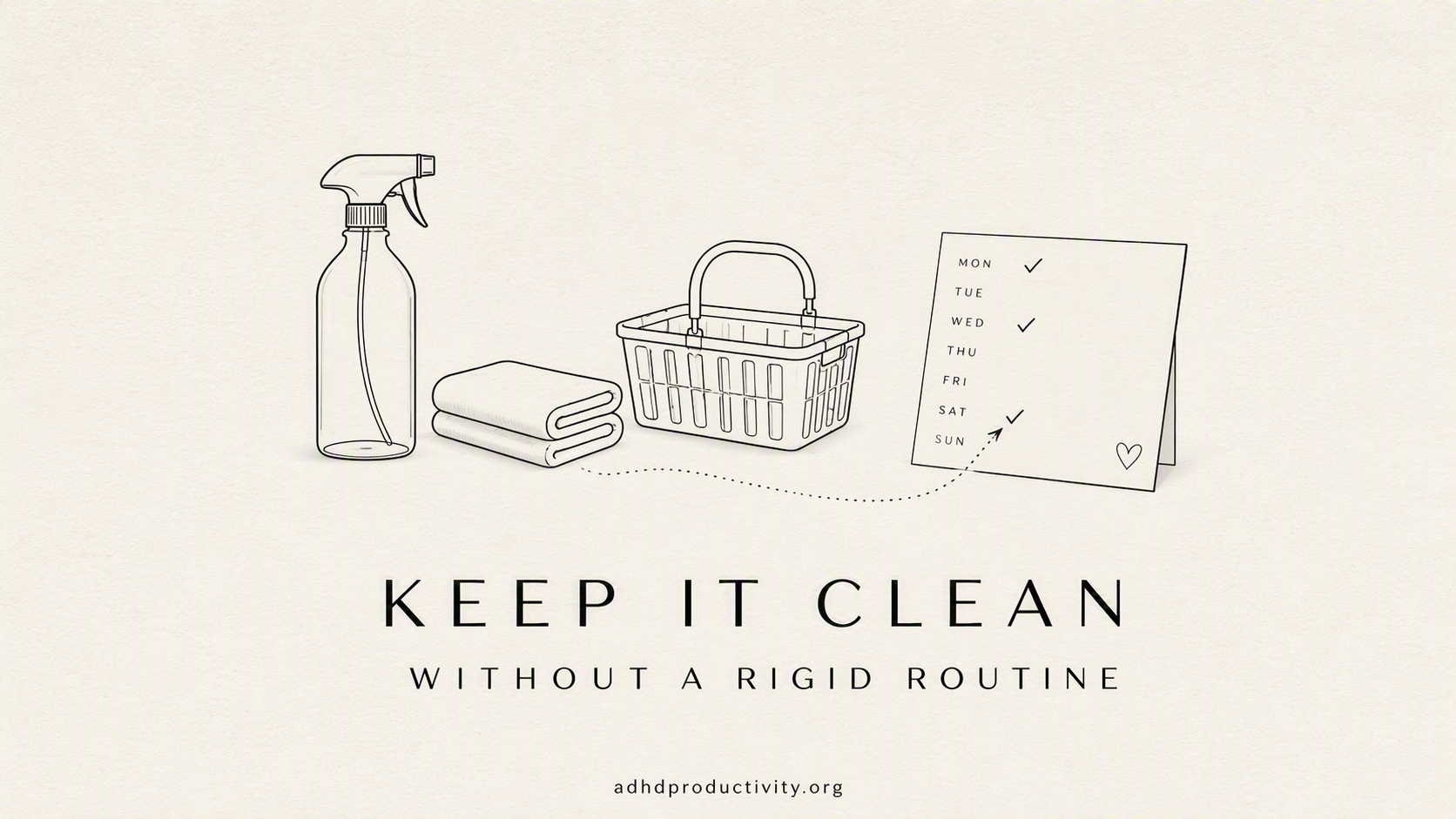
You do not build a routine. You build triggers.
A routine says "clean the kitchen every evening." That requires you to remember, decide, and initiate, which brings us back to the hardest part of any task.
A trigger attaches the behaviour to something already happening:
- Kettle on, counter wiped. The wipe happens during the boil. You were standing there anyway.
- Ad break, five things. Pick up five items, any five, then sit back down.
- Shoes off, post sorted. The pile by the door dies at the door.
- Shower running, sink wiped. Thirty seconds while the water heats.
- Bin bag out, one surface cleared. You are already walking through the house.
Keep supplies in the room they serve. Wipes in the bathroom, wipes in the kitchen, wipes by your desk. Yes, you are buying three packs. The cost of that is much smaller than the ADHD tax you pay on a flat that never gets cleaned because the spray lives two floors away.
Sleep matters. A tired ADHD brain has almost no initiation capacity, and ADHD and sleep problems travel together. I am not going to tell you to fix your sleep in a cleaning article. I will tell you that cleaning gets much easier when you do
Which cleaning method actually fits an ADHD brain?
Most popular methods were designed by and for people whose planning systems work fine. Here is how they hold up.
| Method | How it works | ADHD verdict |
|---|---|---|
| Five-bin sweep | Timed sweep, objects go to destination bins, sort later | Best fit. Removes decisions and stops room-hopping |
| 20/10 (20 min on, 10 off) | Timed cleaning with enforced breaks | Good. Slightly long for a bad day, easy to shorten |
| Pomodoro (25/5) | 25-minute blocks | Workable but built for desk work. Too long to start cold |
| KonMari | Sort by category, hold each item, keep what sparks joy | Poor fit. High decision load, requires multi-day sequencing |
| FlyLady zones | Daily zone assignments plus routines | Mixed. Good structure, but collapses after one missed day |
| "Clean as you go" | Continuous small tidying | Poor fit alone. Depends on noticing mess, which is the actual deficit |
| Deep clean weekends | One long session | Worst fit. Guarantees burnout and a three-week gap |
The pattern is simple. Front-load the decisions and it fails. Front-load the structure and it holds.
Do cleaning apps help?
Some, and not the ones you would expect.
Chore chart apps mostly fail for the same reason chore charts on the fridge fail. They require you to open them. If the app is the thing that reminds you, and remembering to open the app is the problem, you have built a lovely loop that goes nowhere. Our roundup of habit tracker apps for ADHD goes deeper on which ones survive contact with an actual ADHD week.
What does help is anything that captures the thought and then surfaces it later without you asking. You notice the bathroom light is out while brushing your teeth. That thought has a half-life of about four seconds. If you can say it out loud and have it land somewhere you will actually see it, the house slowly gets better.
This is the one category where I use saner.ai at home as well as at work. You dump a messy thought at it, "kitchen is a state, need to do bins and the fridge shelf thing," and it turns that into actual items rather than leaving you a note you have to re-read and re-plan later. That re-planning step is the one Fuermaier's team measured as the weakest link, so removing it is worth more than another chart.
It is not a cleaning app, and I would not buy it for cleaning alone. If you are already using something for tasks, see our comparison of ADHD task management apps.
Your action steps to clean for this week
Do these. Skip the rest of the article if you like.
- Buy five laundry baskets today. Label them Upstairs, Kitchen, Bin, Elsewhere, Donate. This is the entire infrastructure.
- Buy a physical timer. Four pounds, no screen, no notifications.
- Do one fifteen minute sweep in the worst room. One direction, no leaving the room, bins get emptied at the end.
- Pick two triggers from the list above and attach them to things you already do daily.
- Put cleaning supplies in every room that needs them. Buy the duplicates. Stop walking.
- Write one line at the end of each sweep about where you stopped.
- Schedule nothing. Seriously. Do not build a weekly plan yet. Run sweeps opportunistically for two weeks and see how often they actually happen, then plan around that real number rather than your optimistic one. If you do want more structure after that, our guide to planning a week with ADHD is the place to start.
Frequently asked questions
Why do I clean obsessively sometimes and not at all other times?
Because interest and urgency drive an ADHD brain more reliably than importance does. A surprise visitor creates urgency, and suddenly you can deep clean a bathroom in eleven minutes. That capacity is real, it just is not available on demand. Build the system for the low-interest days and let the bursts be a bonus.
How long should I clean for if I have ADHD?
Fifteen to twenty minutes per sweep. Stop when the timer goes, even if you are mid-flow. Stopping while it still feels good is what makes the next sweep easier to start. Long sessions feel productive and then cost you the following three weeks.
Is it normal to have a "doom pile" with ADHD?
Extremely. It is also worth taking seriously, because the research linking inattention to hoarding severity suggests these piles can grow into something harder to reverse. Give the pile a container and a monthly ten-minute appointment. If it is genuinely distressing you or taking over rooms, that is worth raising with a clinician rather than a blog.
Does medication help with cleaning?
Many people report that it does, mostly by making initiation easier. I am not a clinician and I will not make claims about your treatment. Talk to whoever prescribes for you, and notice that medication does not write the plan for you. The bins still help.
What if I live with someone who does not have ADHD?
Show them the bins. Genuinely. Most arguments about mess are actually arguments about whether the other person is choosing this. A visible system reframes it, because now there is a thing they can see working and a thing they can help with. Ask them to write the list. Do not ask them to do the sweep.
Why does cleaning feel physically unbearable sometimes?
Sensory load plus decision load stacking up at once. Music with no lyrics, decent lighting, and gloves fix this for a surprising number of people. Take the shoes off or put proper ones on, whichever your feet prefer. It sounds trivial. It is not.