Body Doubling for ADHD: How It Works and How to Use It

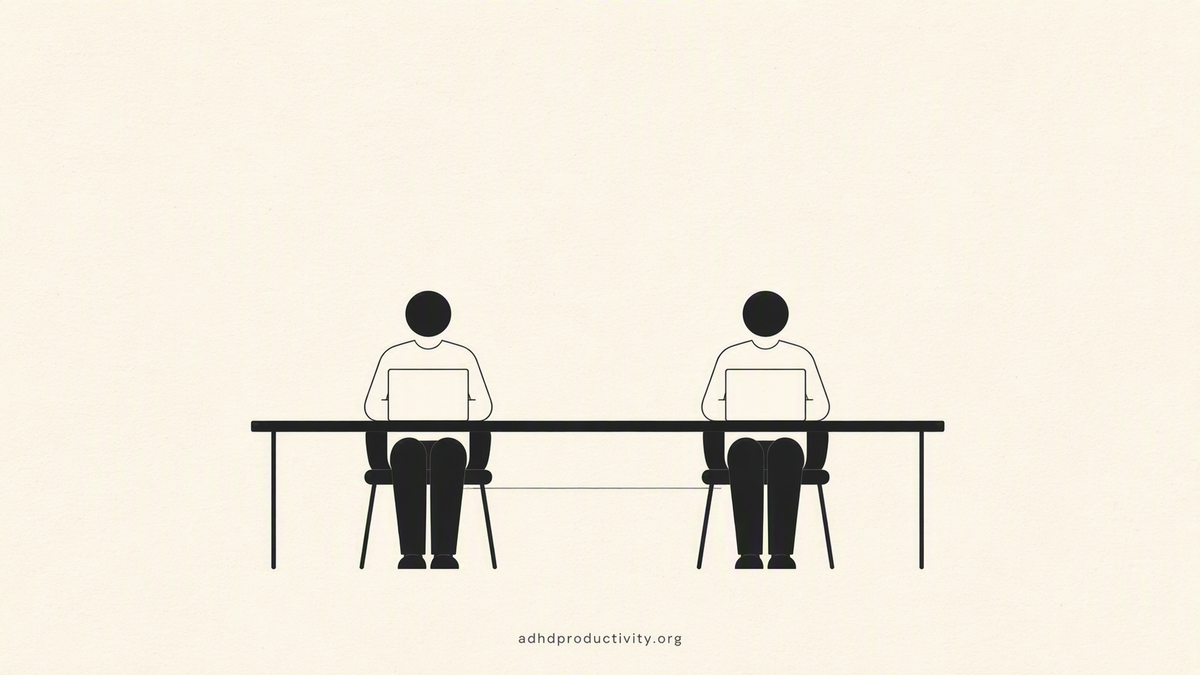
Body doubling means doing a task while another person is present, physically or virtually, so their presence helps you start and stay on it. The other person does not help with your task. They usually do their own thing.
That is the whole trick. Somebody is there. You do the thing.
I want to be upfront about something before you read further: the research on this is thin. Two studies, one survey, one lab experiment with 12 people, and one EEG study that found nothing statistically significant. I will show you all of it, including the part that did not work, so you know how strong the ground is before you build on it.
What body doubling actually is

The researchers who first defined it academically, Tessa Eagle, Leya Breanna Baltaxe-Admony and Kathryn Ringland at UC Santa Cruz, built their definition from what 220 people actually described doing. Their community-sourced version:
Intentionally using the presence of someone (in the same room, online, via media) to help start, work on, or accomplish a task, as a form of accountability and/or reminder to stay on task.
A few things in that definition to notice:
- The other person does not need to be doing your task. In the survey, 65 people specifically said their body double was doing something completely different. Your partner folding laundry counts.
- The other person does not need to know. Sixteen percent of respondents body doubled with strangers in public. The guy next to you at the library has no idea he is on your team.
- It does not need to be a person at all. Forty-one respondents used media instead: recorded "study with me" videos, Twitch streams, podcasts. There is published research on the LoFi Girl YouTube stream functioning as a study buddy for viewers, which is either heartwarming or slightly sad depending on your mood.
Also worth knowing: 24% of the survey respondents learned the term from the survey itself. Fifty-two of them said they had always done this. So if you read that definition and thought "oh, that's why I work in cafes," congratulations, you have been doing evidence-adjacent ADHD management by accident for years.
Does body doubling actually work?
Here is every piece of real evidence I could find, in order of how much weight I would put on it.
The survey (2023 and 2024, 220 participants). Eagle and colleagues surveyed 220 adults, 87.7% of whom identified as neurodivergent and 139 of whom had ADHD. Of those, 186 said they were more likely to finish a task when working alongside someone. Participants described it helping most with tasks that felt overwhelming, boring, or anxiety-producing. This is self-report data with no control group. It tells you the practice is widespread and people believe it helps. It does not prove it helps.
The VR experiment (2025, 12 participants). Ara and colleagues had 12 adults with ADHD do a virtual bricklaying task under three conditions: alone, with a human body double, and with an AI body double. Participants finished faster with either kind of double than alone, and perceived better accuracy and sustained attention. Twelve people is a very small sample and bricklaying in VR is not your inbox, but it is one of the few studies with an actual control condition.
The EEG study (2025, 26 participants). Schuenke, Dickenson and Moore had 26 people, neurotypical and ADHD, medicated and unmedicated, complete ACT reading comprehension tests once with a body double and once alone, while EEG recorded focus and calmness metrics. The result: no statistically significant differences between the body doubling and solo conditions. They did observe no negative effects in any group and what they described as promising trends among unmedicated ADHD participants, and concluded body doubling is a safe strategy worth further investigation.
So the fair summary is this. A lot of people report it works. One small controlled study found faster task completion. One small study measuring brain activity found nothing conclusive. Nobody has found evidence that it hurts.
That is a weak evidence base for a medical intervention. For a free technique with no side effects that you can test on yourself this afternoon, it is more than enough to justify trying.
Why body doubling might work
I am going to separate what has theoretical backing from what people confidently assert on the internet with zero support.
Has support:
- Externalizing motivation. Russell Barkley's model of ADHD holds that internally generated motivation is weak at initiating and sustaining goal-directed behavior, and that people with executive function deficits require externalized sources of motivation arranged at the point of performance. A body double is about the cheapest external motivator that exists. No app, no token system, just a human in a chair.
- Social facilitation. Zajonc's 1965 drive theory in Science held that the mere presence of others raises arousal, which improves performance on simple or well-learned tasks and impairs it on complex or unfamiliar ones. This has been studied and refined for decades. Important caveat: this research is not ADHD-specific, and as you will see below, the "impairs complex tasks" half has real practical consequences.
- Reduced task-related dread. In the Eagle survey, participants repeatedly linked body doubling to tasks that carried anxiety, overwhelm, or embarrassment. One participant used it for showering. The presence of another person seems to lower the activation cost of unpleasant tasks, at least by self-report.
Does not have support, despite being everywhere:
- Claims that body doubling "triggers dopamine release" in the ADHD brain. I found no study measuring this. People state it as fact constantly. It is a plausible-sounding guess.
- Claims involving mirror neurons, oxytocin, or "co-regulation" of the nervous system during body doubling. Same situation. No measurements exist.
- The Hawthorne effect framing. It is a real phenomenon, but nobody has tested it as the mechanism here.
If you see an article confidently explaining the neurochemistry of body doubling, that writer made it up.
OK, so how to make this body doubling usable
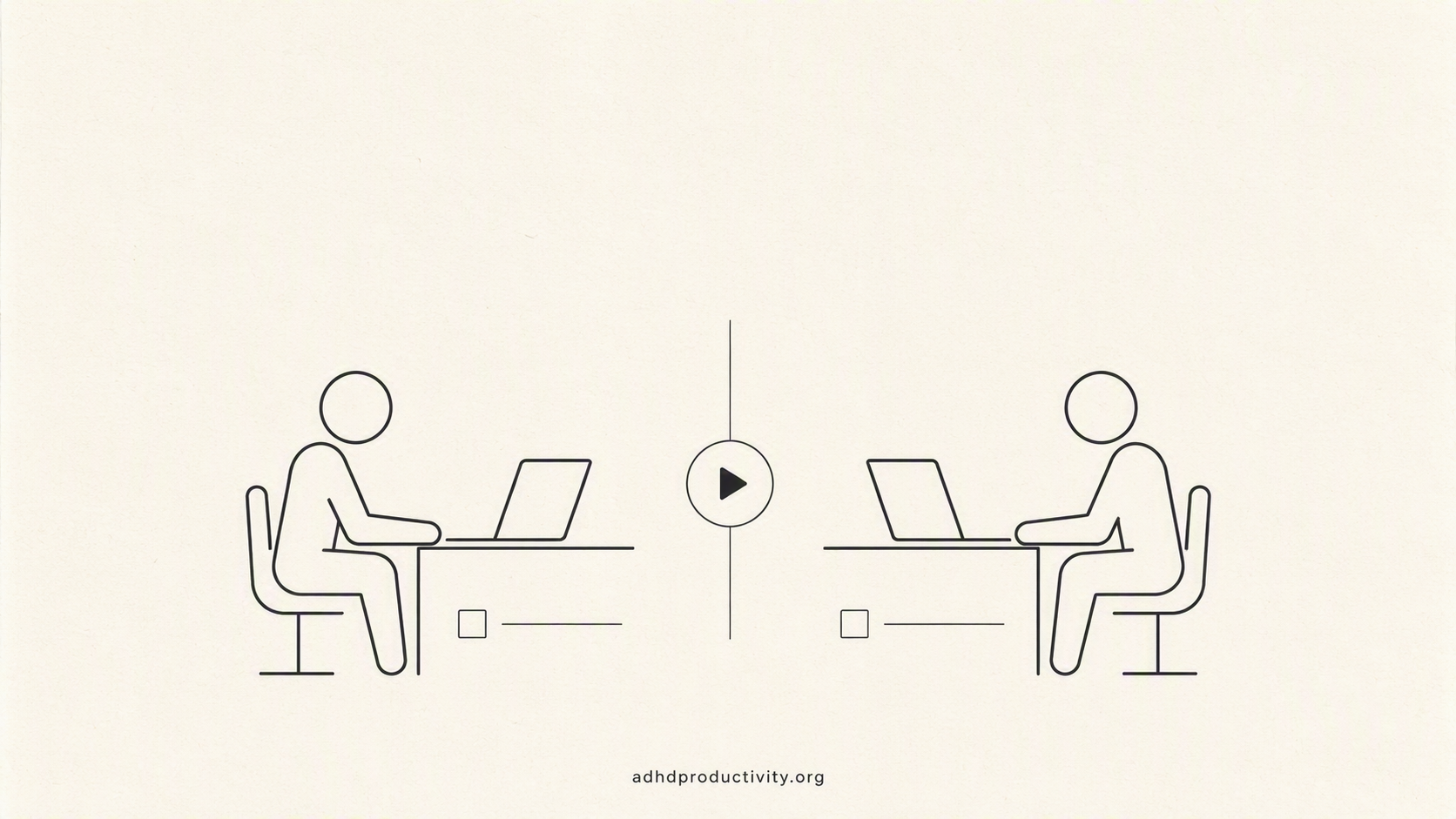
The most practical thing to come out of the research is not a finding, it is a model. Eagle and colleagues plotted body doubling on two axes:
- Space and time: how "live" is the other presence? Same room right now, versus a video call, versus a recording of someone who studied three years ago.
- Mutuality: how aware is the other person of their role? A dedicated accountability partner who checks your progress sits at one end. A stranger at the library who has no idea you exist sits at the other.
Every setup you can build is a point on that grid. And the researchers noted something useful: almost all commercial body doubling products cluster in one corner, high mutuality and high liveness. Live video, real-time, someone watching. That is one option out of four quadrants, and it is the one most likely to feel like surveillance.
If a Focusmate session made you feel worse, you did not fail at body doubling. You tried the most intense version first.
Here is the grid as a practical menu:
| Liveness | Mutuality | What it looks like | Best for |
|---|---|---|---|
| Live | High | 1:1 video call with check-ins, paired Pomodoro | Tasks you have avoided for weeks |
| Live | Low | Working at a cafe or library, coworking space | Steady work, long sessions |
| Recorded | High | A "study with me" video where the host talks to you | Wanting company without pressure |
| Recorded | Low | LoFi streams, ambient work videos, a podcast | Background presence, low stakes |
Start in the bottom right. Move up and left only if it is not enough.
Your first session, in 25 minutes
Do this today. It takes one Pomodoro and no signups.
- Pick a task you have been avoiding for at least three days. Not the hardest thing you own. Something annoying and overdue. The email. The form. The expense report.
- Pick your presence. Easiest possible version: open a "study with me" video on YouTube, or sit at a cafe, or text a friend "working for 25 min, you around?" and put them on a muted video call.
- Say the task out loud, or type it in chat. One sentence. "I am doing the insurance form." This is the accountability half, and it works even if the other person does not respond.
- Set 25 minutes. Do not negotiate with yourself about the length.
- When the timer ends, say what happened. Out loud, in chat, in a text. "Got two thirds through." This closes the loop.
Then check one thing: did you start faster than usual? Task initiation is where the survey respondents reported the biggest effect. That is the metric to watch, not how focused you felt.
Where to find a body double
Ranked roughly from lowest friction to highest.
Free, no coordination:
- A cafe or library. In the survey, 20 people named the library and 17 named cafes as their regular spots. It works because it requires nothing from anyone.
- "Study with me" videos on YouTube. Real people, recorded, silent or lightly narrated. Search "study with me 2 hours" and pick a face you find non-annoying.
- Twitch coworking and study streams. Live, but nobody is watching you back.
Free, some coordination:
- A friend, partner, or sibling on a muted video call. The survey's most common body doubles by a wide margin were friends (60%), family (40%), and coworkers (37%).
- Discord servers for focus and coworking. The EEG researchers noted one body doubling Discord had over 8,200 members as of April 2025, up more than half from the year before.
- Your existing team. If your job has a "focus time" Slack huddle culture, that is body doubling with a business casual hat on.
Paid platforms:
- Focusmate, Flow Club, and Flown all offer scheduled virtual coworking, mostly in the live and high-mutuality corner of the map. All three appear in the academic literature as examples of commercial body doubling tools.
What to say when you ask someone
This is where most people stall. Asking feels like admitting something. Here are three scripts that work because they ask for nothing except presence.
To a friend or partner:
"Weird favour. I focus way better if someone else is around doing their own thing. Can I hop on a call with you for 45 minutes? You don't have to talk to me. You can literally do the dishes."
To a coworker:
"Want to do a silent focus block? Camera on, mics off, 50 minutes, we both just work. I get more done and I think you might too."
To a stranger in a coworking Discord:
"Anyone up for a 25 minute silent session? I'm doing [task]. Starting on the hour."
Notice none of these mention ADHD. Disclose if you want to, and it is often fine, but you do not owe anyone a diagnosis to justify wanting company while you work.
Which tasks to use body doubling for, and which to avoid
This is the part I think most body doubling advice gets wrong, and it comes straight out of the social facilitation literature. Presence increases arousal. Arousal amplifies your dominant response.
- On a task you know how to do, that means you go faster.
- On a novel or genuinely difficult task, it can make performance worse.
Again, that research is not ADHD-specific. But it matches what I would expect, and it gives you a usable rule.
Good candidates:
- Admin, email, forms, expenses, invoices
- Chores: dishes, laundry, cleaning, tidying
- Anything you have been avoiding for emotional rather than intellectual reasons
- Repetitive work you know how to do and simply will not start
Poor candidates:
- The hardest creative problem you have, the first time you are attempting it
- Work requiring long uninterrupted internal reasoning
- Anything where you need to talk to yourself out loud, unless your body double is very tolerant
If you take one thing from this post, take this: for me body doubling is a task initiation tool, not a deep work tool. It gets you into the chair. What happens after that is a different problem with a different solution.
When it does not work
Common failures and what to change, mapped back to the two axes.
- You feel watched and it makes you anxious. Lower mutuality. Move from a 1:1 video call to a cafe or a recorded video. The survey researchers explicitly flagged that not everyone benefits from the high-pressure quadrant.
- You end up chatting the whole time. Raise the structure, not the intensity. Mics off, agreed start and end times, one sentence of intention at the start and one at the end.
- Nothing happens. You still do not start. Try naming the task out loud before the timer. In the survey, accountability was described as an active mechanism by 26 participants, and stating the task is the cheapest form of it.
- It worked for two weeks and then stopped. Very common with ADHD strategies and not a personal failing. Rotate the format. New venue, new person, different quadrant of the map.
- You only body double and never build any other system. Fair enough, but it will not survive a week where nobody is available. Treat it as one tool.
When body doubling is not the answer
Body doubling is a productivity strategy. It is not a treatment for ADHD, and I am not a clinician.
If you are struggling with focus and task initiation to a degree that is affecting your work, relationships, or health, that is worth talking to a doctor about. An estimated 15.5 million US adults, about 6%, have a current ADHD diagnosis, and roughly half of them were diagnosed as adults. Getting assessed is not an admission of defeat. It is data.
Frequently asked questions
Does body doubling work for people without ADHD? The EEG study included neurotypical controls and found no significant differences for any group, in either direction. Plenty of people without ADHD work in cafes for the same reason, so it is not exclusive to neurodivergent brains. It may simply matter more when task initiation is harder.
Does the body double have to be doing the same task? No. In the survey, 65 participants specified that their body double was doing something entirely different, compared to 13 who said the same task.
Can an AI or a video be a body double? Apparently yes, at least in a lab. In the VR study, an AI body double produced faster task completion than working alone, comparable to a human double. And 41 survey respondents used recorded media as their body double.
Who invented body doubling? The term was coined by ADHD coach Linda Anderson in 1996, according to the Eagle paper, which notes this attribution is the best available rather than definitive.
Is it the same as coworking? Related but not identical. The researchers distinguish it: in body doubling, participants do not need to share a task, and the other person does not need to be aware of the arrangement at all.
Sources
- Eagle, T., Baltaxe-Admony, L. B., & Ringland, K. E. (2023). Proposing Body Doubling as a Continuum of Space/Time and Mutuality. ASSETS '23.
- Eagle, T., Baltaxe-Admony, L. B., & Ringland, K. E. (2024). "It Was Something I Naturally Found Worked and Heard About Later": An Investigation of Body Doubling with Neurodivergent Participants. ACM Transactions on Accessible Computing, 17(3).
- Schuenke, R., Dickenson, S., & Moore, M. (2025). Reading Between the Lines: Exploring Body Doubling in ADHD Using EEG. ASSETS '25.
- Ara, Z., Rahim, I. B., Zhou, P., Yu, L., Esmaeili, B., Yu, L.-F., & Hong, S. R. (2025). You Are Not Alone: Designing Body Doubling for ADHD in Virtual Reality. arXiv:2509.12153.
- Barkley, R. A. The Important Role of Executive Functioning and Self-Regulation in ADHD.
- Zajonc, R. B. (1965). Social facilitation. Science, 149(3681), 269-274. Reviewed and meta-analysed in Uziel, L. (2007), Journal of Research in Personality.
- Staley, B. S., et al. (2024). ADHD Diagnosis, Treatment, and Telehealth Use in Adults. MMWR, 73(40), 890-895.
- Taber, L., Baltaxe-Admony, L. B., & Weatherwax, K. (2019). What makes a live stream companion? Interactions, 27(1).