Pomodoro for ADHD: How to make it actually work?

Someone told me once that ADHD brains can only focus for 25 minutes, which is why the Pomodoro Technique is perfect for us.

I believed that for about four years. Then I went looking for the study it came from. There isn't one. What I found instead was research pointing the other direction, and a much better reason to use a timer than the one everybody repeats.
The short version: Pomodoro helps with ADHD. Just not for the reason you have been told, which means the standard 25-on, 5-off setup is probably the wrong shape for you.
Key answer
- Does it work? Yes, for most people with ADHD, but as a starting device and a time-anchor rather than an attention-stamina hack.
- Is 25 minutes the magic number? No. There is nothing special about 25. It was the length of one tomato-shaped kitchen timer in the 1980s.
- What should you use instead? Start at 10 to 15 minutes if starting is your problem. Go to 45 to 50 if your problem is getting pulled out of work. Take breaks closer to 10 minutes than 5.
- The single highest-value change: make the break a scheduled thing you do not choose, and make it long enough to actually be a break.
- When to skip it entirely: when you are already deep in something and working well. Do not set a timer to interrupt yourself.
Why Pomodoro actually works for ADHD
1. It shrinks the starting cost, not the task
The hardest minute of any task is minute zero. A timer does something specific there. It converts "write the report" into "sit with the report for 12 minutes"
The delay-discounting literature backs this up. A meta-analysis in the Journal of Attention Disorders pooled 37 group comparisons across 3,763 participants and found that people with ADHD chose smaller immediate rewards over larger delayed ones significantly more often than controls, with the effect strongest when the rewards on offer were real rather than hypothetical. "Finished report on Thursday" is hypothetical. "Timer goes off in 12 minutes and then I stop" is real and it is soon.
Relatedly, Volkow and colleagues in Molecular Psychiatry found that motivation deficits in adults with ADHD were associated with dysfunction in the dopamine reward pathway. A short timer is not a cure for that. It is a way of building a task whose payoff sits inside the window your brain responds to.
If you never get past minute zero, read task initiation and ADHD paralysis alongside this. The timer is one tool in that problem, not the whole answer.
2. It puts time outside your head, where you can see it
A meta-analysis of 55 independent studies in the Journal of the American Academy of Child and Adolescent Psychiatry found a broad set of timing deficits in people with ADHD: more trouble discriminating brief durations, more variability estimating intervals of several seconds, and patterns in time estimation and production indicative of an accelerated internal clock. The authors also separated two drivers of the errors, an attentional one at short intervals and a motivational one at longer intervals linked to delay aversion.
>> your sense of how long you have been doing something is unreliable, and predictably so. Forty minutes feels like ten. Ten minutes of scrolling feels like ninety seconds. Neither reading is close.
A running timer is a prosthetic for that. It is the same reason a visual countdown beats a digital one, which we get into below, and it is the practical core of what time blindness actually costs you day to day.
3. The scheduled break is helpful
Biwer and colleagues at Maastricht University compared three break strategies among 87 university students during self-study: self-regulated breaks where students chose when to stop, 6-minute breaks after every 24-minute block, and 3-minute breaks after every 12-minute block. The students who chose their own breaks studied in longer stretches and took longer breaks. They also reported higher fatigue and distractedness, and lower concentration and motivation, with no gain in task completion. Systematic breaks came out ahead on mood and on efficiency, getting similar work done in less time.
So the part of Pomodoro that earns its keep is not the focus block. It is that you stop deciding when to rest. Deciding is the expensive operation, and deciding while depleted is the expensive operation performed badly.
Why 25/5 is probably wrong for you
Two separate fixes, depending on which end is broken.
Fix the focus block by symptom, not by tradition:
- Starting is the problem. Go shorter. 10 or 12 minutes. The block needs to be short enough that starting feels stupid to argue with. Biwer's 12-minute condition was not the weak one.
- Getting yanked out is the problem. Go longer. 45 to 50 minutes. If you tend to hit a groove at minute 20, a 25-minute bell is actively sabotaging you.
- You do not know. Start at 15 and adjust by one thing: did the timer going off feel like a relief or an interruption? Relief means go shorter. Interruption means go longer.
Fix the break, because 5 minutes is not enough.
A 2022 meta-analysis in PLOS ONE looked at 22 independent samples covering 2,335 participants and found micro-breaks produced small but reliable improvements in vigor (d = .36) and reductions in fatigue (d = .35). The performance effect overall was not significant, and the detail matters: the longer the break, the greater the boost to performance, with breaks approaching 10 minutes doing better than very brief pauses. Effects were medium for routine clerical work (d = .56), small for creative work (d = .38), and negligible for demanding cognitive work. The authors noted that recovering from highly depleting tasks may need more than 10 minutes.
>> 5 minutes protects your mood a bit. 10 minutes starts protecting your output. If the work was genuinely hard, you need more than the technique gives you. Take the longer break.
And the break has rules, because a bad break is worse than none:
- No feeds. A five-minute scroll is not a break, it is a different job with worse pay. This is the single most common way the method dies.
- Move if you can. Stand up, get water, walk to another room. Physical beats digital.
- Set a timer on the break too. Otherwise the break eats the afternoon and you already know this.
- Do not start something with a plot. No episodes, no articles, no "quick look" at anything with a narrative.
The ADHD-modified Pomodoro, step by step
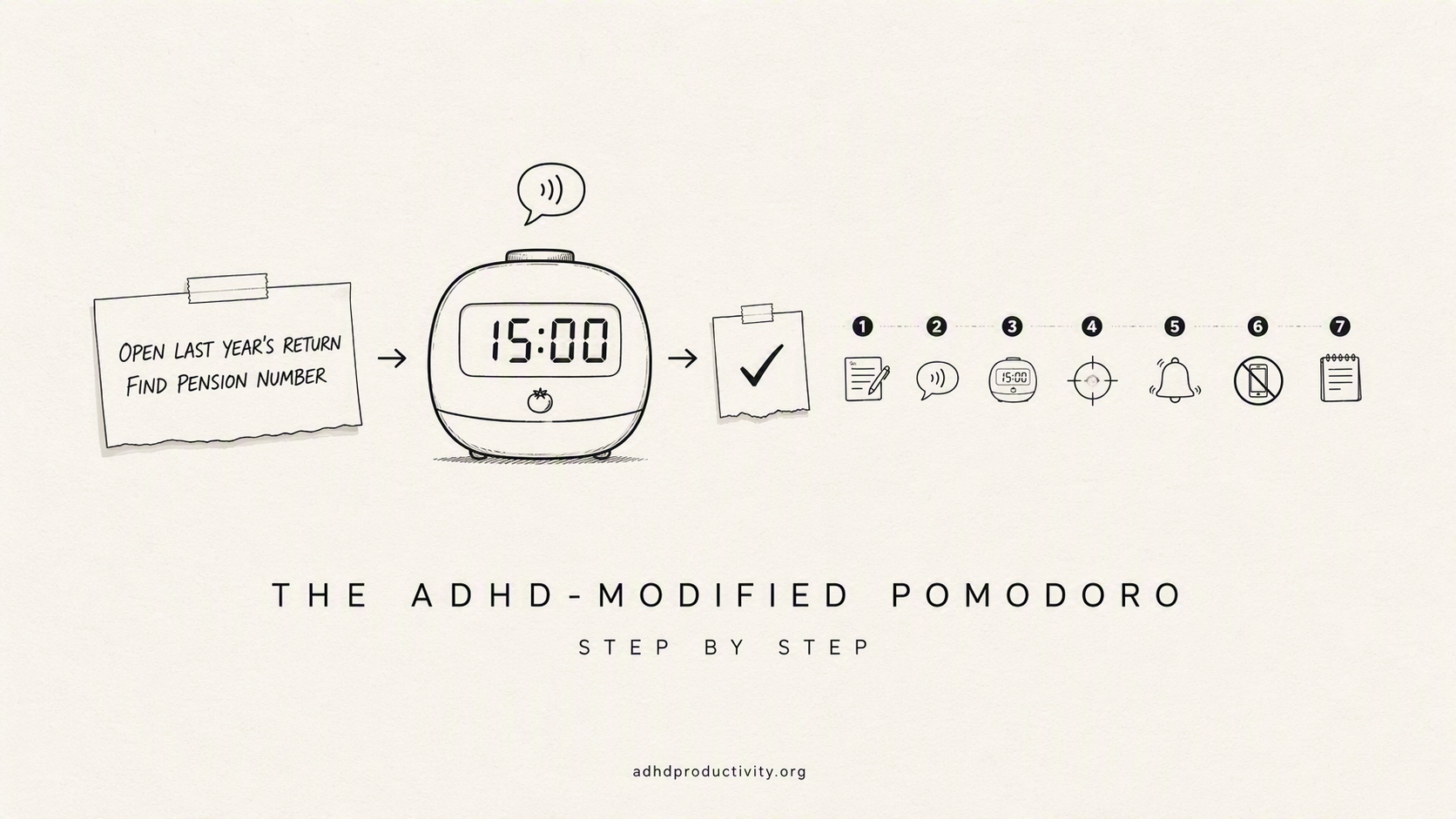
- Write the one task down first, in physical words. Not "taxes." Not "work on deck." Something like "open last year's return and find the pension number."
- Say out loud how long you think it will take. Then write that number down. You are going to be wrong, and seeing how wrong is how the internal clock gets recalibrated over weeks.
- Set 15 minutes. Visible, in the room, not buried in your phone. If the only timer you have is your phone, put the phone face-up across the desk rather than in your hand.
- Work on the one thing, badly if necessary. The rule for the block is not "make progress." It is "stay pointed at this." Staring at the document counts.
- When it rings, stop even if you are mid-sentence. Especially if you are mid-sentence. Stopping mid-thought makes restarting dramatically easier, because you already know your next move.
- Take 10 minutes, on a timer, away from screens.
- Do two blocks, then decide. Two is a win. Do not plan eight and fail at three.
- At the end, write the actual time next to your estimate. That one line, done for a couple of weeks, is worth more than any app on this list.
When not to use a timer
Pomodoro has a failure mode that the productivity blogs never mention: it interrupts you on purpose, and you are already easy to interrupt.
Gloria Mark's team at UC Irvine ran an experiment with 48 participants doing an email task under interruption. Interrupted work actually got done faster, 20.31 minutes versus 22.77 in the uninterrupted baseline, because people compensate by working faster and writing less. But the psychological cost was real: stress rose from 6.92 to 9.46, frustration from 4.73 to 6.63, and effort from 9.50 to 11.04. Faster, at a price.
That was external interruption, which is not the same as a break you scheduled yourself. But it is a decent argument against ringing a bell at yourself when nothing is wrong.
So: do not run a timer when you are already in it and the work is flowing. If you hit that state, let it run and drink some water. You can come back to structure tomorrow. There is more on protecting those stretches in deep work with ADHD.
Also skip it when you are past tired and into depleted. A timer applied to an empty tank just produces 25-minute units of staring plus guilt. That is a burnout signal, not a technique problem, and sleep is usually upstream of it.
Timers and apps worth using for ADHD pomodoro
You do not need an app. The timer already on your phone works. But a few options solve real problems.
| Tool | Platform | Cost | Solves |
|---|---|---|---|
| Your phone's timer | Everything | Free | Zero setup, zero excuses |
| Time Timer (physical) | A physical object | Roughly $25 to $41 depending on model | Seeing time without reading numbers |
| Pomofocus | Browser, desktop | Free, with a paid premium tier | Custom intervals plus a task list and reports |
| Focus To-Do | iOS, Android, Mac, Windows, Watch, Chrome | Free to install | Pomodoro and task management in one place |
| Session | Mac, iOS, iPadOS | Subscription, with a Pro tier | Blocking distractions during the block |
The physical timer is the underrated one. Time Timer uses a red disc that shrinks as time passes, so you read remaining time as an amount of red rather than as a number you have to convert. Given the research on timing deficits above, making duration spatial rather than numeric is a reasonable thing to want. The company markets it for ADHD and autism and has been selling it for 30-plus years. It is also on your desk, which means it is not in the same object as your notifications.
Pomofocus runs in a browser, lets you set your own focus and break lengths, keeps a task list with time estimates and gives you daily and weekly reports. Free tier is fine for this.
Focus To-Do is the pick if you want the timer attached to your actual task list, across basically every platform including Apple Watch, with per-project time stats.
Session is for the specific problem of your own hands opening Twitter at minute four. It blocks distracting sites and apps during a session on macOS and iOS and tracks your sessions afterward.
If blocking is your real bottleneck rather than timing, our focus apps roundup covers that category properly, including Freedom, Cold Turkey, Opal and Forest.
One honest note on tooling. A timer is useless if you do not know what to put in the block, and a lot of failed Pomodoro attempts are actually failed planning attempts wearing a timer. Saner.ai is an AI assistant that takes messy capture (voice notes, half-formed thoughts, email) and turns it into tasks and a plan for the day, which is the step before the timer.
>> If you would rather solve that without a new tool, how to plan a week with ADHD does the same job for free.
Why it stopped working, diagnosed
Every failure I have had with this maps to one of these.
- You planned eight blocks and did three, so you feel like a failure. Plan two. Bank the win. Ambition on the schedule is how the method dies by Wednesday.
- Your breaks are phone breaks. Then you are not resting, and by block three you are running on fumes and blaming your attention.
- The bell keeps cutting you off mid-flow. Your block is too short. Move to 45 minutes and stop obeying the tomato.
- You cannot make yourself start even a 15-minute block. The timer is the wrong layer. Either the task is not broken down small enough, or you need a person in the room. Body doubling is the usual fix.
- You did it beautifully for nine days and then never again. Normal. This is a tool you pick up on hard days, not a streak to maintain. If you want to track it anyway, our habit tracker roundup covers apps that survive a missed day.
- You are timing the wrong hours. Blocks land better when they sit inside a rough plan for the day. Time blocking is the layer above this one.
Frequently asked questions
Does the Pomodoro Technique work for ADHD?
For most people, yes, but as a starting device and a time-anchor rather than an attention-stamina tool. The evidence that helps most here is on scheduled versus self-chosen breaks: students given systematic breaks reported less fatigue and distractedness and more concentration and motivation than students who chose their own break timing, with no loss in work completed.
Why 25 minutes? Is it based on anything?
No. Francesco Cirillo named the technique after the tomato-shaped kitchen timer he used as a student in the late 1980s. It is a convention, not a finding. Treat it as a default to change.
What is the best Pomodoro length for ADHD?
Start at 10 to 15 minutes if your problem is starting, and 45 to 50 if your problem is being pulled out of work. Adjust using one signal: whether the bell feels like relief or interruption.
How long should breaks be?
Longer than 5 minutes. The meta-analytic evidence on micro-breaks shows performance benefits rising with break length and breaks near 10 minutes outperforming very short ones, with more than 10 minutes needed after genuinely depleting work.
Can I use Pomodoro during hyperfocus?
Don't. If the work is flowing, let it run. Deliberately interrupting productive work buys speed at the cost of stress and frustration, and you can return to structure the next day.
Is there an ADHD-specific study proving Pomodoro works?
Not that I could find, and I looked. The break-timing and micro-break research is on general and student populations, and the ADHD-specific research I have cited here is about timing perception and reward, not about the technique itself.
Does this replace medication or therapy?
No. It is a scheduling tool. If starting tasks is wrecking your work or your relationships, that is a conversation for a clinician, not a timer.
Your next 10 minutes
- Pick one task and write it as a physical action.
- Guess how long it will take. Write the guess down.
- Set 15 minutes on something that is not your phone.
- When it rings, stop mid-sentence and take 10 minutes away from a screen.
- Write down what it actually took.
Do that twice today. Not eight times. Twice.
The 25-minute rule was never about your brain. It was about one guy's kitchen timer, and you are allowed to use a different number.