How I Manage Employees With ADHD 🫂

Key facts
- An estimated 3.5% of workers meet criteria for adult ADHD (de Graaf et al., Occupational and Environmental Medicine, 2008)
- 6.0% of US adults, around 15.5 million people, had a current ADHD diagnosis in 2023 (CDC / National Center for Health Statistics)
- There is almost no research on managing ADHD at work. A 2022 systematic review synthesised 143 intervention studies and found that none were conducted in a real workplace (Lauder, McDowall & Tenenbaum, Frontiers in Psychology, 2022)
- Working memory deficits persist into adulthood at moderate effect sizes across 38 studies of adults with ADHD (Alderson et al., Neuropsychology, 2013)
- 61% of workplace accommodations cost the employer nothing. Of those that do cost something, the median one-time expense is $300 (Job Accommodation Network)
- You generally cannot ask. After hiring, disability-related inquiries are only permitted when job-related and consistent with business necessity
What's in this post
- What you are actually managing with ADHD
- The one rule that changed everything for me
- How I assign work now
- How I give feedback now
- Meetings, and why they cost more than you think
- The emotional part nobody warns you about
- What you can and cannot legally do
- Three things I got wrong
- The conversation that starts all of this
- What the evidence actually supports
- FAQ
What you are actually managing
I have ADHD. I also manage people who have it. That combination makes me either the ideal person to write this or the very worst one 🤣
First, you are not managing a motivation problem. You are managing an executive function problem, which is a different machine entirely.
Executive function is the set of processes that let a person start a task, hold a plan in mind, sequence steps, and stop themselves doing something else. ADHD disrupts those specifically. Russell Barkley's foundational model frames the whole condition as a failure of behavioural inhibition that cascades into the executive functions downstream (Barkley, Psychological Bulletin, 1997). Nothing in that model says anything about how much your report cares.
That distinction determines whether your management response is useful or harmful:
- If you think it's motivation, you apply pressure. Pressure does not repair working memory.
- If you think it's effort, you escalate consequences. Consequences do not create a first step.
- If you think it's executive function, you supply structure. That one works.
👉 If you have a colleague who still thinks this is about trying harder, the piece on executive dysfunction versus laziness is the one to send them.
The one rule that changed everything for me
That's it. That's the rule. Everything below is an application of it.
The evidence for why: working memory deficits in adults with ADHD show up at moderate magnitude across both verbal and visuospatial domains (Alderson et al., 2013). So when I tell someone a task in the hallway and expect it they to remember it, I am asking a specific cognitive system to do the exact thing it is measurably bad at, and then getting annoyed when it doesn't.
I stopped doing that. Now I do these:
- Every assignment gets written down somewhere both of us can see. Not a DM. A ticket, a doc, a card. Somewhere it still exists on Thursday.
- One source of truth. If tasks arrive by Slack, email, Jira, and hallway, the ADHD tax isn't doing the work. It's reconciling four lists.
- I confirm verbal agreements in writing within the hour. "To confirm what we said: you're taking X, due Friday, first step is Y." It takes ninety seconds and eliminates an entire category of failure.
- Decisions get recorded, not just made. Otherwise the same decision gets relitigated in three weeks.
This is good management for everyone. Nobody has ever complained that a deadline was too clearly written down.
How I assign work for my ADHD employees
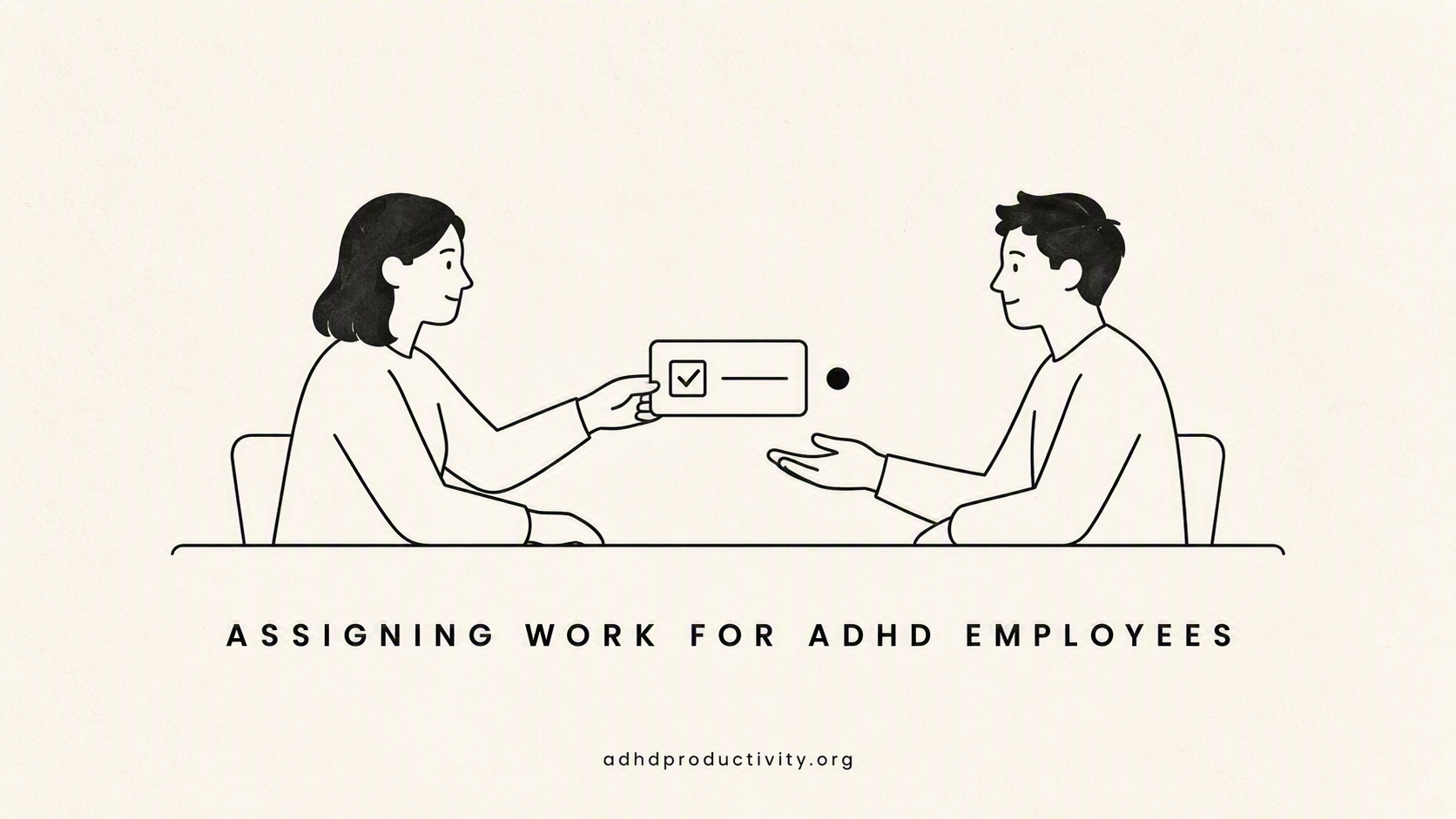
Four changes, in order of how much they mattered.
1. I state the first action, not just the outcome.
"Own the Q3 vendor review" is not a task. It's a category. Task initiation is one of the hardest parts of ADHD, and the research support sits with strategies like if-then plans that specify exactly when, where and how you'll start (more on that here).
So I say: "Own the Q3 vendor review. First thing is emailing the three vendors to ask for updated pricing. Do that today." The rest of the project stops being a wall and becomes a next thing.
2. Milestones, not one distant deadline.
Time perception in ADHD is altered. A meta-analysis pooling 55 studies found deficits across every major timing paradigm tested, including estimation, production and reproduction (Journal of the American Academy of Child and Adolescent Psychiatry, 2022). A deadline six weeks out is not a real object to a brain like that. It's a rumour.
- Break long projects into checkpoints with their own dates
- Make the first checkpoint suspiciously soon, within a week
- Put the checkpoints in a system that sends the reminder, not in a system that requires them to remember to check
- Send deadline reminders 48 hours out
👉 More on the underlying mechanism in the time blindness guide.
3. I let them break the task down however they want.
Some of my reports use a whiteboard. One uses an AI tool to shred a big task into steps before starting. I do not care what the method is. I care that the task arrives at their desk already decomposed, by them or by me.
4. I estimate with them, not at them.
I ask "how long do you think this takes?" and then I ask "and what would make that number wrong?" The second question surfaces the dependency they were about to forget.
How I give feedback
Shorter loops. Much shorter than feels natural.
- Weekly, not quarterly. A quarterly review is an autopsy. A weekly fifteen-minute check-in is steering.
- Immediate and specific when something goes well. Not "great work lately." Say the thing, name the day.
- Corrective feedback goes to the behaviour, in private, with a fix attached. Never a vague "is everything okay?", which lands as a threat wrapped in concern.
- I never save up feedback. Three weeks of accumulated notes delivered at once is not thoroughness, it's an ambush.
- I write it down after. Same rule as everything else.
One managerial habit I removed: the drive-by "quick question." Every one of those is an interruption with a recovery cost, and for a brain that already struggles to hold a thread, it's expensive. I batch them now. But I am not a saint about it. I'm maybe 70% good at it.
How I manage meetings
A meeting is a working memory test with an audience. For a report with ADHD it's often the least productive hour of their day, and it eats the two hours around it too.
What I do:
- Agenda in advance, always. Not "sync re: roadmap." Actual items.
- Written notes or an AI notetaker, with everyone's knowledge. The information has to survive the room.
- Actions assigned by name at the end, in writing. Meetings that end without owners are just group meditation.
- Fewer status meetings. Most status meetings are a document someone read aloud slowly.
- Doodling, standing, walking, fidgeting: all fine. Movement during listening is not disrespect.
If your team is distributed, the failure modes change shape. I wrote about that side of it in ADHD and remote work.
How I handle The emotional part
This is the section I wish someone had given me before my first ADHD direct report.
Emotion dysregulation is prevalent in ADHD across the lifespan and is a major contributor to impairment, according to a review in the American Journal of Psychiatry (Shaw, Stringaris, Nigg & Leibenluft, 2014). It's not in the diagnostic criteria, which is exactly why it blindsides managers. A review of ADHD and occupational health also flags irritability and low frustration tolerance as recurring workplace features (Küpper et al., International Archives of Occupational and Environmental Health, 2012).
In practice, this means ordinary feedback sometimes produces a reaction that looks disproportionate. What helps:
- Separate the work from the person, explicitly and out loud. "This draft missed the brief" is very different from "you missed the brief," even though it's the same sentence with the blame removed.
- Give the reaction a minute. The initial response is often not the considered one. Don't respond to it as though it is.
- Follow up the next day. "Wanted to check we're good on yesterday" costs you nothing and defuses a week of rumination.
- Do not read intensity as insubordination. Sometimes it is. Usually it's a regulation lag.
Plenty of people with ADHD take feedback more calmly than I do.
What you can and cannot legally do
US-specific. If you're elsewhere, look up your local equivalent before acting on any of this.
- You generally cannot ask whether someone has ADHD. After employment begins, disability-related inquiries are only permitted where job-related and consistent with business necessity, meaning a reasonable belief based on objective evidence.
- You can absolutely talk about work performance and offer adjustments. Discussing missed deadlines and asking what would help is normal management, not a medical inquiry.
- If they disclose, keep it confidential. Medical information must be kept confidential under the ADA. That includes not telling the rest of the team, however well-intentioned.
- There are no magic words for a request. An employee does not have to say "reasonable accommodation" or "disability" to trigger the process. If someone tells you they need a change at work because of a medical condition, that's a request
- JAN is free and it's for you too. The Job Accommodation Network is funded by the US Department of Labor and consults with employers, not just employees. Call 800-526-7234.
👉 If your report is weighing whether to say anything at all, this piece on disclosure explains what's actually at stake for them, and the accommodations guide covers the request from their side.
Three things I got wrong when managing my ADHD staff
I tried to fix their system.
- I sent planner recommendations. I suggested a methodology. It went badly, because a system someone else picked is a system you have to remember to maintain. Now I ask what they already use and I build my process around it. If they ask me for tool recommendations I point them at the planner apps roundup and let them choose.
I treated hyperfocus as a resource I could schedule.
- It isn't. The research on hyperfocus is genuinely thin, poorly defined, and inconsistent enough that a 2021 review in Psychological Research had to propose an operational definition because the field didn't have a shared one (Ashinoff & Abu-Akel, 2021). Loading someone with the hardest work because they once had an incredible week is how you get burnout, not throughput.
I mistook silence for progress.
- The most common failure mode I've seen is a stuck task that nobody mentions. Short check-ins solve this.
The conversation that starts all of this
You don't need a diagnosis, a policy, or a training day. You need one honest twenty-minute conversation, and it works whether or not the person has ADHD.
Ask these, and then be quiet:
- "Which part of the work is hardest to start?" Not hardest to do. Hardest to start. Different answer, more useful.
- "How do you want work assigned to you?" Written, verbal, ticket, doc. Then actually do it that way.
- "What's currently getting lost, and where does it get lost?"
- "What would you change about how our week is structured if you could change one thing?"
- "What's a bad day here look like, and what makes it worse?"
Then pick two changes. Frame them as a trial: "let's run this for 15 days and review."
The other thing I'd say: ADHD is heterogeneous. Two people with the same diagnosis can need opposite things. One of my reports wants tight weekly structure. Another experiences the same structure as surveillance. Ask. Don't pattern-match to this article and assume you've solved someone.
FAQ
Should I ask my employee if they have ADHD?
No. After employment begins, an employer may only make disability-related inquiries where they are job-related and consistent with business necessity, which requires a reasonable belief based on objective evidence. You can and should discuss performance and offer adjustments without ever raising a diagnosis.
What if they tell me they have ADHD?
Thank them, ask what would help, and keep it confidential. Medical information about an employee must be kept confidential under the ADA. Do not tell the team, and do not adjust their responsibilities unilaterally based on the disclosure.
What accommodations should I offer?
Ask them first. The most commonly useful ones are written task assignments, milestone deadlines, advance meeting agendas, flexible start times, focus blocks, noise-cancelling headphones, and permission to record or transcribe meetings. In JAN's employer survey, 61% of accommodations cost nothing and the median one-time cost of the rest was $300.
Is it fair to the rest of the team?
Almost everything in this post improves work for everyone: clearer assignments, written decisions, agendas, faster feedback. If a specific adjustment is genuinely one-sided, that's what the accommodation process is for, and you don't have to explain one person's arrangements to their colleagues.
What if performance is not acceptable?
Then you manage performance, and you do it clearly and in writing. ADHD explains difficulties, it doesn't erase job requirements. But do the environment work first, because if the structural problem is that tasks are assigned verbally and deadlines are invisible, a performance improvement plan is just documentation of your own process failure.
How common is this on my team?
Roughly 3.5% of workers meet criteria for adult ADHD according to the WHO World Mental Health Survey analysis, and 6.0% of US adults reported a current diagnosis in 2023. On a team of thirty, the base rate says at least one person, probably more, and most of them will never tell you.
Where do I learn more about the underlying systems?
Start with the complete guide to ADHD productivity, which covers the executive functions this post keeps referencing. Time blocking and body doubling are the two individual techniques most likely to show up in a work context.
Sources
- de Graaf R, Kessler RC, Fayyad J, et al. The prevalence and effects of adult attention-deficit/hyperactivity disorder (ADHD) on the performance of workers: results from the WHO World Mental Health Survey Initiative. Occupational and Environmental Medicine, 2008;65(12):835–842.
- Lauder K, McDowall A, Tenenbaum HR. A systematic review of interventions to support adults with ADHD at work. Frontiers in Psychology, 2022;13:893469.
- Alderson RM, Kasper LJ, Hudec KL, Patros CHG. Attention-deficit/hyperactivity disorder (ADHD) and working memory in adults: a meta-analytic review. Neuropsychology, 2013;27(3):287–302.
- Shaw P, Stringaris A, Nigg J, Leibenluft E. Emotion dysregulation in attention deficit hyperactivity disorder. American Journal of Psychiatry, 2014;171(3):276–293.
- Küpper T, Haavik J, Drexler H, et al. The negative impact of attention-deficit/hyperactivity disorder on occupational health in adults and adolescents. International Archives of Occupational and Environmental Health, 2012;85(8):837–847.
- Barkley RA. Behavioral inhibition, sustained attention, and executive functions: constructing a unifying theory of ADHD. Psychological Bulletin, 1997;121(1):65–94.
- Ashinoff BK, Abu-Akel A. Hyperfocus: the forgotten frontier of attention. Psychological Research, 2021;85(1):1–19.
- Meta-analysis: Altered Perceptual Timing Abilities in Attention-Deficit/Hyperactivity Disorder. Journal of the American Academy of Child and Adolescent Psychiatry, 2022.
- Staley BS, Danielson ML, Robinson LR, et al. Attention-Deficit/Hyperactivity Disorder Diagnosis, Treatment, and Telehealth Use in Adults. MMWR, 2024;73(40):890–895.
- US Equal Employment Opportunity Commission. Enforcement Guidance on Disability-Related Inquiries and Medical Examinations of Employees under the ADA.
- US Equal Employment Opportunity Commission. Depression, PTSD, and Other Mental Health Conditions in the Workplace: Your Legal Rights.
- Job Accommodation Network. Costs and Benefits of Accommodation. US Department of Labor, Office of Disability Employment Policy.
- Understood.org and The Harris Poll. 2025 Neurodiversity at Work Survey, May 2025.