ADHD Object Permanence: How to Beat 'Out of Sight, Out of Mind'

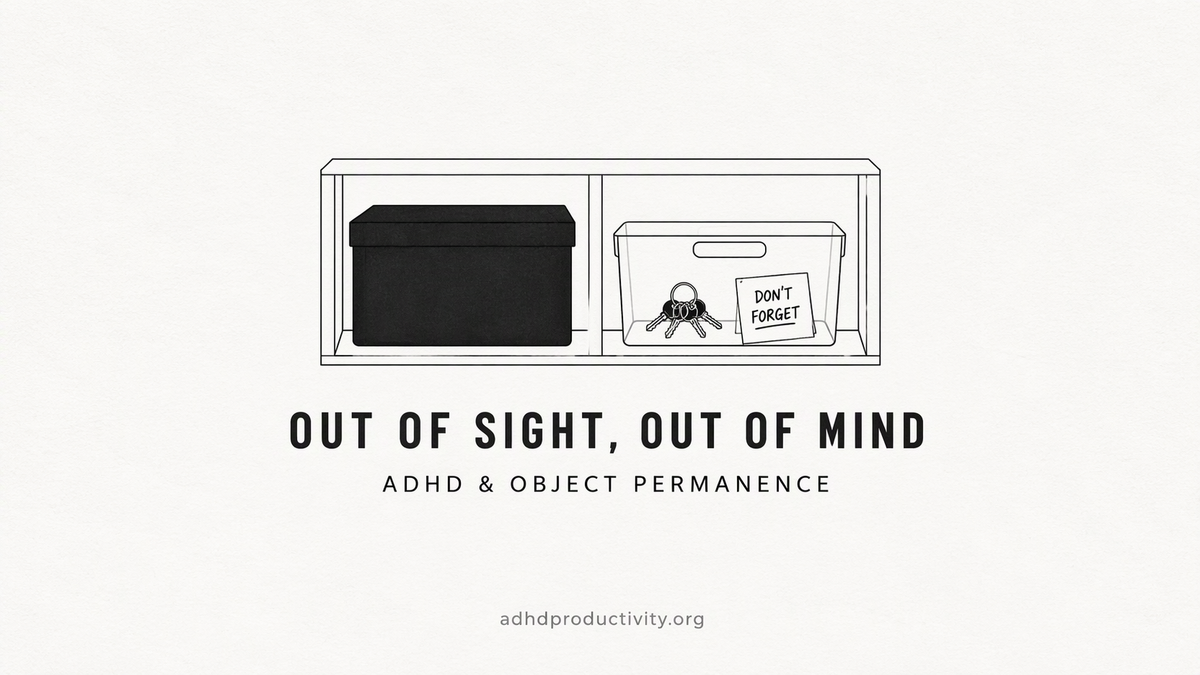
If you have ADHD and things stop existing the moment they leave your line of sight, you're not imagining it 😂

People online call it "ADHD object permanence." Trying harder to remember won't fix it. Building a home where the important stuff can't hide will.
This guide gives you the setup. Room by room, screen by screen, with the apps that help and the ones that make it worse.
The short answer
ADHD "object permanence" is the habit of forgetting things, tasks, and even people once they're out of view.
It isn't an official symptom name. It's a nickname for a mix of working-memory and prospective-memory trouble. The practical fix is to stop storing important things in your head or in closed places, and put them where you'll see them at the moment you need them.
Quick version:
- Keep the things you use daily out in the open (clear bins, open shelves, hooks).
- Put reminders where the task happens, not in an app you never open.
- Pick one "can't miss it" digital spot (lock screen, pinned window, or a widget) and limit it to three items.
- Run a 10-minute weekly sweep so the out-of-sight piles don't grow teeth.
What "object permanence" means here
The term comes from child development. A baby learns that a toy hidden under a blanket still exists. Adults with ADHD obviously know the leftovers in the fridge still exist. You just don't think of them until they've become a science project.
So it's less "I don't believe it exists" and more "it never pops into my head at the right time."
What the research points to:
- Forgetting and losing things is a core ADHD sign. The CDC lists "forget or lose things a lot" among the signs of ADHD, and notes that people with the inattentive presentation often forget details of daily routines.
- Working memory takes a real hit. A 2018 review of meta-analyses in Archives of Clinical Neuropsychology found working memory showed one of the largest average deficits of any cognitive area studied in ADHD.
- Remembering to do things later is hard in real life, not only in labs. In a 2019 study by Altgassen and colleagues, adults with ADHD showed clear everyday prospective memory deficits.
Put those together and "out of sight, out of mind" makes a lot of sense. Your brain is not a reliable place to park future plans. So don't park them there.
The one principle behind every fix
Put the cue where the action happens.
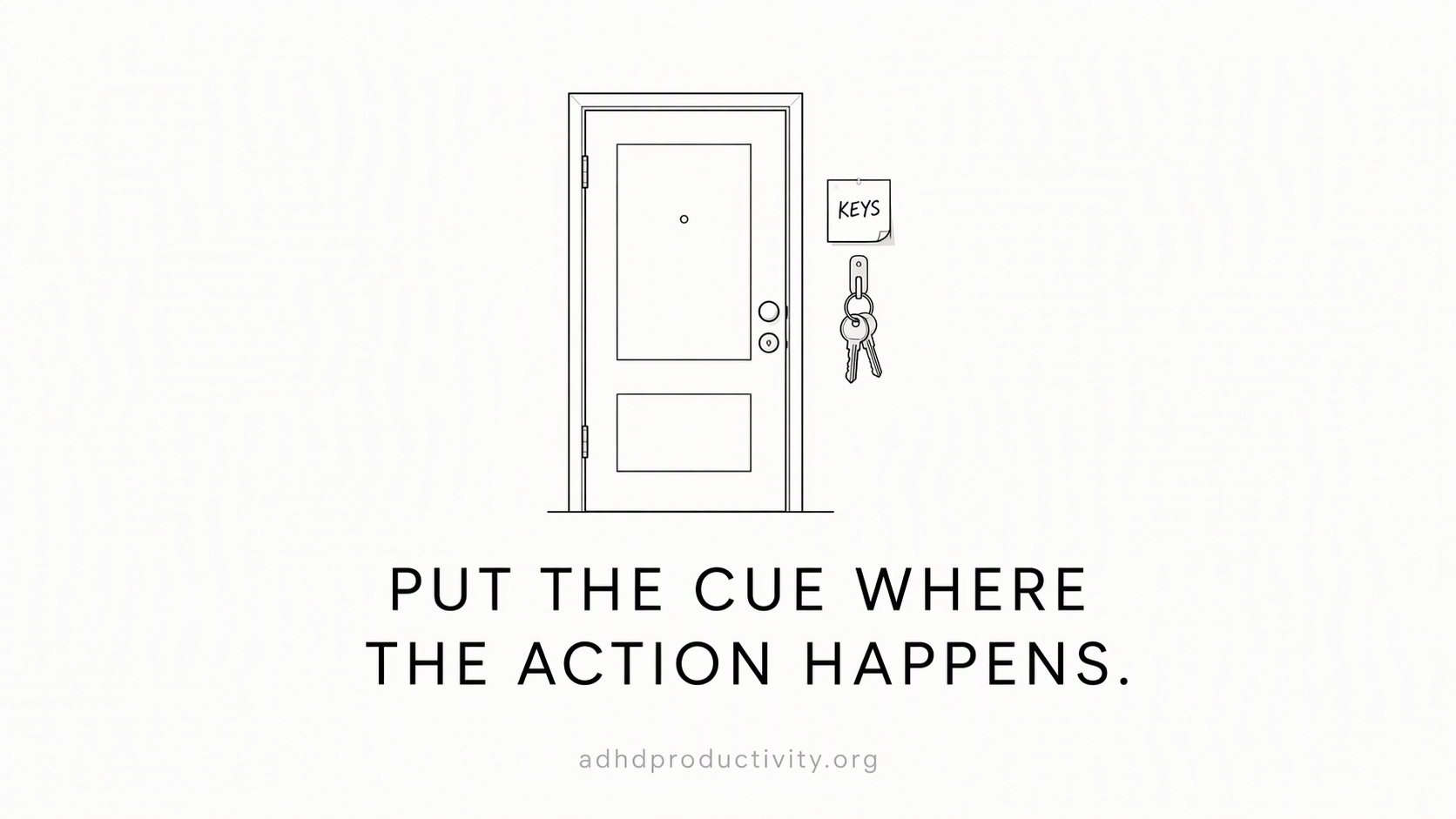
The idea is simple enough to: help works best at the exact spot and moment you need it. A reminder to take your vitamins belongs next to the coffee maker. Not in a to-do app you open on Thursdays.
Your physical space: make stuff visible
Kitchen
The fridge is the natural habitat of forgotten food. Some fixes:
- Eat-first shelf. One shelf at eye level for anything that expires in the next three days. Nothing else goes there.
- Clear containers only. If you can't see the soup, the soup doesn't exist.
- Whiteboard on the fridge door. Two columns: "Use soon" and "Buy." Takes ten seconds to update. My ADHD meal planning guide goes deeper on keeping food from going feral.
Closets, drawers and cupboards

Doors and drawers are where possessions go to be forgotten.
- Swap closed bins for clear bins with labels facing out.
- Use open shelving or hooks for daily items: bag, keys, headphones, charger.
- Take the doors off one cupboard if you're brave. (Renters, maybe just prop it open with a label.)
- Keep a "launch pad" by the front door: a tray or hook for everything that leaves the house with you.
Bills, mail and paperwork
Paper in a drawer is paper you'll never see again until the late fee arrives.
- One vertical "action" file on the desk, open and upright. Mail that needs action goes in it, period.
- Anything with a deadline gets photographed and turned into a dated task the same day.
- Set bills to autopay where you can. A task you never have to remember is the best kind.
Clothes and laundry
- Keep a small "wear again" chair or hook so half-clean clothes don't vanish into a pile.
- Clean laundry that stays in the basket is fine. Really. Visible beats folded-and-forgotten.
If cleaning in general is a wall for you, our guide to cleaning with ADHD has smaller starting points.
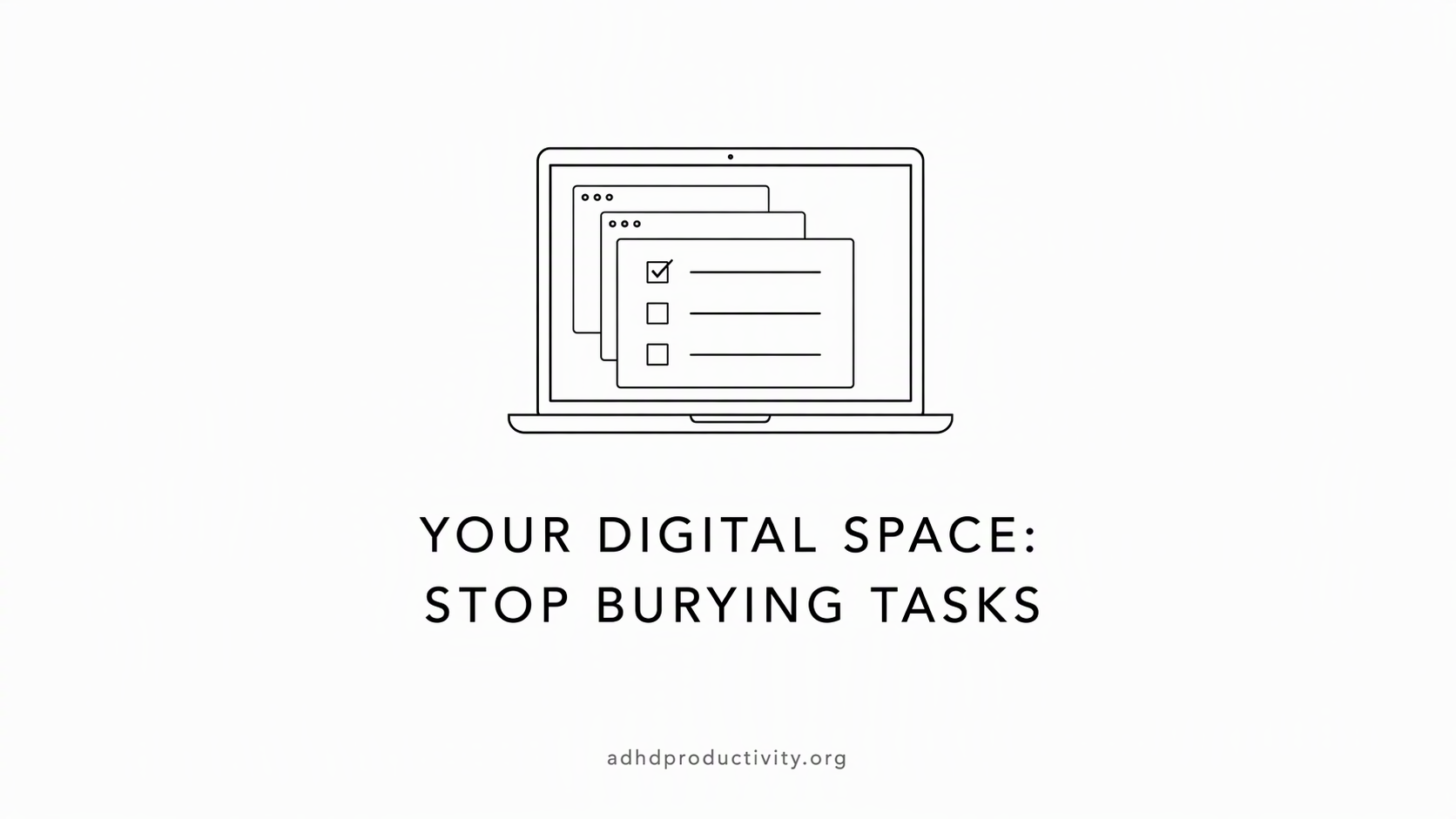
Your digital space: stop burying tasks
Here's where most systems fail. You write the task down (great!) in an app that lives in a folder on page three of your phone (less great). Out of sight again.
Rule 1: one capture spot, always reachable
You need a single place to dump tasks the second they show up. Phone home screen, a keyboard shortcut, a voice command. Whatever is fastest.
If you don't have a dumping habit yet, start with our ADHD brain dump walkthrough. I personally use Saner.AI as my braindump space

Rule 2: one "can't miss it" spot, with three things max
Capture is half the job. The other half is seeing the right three tasks at the right time. Options:
- Lock screen widget with today's top tasks.
- A pinned window on your desktop.
- A sticky note on your monitor (low-tech, very effective, slightly ugly).
Keep it to three. Ten items in your face is just a second hiding place, because your eyes learn to skip it.
Rule 3: reminders that fire at the right place, not just the right time
Time-based alarms are fine for meetings. For errands, location works better. On iPhone, Apple Reminders can alert you when you arrive at or leave a place ("remind me to drop off the package when I leave home"). You can even say it to Siri.
That's point of performance in app form. For more options, see our list of the best reminder apps for ADHD.
Rule 4: don't let email become a closet
Your inbox is a closed drawer with a notification badge. Anything that needs action should leave email and land in your task list, where you'll actually see it.
The "out of sight" setup in 30 minutes
Want to do this today? Set a timer and go.
- Minutes 0–5: Pick your launch pad. Clear one spot near the door. Put keys, wallet and bag there.
- Minutes 5–10: Make an eat-first shelf. Pull anything expiring soon to eye level.
- Minutes 10–15: Set up an action file. Grab all the mail lying around. Anything that needs action goes in one upright folder on your desk.
- Minutes 15–20: Choose your capture spot. Put your task app on your phone's home screen dock. Remove the others from view.
- Minutes 20–25: Create your "can't miss it" view. Add a lock screen widget or pin your top three tasks (Focus Box in Saner works for this).
- Minutes 25–30: Add two location reminders. One for leaving home, one for arriving at work or the store.
That's it. You won't finish everything perfectly and that's fine. Something visible beats something perfect in a drawer.
Object permanence with people
This one stings. Friends drift because you didn't text back, and not because you stopped caring. Out of sight, out of mind applies to relationships too.

Low-effort fixes:
- A "people" list in your notes app with names you want to keep in touch with.
- Recurring reminders to check in with two or three close people every couple of weeks.
- Tell them. "If I go quiet, it's my brain, not you. Ping me." Most people are kind about it.
- Reply fast or snooze on purpose. If you can't reply now, set a reminder for tonight instead of leaving the message "read" forever.
Common mistakes
- Too many visible things. If your whole desk is "visible reminders," your brain filters all of it out. Visibility works when it's selective.
- Pretty systems you never open. A gorgeous planner in a drawer is still in a drawer.
- Relying on willpower. "I'll just remember" is the plan that got you here.
- Five apps for five kinds of task. Each app is another closed door. Consolidate where you can.
- Skipping the reset. Without the weekly sweep, every system decays. That's entropy. Not a character flaw.
If time is the thing that disappears for you, not just objects, our post on ADHD time blindness pairs well with this one. And for the broader picture of why things slip, see ADHD forgetfulness.
My take

Stop trying to fix your memory. Fix your environment. You'll still forget things. Brains do. But you'll forget fewer of the things that cost money, friendships or sleep. Start with the launch pad by the door. It's the cheapest win in this whole post.
FAQ
Is object permanence an actual ADHD symptom?
Not officially. "Object permanence" is a child-development term that people with ADHD borrowed as a nickname. The real symptoms underneath it are forgetting and losing things, which the CDC lists as signs of ADHD, plus weaker working memory and trouble remembering future plans.
Why do I forget food in the fridge until it goes bad?
Because it's behind a door and out of view. Make an eat-first shelf at eye level, use clear containers, and keep a "use soon" list on the fridge door.
Does ADHD treatment help with "out of sight, out of mind"?
Ask your clinician. The NIMH lists medication and psychosocial treatments such as CBT as standard care, and a 2010 JAMA trial found CBT helped adults whose symptoms persisted on medication. Environment fixes like the ones above work alongside treatment, not instead of it.
What's the best app for ADHD object permanence?
Any app that keeps a few tasks in your face. Look for a lock-screen widget or pinned view, location reminders, and fast capture. Saner.AI's Focus Box and lock-screen focus task do this, and Apple Reminders handles location alerts for free.
How do I stop forgetting to text friends back?
Keep a short "people" list, set recurring check-in reminders for your closest few, and tell friends that silence means your brain, not your feelings.
Is "out of sight, out of mind" just laziness?
No. Forgetting what you can't see is tied to how ADHD affects memory and planning. Our post on executive dysfunction vs laziness goes into the difference.
Sources
- CDC: Symptoms of ADHD
- Archives of Clinical Neuropsychology (2018): The Neurocognitive Profile of ADHD: A Review of Meta-Analyses
- Altgassen, Scheres & Edel (2019), ADHD Attention Deficit and Hyperactivity Disorders: Prospective memory (partially) mediates the link between ADHD symptoms and procrastination
- NIMH: Attention-Deficit/Hyperactivity Disorder
- Safren et al. (2010), JAMA: CBT vs relaxation with educational support for medication-treated adults with ADHD
- Katz (2013), CHADD Attention: Interventions at the Point of Performance
- Apple Support: Set location-based reminders on iPhone
- Saner.AI: Changelog, November 2025 release note, Pricing, Chrome extension guide