Should You Disclose ADHD to Your Employer?

But "disclosure" is not one decision. It is four: what you say, who you say it to, when you say it, and how much of the label you attach.
Key takeaways
- You can keep your diagnosis private in most situations. Under the ADA, a US employer may only ask medical questions in four narrow circumstances, and "I want to know" is not one of them (EEOC).
- You often don't have to name ADHD at all. The EEOC has said that if you don't want your employer to know the specific diagnosis, documentation describing your condition more generally may be enough (EEOC).
- Timing beats wording. An employer does not have to excuse poor performance that already happened, even if a medical condition caused it. Accommodations are forward-looking (EEOC).
- If you disclose and ask for nothing, nothing happens. Saying "I have ADHD" without tying it to a work barrier usually doesn't start any formal process at all (ADA National Network).
- Your manager is the variable. Not the policy, not the handbook. Every honest account of this, mine included, comes back to whether the specific human above you is decent.
- Anything you do disclose must be kept confidential, including from your coworkers (EEOC).
What's in this post
- Disclosure is four decisions, not one
- What you're legally entitled to
- What the evidence actually says
- When disclosing is usually the right call
- When to wait, or not disclose at all
- The timing mistake almost everyone makes
- Who to tell first
- Three scripts, at three levels of disclosure
- What happens after you say it
- Special situations
- If it goes badly
- FAQ
ADHD Disclosure is four decisions, not one
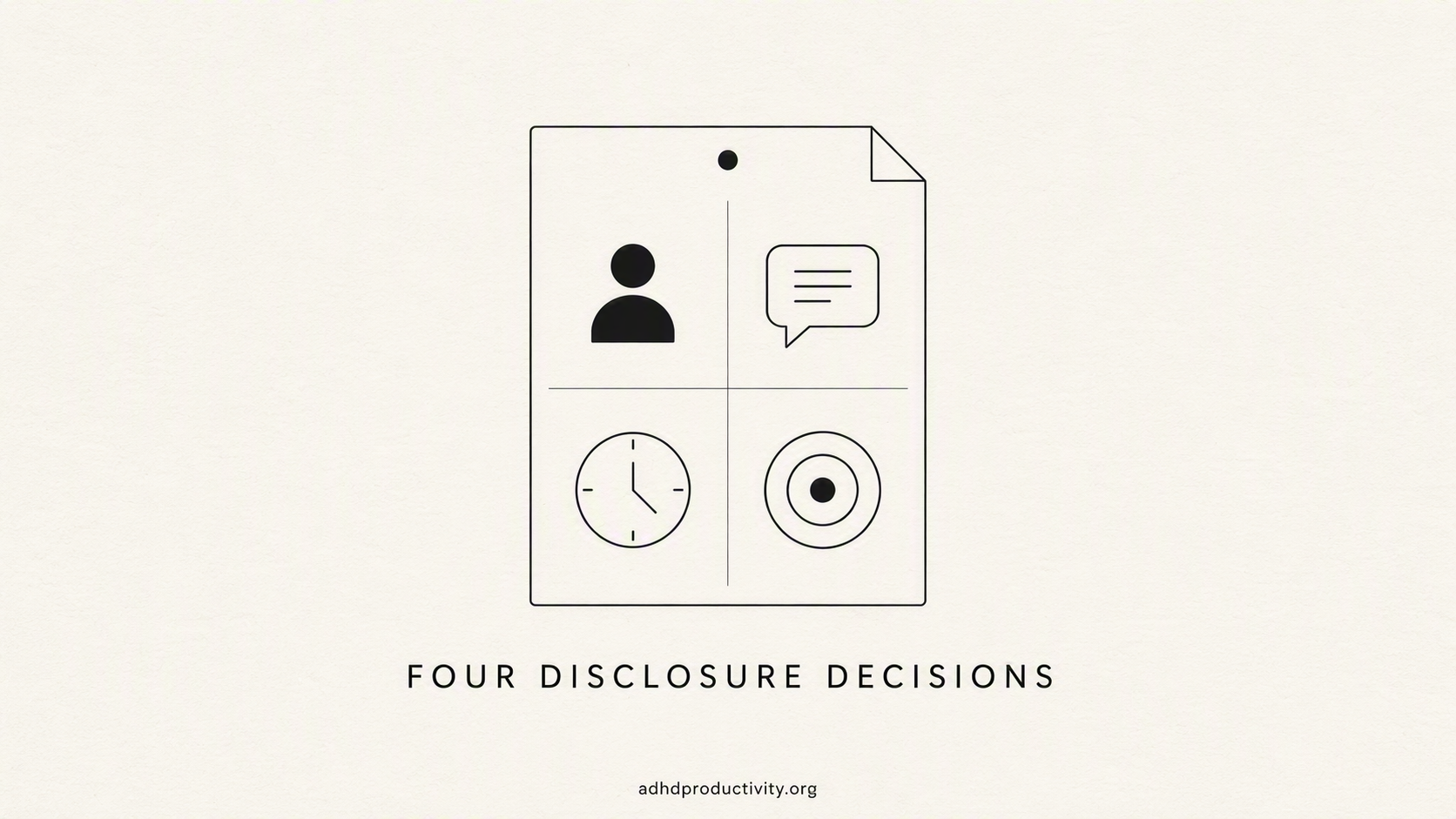
The reason this question feels impossible is that people treat it as a single yes or no. It isn't. Break it into four and it gets much easier.
- What. A functional limitation ("I struggle to hold verbal instructions in working memory"), a general category ("a neurodevelopmental condition"), or the actual diagnosis ("ADHD, combined type").
- Who. HR, your direct manager, your skip-level, your team, or a single trusted colleague. These are wildly different risk profiles and people constantly collapse them into one.
- When. Application, interview, offer stage, first week, when things are fine, or when things are on fire.
- Why. To get an accommodation, to explain a pattern, to stop masking, or to change how a specific person interprets your behaviour.
You can pick a different answer for each. I have told HR the diagnosis and told a manager only the functional version.
The highest-leverage combination for most people, most of the time: functional language, to HR, before anything is on fire, in order to get a specific change.
What you're legally entitled to
This section is US-focused. Skip to special situations if you're elsewhere.
You can keep it private. An employer may only ask you medical questions in four situations: when you request an accommodation, after a job offer but before you start (if everyone in that job category is asked the same thing), when it's running a disability affirmative action programme, and when there is objective evidence you may be unable to do your job or may pose a safety risk. Outside those, your medical history is yours.
It's illegal to fire you for having ADHD. Discriminating against you simply because you have a mental health condition is unlawful, and so is refusing to hire or promote you because you asked for an accommodation. What an employer can act on is objective evidence that you cannot perform essential job functions, or a genuine safety risk. Not assumptions about the diagnosis.
What you disclose stays confidential. If you do tell your employer, it must keep that information confidential, including from coworkers. You can choose to tell coworkers yourself. Your employer cannot choose for you.
Disclosure alone does nothing. This is the part that trips people up. The accommodation process starts when you connect the condition to a work barrier. As the ADA National Network puts it, telling an employer you have a disability without saying it is affecting your work is usually not enough to begin the process (ADA National Network). Disclosure is not a request. It's a preamble.
You don't have to say "ADHD." If you'd rather not hand over the specific label, documentation that describes your condition more generally may be sufficient. Whether that's practical depends on your provider and your HR department, but the option exists and almost nobody knows it does.
For the mechanics of the request itself, the two-column problem-and-solution method, the email template, and what to do when HR stalls, go to ADHD accommodations at work. This post stays on the decision.
When should you disclose?
- You need a change that requires permission. Headphones during focus time, a moved desk, written instructions, interim deadlines, a flexible start. If you need someone to say yes, they need a reason.
- Your manager is decent and you have evidence of it. Watch how they've handled someone else's parental leave, medical absence, or bad quarter. That's your data.
- You're in a large organisation with an actual accommodations process. A form and a coordinator means the decision is partly procedural, which reduces how much rides on one person's temperament.
- You're being read as careless when you're actually struggling. If your reputation is drifting toward "unreliable," disclosure with a plan attached can reset the interpretation.
- Masking is costing you more than the risk. If you're spending your evenings recovering from the performance of being neurotypical, that is a real cost with a real endpoint.
- You already have the documentation.
When to wait, or not disclose at all
- You're inside your probation period. Legal protection exists, but proving discrimination in a period designed for at-will dismissal is hard.
- Your organisation is in layoffs or restructuring. Not because disclosure will definitely get you cut, but because in a process with heavy managerial discretion, you're less able to see what's driving decisions.
- You have a specific manager problem, not a work problem. If your manager is the issue, disclosure hands them information rather than solving anything
- Your job has hard safety requirements and you haven't checked how your role is regulated. Employers can act on genuine safety risk, though it must be based on objective evidence rather than stereotypes. Get advice specific to your role before disclosing.
- You don't actually want anything. If there's no change you're asking for, disclosure gives away information and gets you nothing procedural in return. Sometimes you want to stop masking, and that's ok.
- Your employer has fewer than 15 employees and you haven't checked state law. ADA employment protections start at 15 employees, though many states set a lower threshold. Check before, not after.
Who to tell first
| Who | What they can do | Risk | When it makes sense |
|---|---|---|---|
| HR / People Ops | Start the formal accommodation process, keep records, bind the company to a legal duty | Lowest. Bound by confidentiality rules and process | Default choice. Especially if you have any doubt about your manager |
| Your direct manager | Change your day-to-day immediately, informally, without paperwork | Medium. Depends entirely on the person | You have real evidence they're decent, and you want speed over protection |
| Skip-level or a sponsor | Protect you politically, influence how you're described in calibration | Medium to high. Usually can't act directly | You already have a relationship, and your reputation is the problem |
| Your team | Adjust how they work with you day to day | Highest. Cannot be undone | Only when you actively want to stop masking, not to obtain anything |
One nuance worth naming. HR is not on your side, exactly. HR is on the company's side, and the company's interest is in following the process correctly. That happens to align with yours here, which is why HR is the right first stop even though it doesn't feel warm.
Three scripts, at three levels of ADHD disclosure
Pick the smallest one that gets you what you need. You can always escalate. You can't retract.
Level 1: Functional only. No condition named.
"I want to flag something about how I work best. I lose accuracy on instructions given verbally in meetings, so I'd like to switch to written task assignments for anything with a deadline. Would that work?"
Use this with a manager, in a one-to-one, for something small. It requires no documentation, no process, no label. Honestly, this solves a surprising share of problems on its own.
Level 2: Medical condition, category only.
"I have a medical condition that affects concentration and working memory. It's manageable, and I'm not looking to change my responsibilities. There are two specific adjustments that would help me do the job more consistently, and I'd like to start whatever process you use for that."
This is the sweet spot. It triggers the formal accommodation duty. It gives HR a category they can work with. And it doesn't hand over a label that carries thirty years of cultural baggage about laziness and school reports.
Level 3: Named diagnosis.
"I have ADHD. I was diagnosed in [year] and I'm treated for it. I'm telling you because two things about how our team works are creating avoidable problems for me, and both have easy fixes. I'd like to talk through those."
Use this when you have a manager you trust, or when the specific label helps the person understand a pattern they've already noticed. Level 3 buys you understanding. It does not buy you more legal protection than Level 2.
Three things every version has in common, and they're not accidents:
- A specific ask. Never disclose without one. A disclosure with no request is a confession, and it will be received like one.
- No apology. Not "sorry to bring this up," not "I know this is a lot." It isn't. Most accommodations cost the employer nothing at all (JAN).
- A frame of consistency, not capacity. "More consistently" rather than "at all." You are describing variance, not incapacity. That distinction matters more than any other word choice on this page.
What happens after you say it
- Expect a pause. A blank face is usually unpreparedness, not rejection. Fill the silence with your ask, not with reassurance.
- The process is meant to be two-way. The accommodation process is explicitly interactive, with both sides participating to reach a workable solution (ADA National Network). If someone tells you it's a yes-or-no decision handed down from above, that's not how it's supposed to run.
- They may ask for documentation. They can ask you to put the request in writing and to submit a letter from your provider. The EEOC publishes a guide written for clinicians, The Mental Health Provider's Role in a Client's Request for a Reasonable Accommodation at Work, which you can hand to your provider so they know what to write.
- They get to choose among options. If more than one accommodation would work, the employer picks. Bring a second-choice option so the conversation has somewhere to go other than no.
- Write down what was agreed. Same day, in email, starting with "to confirm what we discussed." Every time. It's tedious and it's the thing that protects you six months later when the manager who agreed has moved on.
- Call JAN before or after, for free. The Job Accommodation Network is funded by the US Department of Labor and gives free, confidential advice to employees, not just employers. 800-526-7234. You are not obliged to tell your employer you called.
Special situations
In a job interview. Don't. You're under no obligation, and pre-offer discrimination is close to impossible to prove. The exception is if you need an adjustment to the interview itself, like extra time on a take-home task. Ask for that adjustment without explaining your medical history.
On a performance improvement plan. Disclose immediately, and get advice first if you can. You've lost the timing advantage, so the goal shifts: you're trying to get accommodations in place for the PIP period itself, since that's forward-looking and therefore still covered. Do not expect it to erase what triggered the PIP.
Starting a new job. The strongest window is after you've signed and before you've built a reputation, roughly weeks two to six. Late enough that the offer is secure, early enough that no pattern has formed. This is the moment I'd choose if I were doing it again.
Working remotely. Remote work is often the accommodation, which means many people never need to disclose at all. The trade is that remote work removes structure you were silently borrowing from the office, so the problems change shape. We covered that in ADHD and remote work.
Outside the US. The framework is different everywhere. In the UK, the Equality Act 2010 requires employers to make reasonable adjustments once they know, or could reasonably be expected to know, that you're disabled, and ADHD can meet that definition (Acas). Canada, Australia, and EU member states each have their own equivalents. Look up yours before using any language from this post.
If it goes badly
- Get it in writing. Any denial, any change in how you're treated, any comment that lands wrong. Contemporaneous notes with dates are worth more than a good memory.
- Harassment based on a disability is unlawful, and if you report it your employer is legally required to act to prevent it recurring
- Watch the clock. In the US you generally have 180 days from the alleged violation to file a charge with the EEOC, or 300 days if a state or local law also covers your employer. That is much shorter than people assume, and it is the deadline I most often see missed.
- Retaliation is separately illegal. Your employer cannot lawfully punish you for contacting the EEOC or filing a charge
- Consider that the answer might be leaving. Sometimes a role and a brain are just badly matched, and no calendar buffer fixes it. Finding that out at month eight is a much better outcome than finding out at year three.
One last thing. Disclosure changes your environment. It doesn't change how you start a task on a Tuesday morning, or which task manager survives contact with your brain, or the fact that an hour still doesn't feel like an hour. Do both. The environment work has better leverage, because you only have to win that argument once. The daily systems you have to rebuild roughly forever.
FAQ
Do I have to tell my employer I have ADHD?
No. In most situations you can keep a diagnosis private. A US employer may only ask medical questions in four narrow circumstances, and having a diagnosis is not one of them (EEOC). The main reason people choose to disclose is to request an accommodation, because an employer cannot provide one it does not know is needed.
Can I be fired for having ADHD?
Not for having it. It is illegal for an employer to discriminate against you simply because you have a mental health condition, including firing you or rejecting you for a promotion (EEOC). An employer can act on objective evidence that you can't perform essential job functions, or a genuine safety risk, but not on assumptions about the diagnosis.
Should I tell HR or my manager first?
HR, if you have any doubt. HR can start the formal accommodation process, is bound by confidentiality rules, and creates a written record. Your manager can move faster and more informally, which is better only if you already have real evidence that they handle this kind of thing well.
Do I have to name ADHD specifically?
Often not. The EEOC has stated that if you don't want your employer to know your specific diagnosis, documentation describing your condition more generally may be sufficient. You do need to indicate that you need a change at work because of a medical condition.
Should I disclose ADHD in a job interview?
Generally no. There is no obligation to, and discrimination that happens before a job offer is very difficult to prove, which is why many people wait until after an offer. If you need an adjustment to the interview process itself, request that adjustment without disclosing your medical history.
Will my coworkers find out?
Not from your employer. If you disclose a condition, your employer must keep that information confidential, including from coworkers. You can tell colleagues yourself if you want to
Is it too late to disclose if I've already had a bad performance review?
It's not too late to get accommodations going forward, and you should. But it won't undo the review. Employers do not have to excuse past poor performance caused by a medical condition, and are not required to rescind discipline issued before an accommodation request (JAN).
What if my employer has fewer than 15 employees?
Title I of the ADA applies to employers with 15 or more employees. Below that, check your state law, since many states set a lower threshold and some cover independent contractors. The Job Accommodation Network will tell you what applies to you, for free.
Does disclosing actually make things better?
There's no ADHD-specific study that answers this cleanly. The closest evidence is a decision-aid study of employees with mental health conditions, where 36.3% chose to disclose after structured deliberation and disclosure was associated with a greater reduction in mental ill-health symptoms than non-disclosure (Stratton and Glozier, 2023). That comparison was observational, so it can't establish cause. What it does support is that deliberating carefully beats avoiding the decision.
Where can I get free, confidential advice before I decide?
The Job Accommodation Network, funded by the US Department of Labor's Office of Disability Employment Policy, provides free confidential consultation to employees as well as employers. Call 800-526-7234 or visit askjan.org. In the UK, Acas publishes free guidance and runs a helpline.
Sources
- US Equal Employment Opportunity Commission. Depression, PTSD, and Other Mental Health Conditions in the Workplace: Your Legal Rights, 2016.
- US Equal Employment Opportunity Commission. Enforcement Guidance on Reasonable Accommodation and Undue Hardship under the ADA.
- US Equal Employment Opportunity Commission. The Mental Health Provider's Role in a Client's Request for a Reasonable Accommodation at Work.
- ADA National Network. Reasonable Accommodations in the Workplace.
- Job Accommodation Network. Disclosing a Disability Before an Accommodation is Needed. US Department of Labor, Office of Disability Employment Policy.
- Job Accommodation Network. Costs and Benefits of Accommodation, updated September 2025.
- Stratton E, Glozier N. Adaptation and implementation of an employee mental health disclosure decision aid tool in a real-world sample. Translational Behavioral Medicine, 2023.
- McIntosh CK, Hyde SA, Bell MP, Yeatts PE. Thriving at work with ADHD: antecedents and outcomes of proactive disclosure. Equality, Diversity and Inclusion, 2023;42(2):228–244.
- Carter-Rogers K. TMI? Exploring the effects and experiences of ADHD disclosure on career progression. Unpublished thesis, St Francis Xavier University, 2026. Qualitative, n=22.
- Akili Interactive. ADHD in the Workplace survey. Vendor-funded market research, not peer-reviewed.
- Acas. Reasonable adjustments at work. UK.
This article is about workplace strategy and employment law, and is not medical or legal advice. It does not diagnose or treat ADHD. For clinical questions, talk to a qualified provider. For legal questions specific to your situation, talk to an employment attorney or contact the Job Accommodation Network, which is free. Read our full editorial policy and medical disclaimer.
For the daily systems side, start with the ADHD Productivity Guide.