How to Increase Productivity with ADHD: The Complete Guide

ADHD productivity means building systems around the executive functions ADHD disrupts, rather than relying on the ones it doesn't reliably supply. Standard advice assumes you can hold a plan in your head, feel a deadline approaching, and start a task because it's important. Research suggests all three of those assumptions are weaker in ADHD brains. Everything in this guide follows from that.
I'm not a clinician. I have ADHD, I work in AI, and I've spent months testing tools and systems and writing down what happened. Every clinical claim below links to the study it came from. Where I couldn't find good evidence, I say so instead of guessing.
What this guide covers
- Why standard productivity advice fails, mechanically
- The five deficits that matter and what each one breaks
- The one principle that connects every workable ADHD system
- What the research supports, what it doesn't, and what nobody has studied yet
- How to build a system in a week
Why does standard productivity advice fail people with ADHD?
Standard productivity advice fails because it treats the gap between knowing and doing as a motivation problem. In ADHD it looks more like an inhibition and self-regulation problem.
Russell Barkley's model, published in Psychological Bulletin in 1997, argues that ADHD is fundamentally a deficit in behavioral inhibition, and that this deficit produces secondary impairments in four executive functions that depend on it: working memory, self-regulation of affect and motivation, internalization of speech, and reconstitution (Barkley, 1997). SciSpace
That matters practically. If your problem were motivation, then a better reason to do the thing would fix it. If your problem is that the mechanism translating intention into action fires unreliably, a better reason changes nothing. You already had a good reason. You had it for six weeks.
This is not a small population. An estimated 6.0% of US adults had a current ADHD diagnosis in 2023, roughly one in 16, or about 15.5 million people, and more than half of them, 55.9%, were first diagnosed at 18 or older (Staley et al., 2024, CDC MMWR). A lot of adults are running systems built for a brain they don't have, and only recently found out why it wasn't working. nihCDC
What are the five ADHD deficits that break productivity systems?
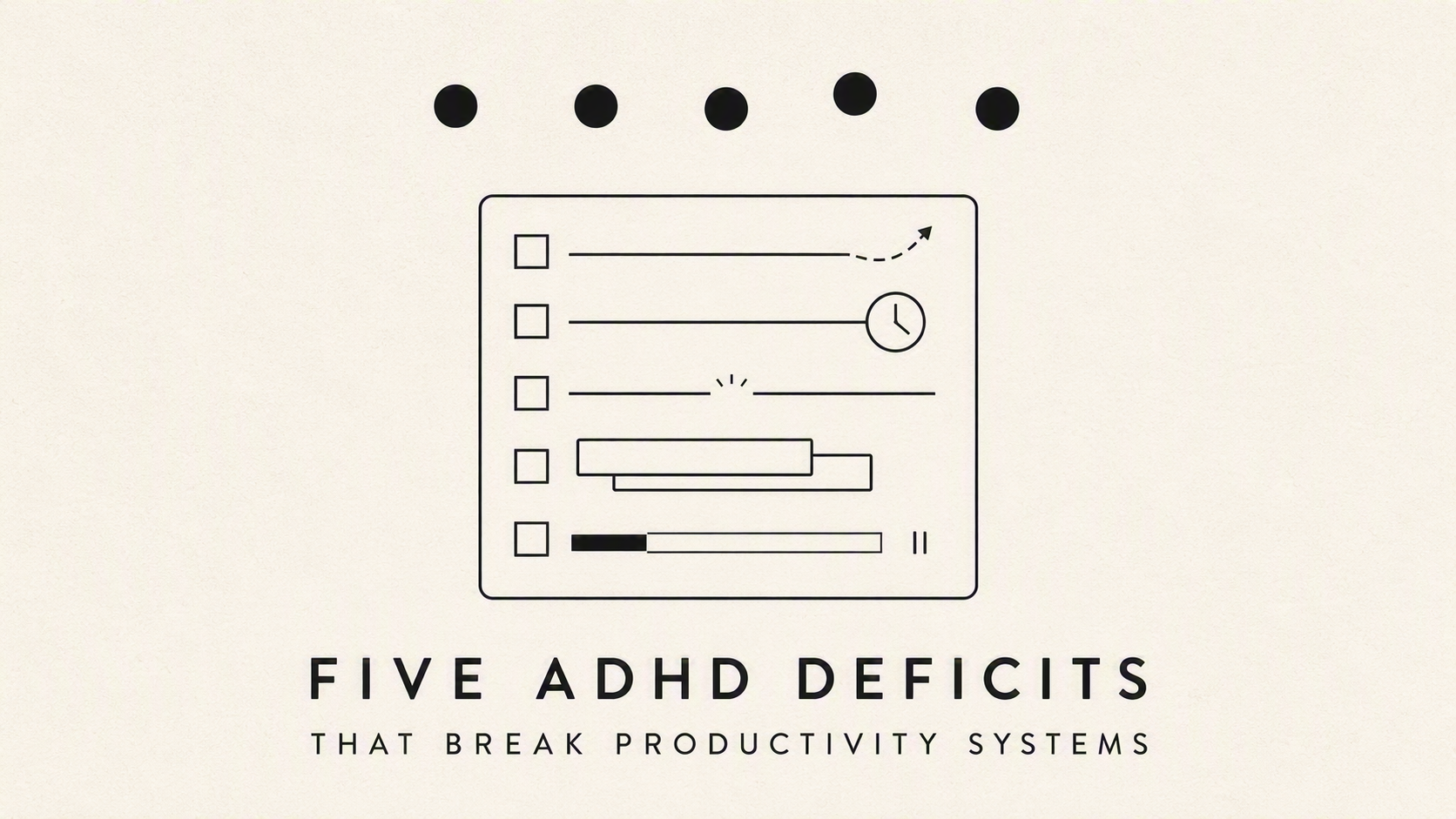
Five documented differences do most of the damage: inhibition, working memory, time perception, reward valuation, and emotional regulation. Each one breaks a specific assumption that ordinary productivity systems depend on.
1) Working memory
A meta-analysis of 38 studies of working memory in adults with ADHD found moderate-magnitude effect sizes across both phonological and visuospatial working memory compared with controls, and concluded that these deficits persist into adulthood (Alderson, Kasper, Hudec & Patros, 2013, Neuropsychology). PubMedSemantic Scholar
What this breaks: any system that requires you to remember it exists. Mental to-do lists. Multi-step instructions. The plan you made in the shower.
2) Time perception
This is the one people mean when they say time blindness. A meta-analysis of 55 studies comparing perceptual timing in people with ADHD against neurotypical participants found more severe difficulty discriminating very brief durations, more variability estimating durations lasting several seconds, and deficits in time estimation and production accuracy consistent with an accelerated internal clock (Marx, Cortese, Koelch & Hacker, 2022, JAACAP). ScienceDirectScienceDirect
What this breaks: schedules, estimates, and any plan that depends on feeling how much time has passed.
Worth flagging: a 2023 review of the adult literature specifically found the research base scarce, with some studies showing clear deficits in time estimation and reproduction and others failing to find a clear association, with methodology varying widely between studies (Weissenberger et al. review, 2023). The child and adolescent evidence is much stronger than the adult evidence. Anyone telling you time blindness is settled science in adults is overstating it. PubMed
3) Reward valuation
A meta-analysis of case-control studies on monetary delay discounting found significantly higher discounting of future rewards in people with ADHD, at a level of statistical significance the authors said would meet the highest evidentiary thresholds (Jackson & MacKillop, 2016, Biological Psychiatry: CNNI). In plain terms, a reward loses value faster as it moves further away. ScienceDirect
What this breaks: any system whose payoff is in the future. Which is most of them. "Do this now and your quarter will go better" is a sentence your brain does not price correctly.
4) Emotional regulation
A meta-analysis of 13 studies covering 2,535 people found substantially higher emotion dysregulation in adults with ADHD than in controls, with a large effect size (Hedges' g = 1.17), and emotional lability showing the strongest individual effect (g = 1.20) (Beheshti, Chavanon & Christiansen, 2020, BMC Psychiatry). An earlier analysis put the share of adults with ADHD who have significant emotion dysregulation at 30% to 70% (Shaw et al., 2014, American Journal of Psychiatry). nihAPA
What this breaks: the recovery loop. One piece of critical feedback at 10am and the whole day is gone.
5) Inhibition
The root of Barkley's model. It's why you open the browser to check one thing and resurface twenty minutes later having checked eleven.
I'd add one honest note here. Barkley's model is influential but not universally accepted, and researchers still argue about whether executive dysfunction is the core of ADHD or one feature among several. I use it because it's the most practically useful frame I've found, not because the debate is closed.
→ Deep dive: Executive dysfunction is not laziness
What is the single most useful principle for ADHD productivity?
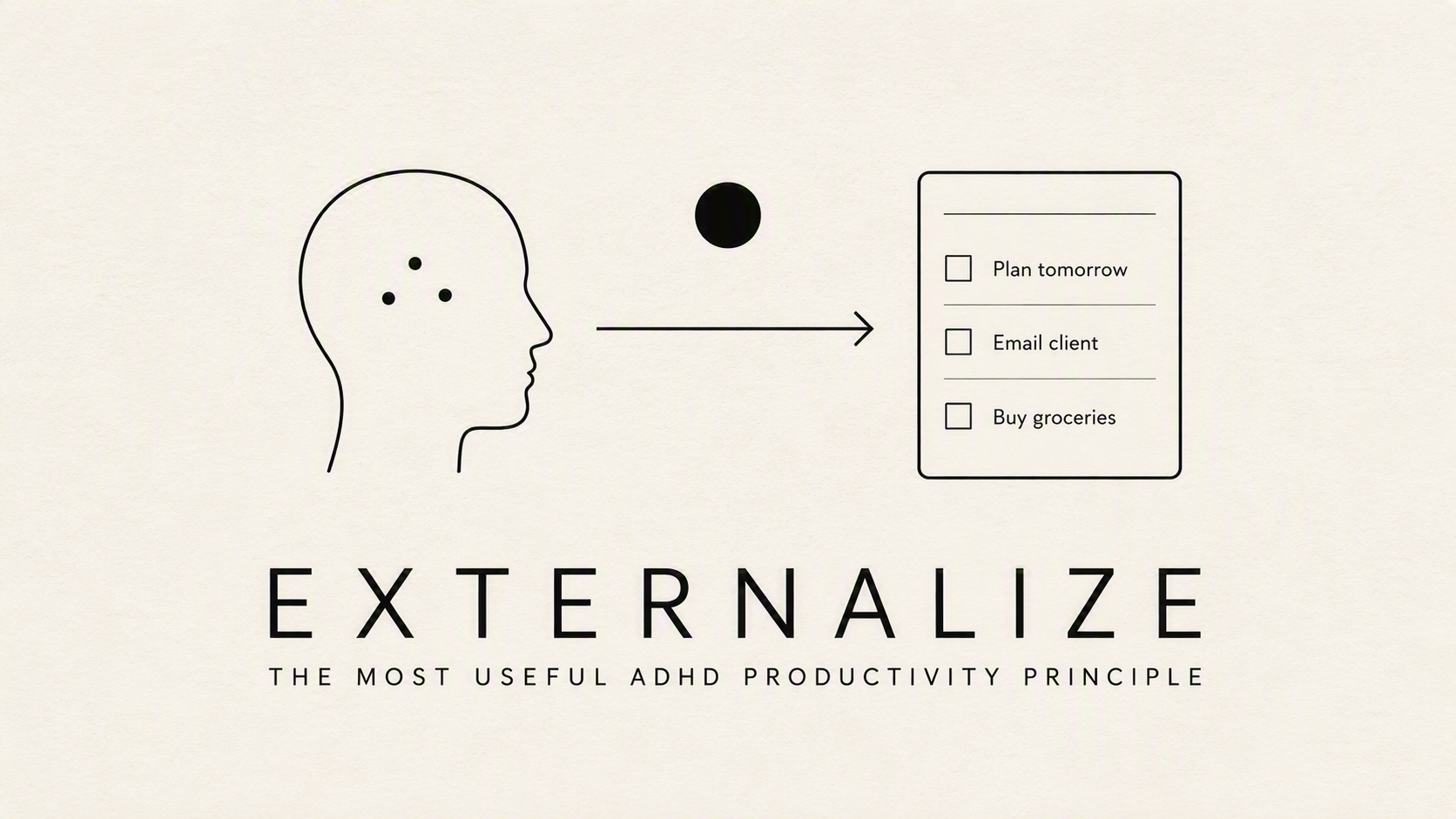
Externalize!
- Move as much cognitive load as possible out of your head and into the environment, where it doesn't depend on working memory to survive. This follows directly from Barkley's model: if the internal mechanism is unreliable, stop routing critical functions through it. Almost every ADHD strategy that works is a version of this.
Timers instead of felt time.
- Visible lists instead of remembered ones. Alarms instead of intentions. A calendar that shows duration as physical space rather than a start time. A whiteboard you cannot avoid walking past.
The test for any tool or system: does it reduce what I have to hold in my head, or does it add to it? Most productivity software adds to it.
How do you actually start a task with ADHD?
Shrink the first step until starting stops being a decision, and pre-commit the trigger.
The most researched technique here is the if-then plan, or implementation intention: deciding in advance what specific cue will start what specific action, so initiation doesn't require an in-the-moment choice.
The ADHD evidence for this is real but narrower than most blogs admit. In two studies, children with ADHD who furnished a suppression goal with implementation intentions improved response inhibition on a Go/No-Go task to the same level observed in children without ADHD (Gawrilow & Gollwitzer, 2008, Cognitive Therapy and Research).
Follow-up work found if-then plans also benefited executive functions and delay of gratification performance in children with ADHD (Gawrilow, Gollwitzer & Oettingen, 2011). Semantic Scholar
The caveat matters. As APSARD notes, implementation intentions have not yet been studied in adults with ADHD; the supporting evidence comes from children (APSARD). I use if-then plans daily and they work for me. That's an anecdote sitting on top of pediatric data, and you should weigh it accordingly.
In practice:
Bad: "I'll work on the report tomorrow."
Better: "When I sit down with coffee after standup, I will open the report document and write one sentence."
The specificity is the mechanism. Cue, then single action, small enough that refusing feels absurd.
The second lever is reducing what sits between you and the work. Every step counts. If starting requires opening an app, finding the file, and deciding where to begin, you've stacked three initiation problems where you needed one. Leave the document open. Leave the tab pinned. End yesterday's session mid-sentence so today has an obvious entry point.
→ Deep dive: How to start a task when you have ADHD
→ Deep dive: Using AI to break down overwhelming tasks
Does body doubling actually work?
The evidence is early and mostly descriptive, but it exists, and it's the strategy I'd try first because it costs nothing. Body doubling means working alongside another person, physically or over video, on unrelated tasks.
The first formal peer-reviewed investigation of the practice, published in ACM Transactions on Accessible Computing in 2024, surveyed neurodivergent participants and found they overwhelmingly used body doubling to initiate tasks, stay motivated during them, and complete them (Eagle et al., 2024). 10000Hours
Read that carefully. It's a survey of how people use the practice and what they report, not a randomized controlled trial establishing that it outperforms working alone. One review noted that a search for credible sources on body doubling turned up two peer-reviewed articles and two master's theses, one of which found body doubling counterproductive regardless of ADHD diagnosis (BACA, 2025). Medical News Today's review concluded there is no recent research testing effectiveness, with support resting largely on anecdotal reports (Medical News Today, 2024). BACAMedical News Today
So: promising, widely reported to help, not proven. It's also free, reversible, and takes ten minutes to test. That ratio of possible benefit to cost is why it's the first thing I recommend, and why I'm being careful not to oversell it.
→ Deep dive: Body doubling: how it works and where to find partners
How do you work around time blindness?
Make time physical.
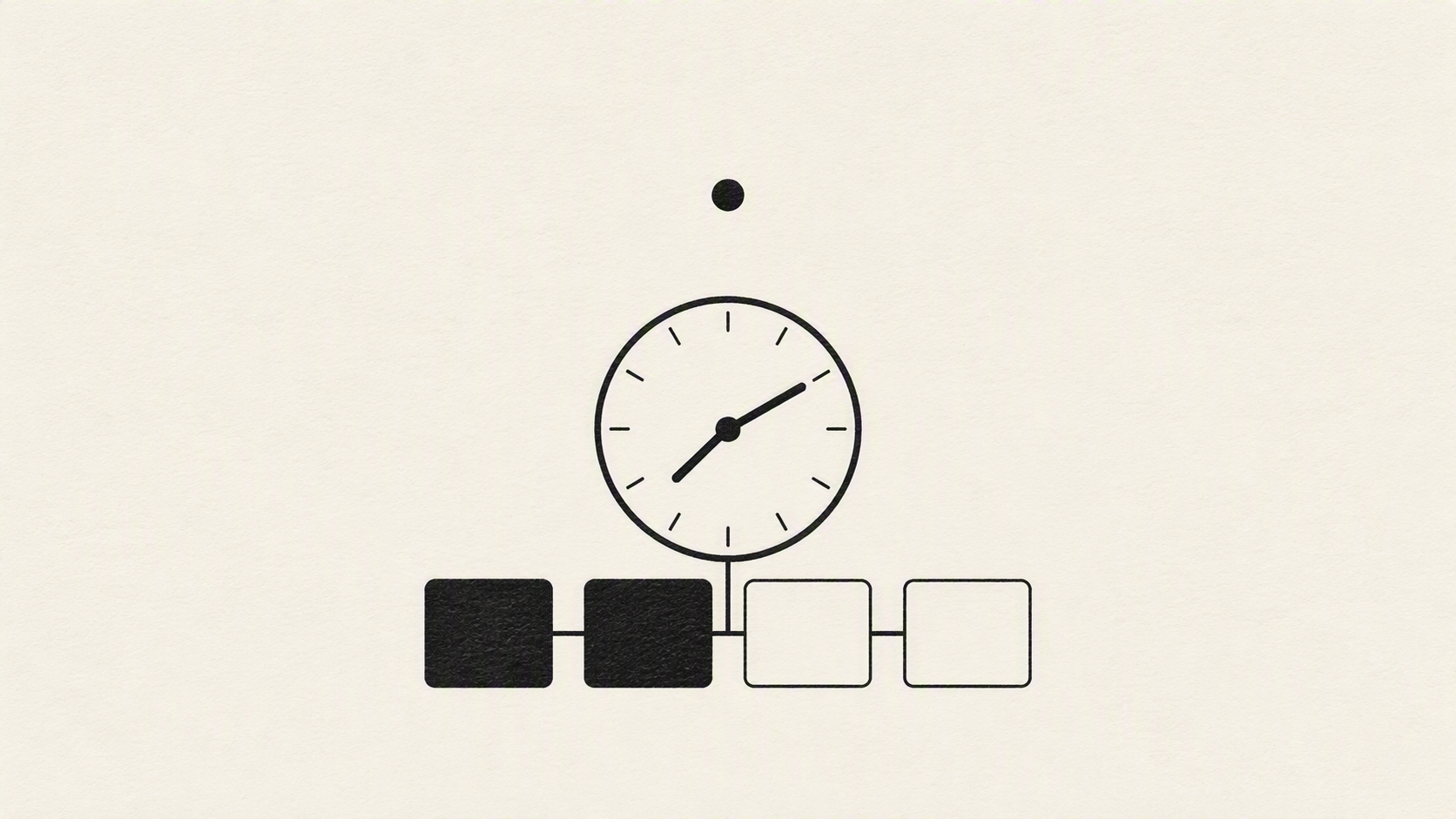
If your internal sense of duration is unreliable, the fix is to put duration somewhere you can see it, and to build slack into every estimate because the estimate is the thing that's broken.
What I actually do:
A visible countdown running during work blocks. Not a phone timer buried behind a lock screen. Something on the desk or on screen, showing time draining rather than time elapsed.
Calendar blocks sized to real duration rather than optimistic duration. I take my instinctive estimate and multiply it. My multiplier is [1.5x / 2x, use your real number]. Find yours by tracking three tasks this week and comparing estimate to actual. Two data points is enough to be uncomfortable.
Blocks with gaps between them. Back-to-back scheduling is how ADHD time blocking dies. One overrun cascades, the whole day collapses, and then you abandon the system entirely and feel bad about it for a month. Generous blocks with buffers survive contact with reality. Tight ones do not.
Buffers before appointments rather than after. Waiting mode, where a 3pm meeting makes the preceding four hours unusable, is a real experience with no clinical name I could find. If anyone knows of research on it, email me, because I looked and came up empty.
→ Deep dive: Time blindness explained
→ Deep dive: ADHD time blocking that survives contact with reality
How do you make yourself care about a task that pays off later?
Move the reward closer.
Given that delay discounting is steeper in ADHD, a system that pays off in three months is competing against one that pays off in three seconds, and losing. The fix isn't more willpower. It's shortening the distance to the payoff.
Concretely, that means checkpoints small enough that finishing one produces an actual feeling. Not "finish the project." A visible unit of progress at least every session, ideally more often. Crossing things off is not childish, it's the payoff schedule doing what your reward system needs it to do.
It also means being suspicious of any productivity system whose entire reward is future-tense. Most are. That's why they get abandoned in week two, when novelty stops supplying the reward and the system's own payoff structure has to carry it, and can't.
A caution I'd give about the popular framing here. The community explanation for all of this is usually "dopamine," and you'll see confident claims about ADHD dopamine deficits everywhere. I've deliberately not made those claims, because I didn't find primary sources I could stand behind at the level of specificity those posts use. Delay discounting is well documented. The neurochemical story people tell about it in blog posts is a good deal shakier than the confidence suggests.
What should you look for in an ADHD productivity tool?
Judge tools on how little they demand from you on a bad day, not on feature count.
The best-featured app in this category is often the worst ADHD app in it, because features mean setup, setup means decisions, and decisions are the resource in short supply.
My five criteria, in order:
Can I capture something in under five seconds, from anywhere? If capture has friction, capture doesn't happen, and everything downstream is empty.
Does it surface things at me, or wait for me to check it? Working memory research says the second one fails. A tool that requires you to remember to open it has offloaded the hardest part back onto you.
How much does it break if I ignore it for four days? Everyone ignores their system for four days. A tool that punishes you with a backlog of overdue red text on return is a tool you will delete.
Does it show time as space? Calendar views beat list views for time blindness, because they make duration visible instead of abstract.
Can I use it without maintaining it? Tagging, sorting, and reorganizing are executive function taxes. Every one you pay is a reason to quit.
I test every tool for at least 3 weeks against these before writing about it. Week one tells you nothing. Everything is great in week one.
→ Deep dive: Best ADHD apps
→ Deep dive: Best AI tools for ADHD
What doesn't work, and what's being oversold?
Four things I think this space gets wrong.
Pomodoro as prescribed. I could not find research testing the standard 25/5 Pomodoro structure specifically in ADHD populations. Not "the research is mixed." I could not find it. The technique may still help you, and it helps me in modified form, but anyone presenting the 25-minute interval as ADHD-optimized is presenting a preference as a finding.
Hyperfocus as a superpower. It gets sold as ADHD's compensating gift. You don't choose the target and you frequently can't exit on demand. A regulation failure that occasionally points somewhere useful is not the same as a controllable ability.
Apps as the answer. No app fixes executive dysfunction. The good ones reduce the load on it. The distinction sounds pedantic until you've bought your ninth subscription.
What actually has the strongest evidence behind it?
Cognitive behavioral therapy adapted for adult ADHD, on top of medication, has the best trial evidence of anything in this guide. A randomized controlled trial of 86 medication-treated adults with persistent ADHD symptoms compared CBT against relaxation with educational support, and found that CBT produced improved ADHD symptoms which were maintained at 12 months (Safren et al., 2010, JAMA). PubMedSemantic Scholar
I mention this because it's the honest ranking. A blog post about task initiation is not competing with that, and I'd be doing you a disservice by implying otherwise. If you have access to an ADHD-informed CBT program, that outranks every tool I review.
Everything in this guide is the layer underneath: things you can do this week, at no cost, without a waiting list.
How to have a system in one week
Day one. Pick one capture tool. Any of them. Put it on your home screen and delete the other eight.
Day two. Time three tasks. Write your estimate before, the actual after. Find your multiplier.
Day three. Write two if-then plans for the two things you most reliably avoid. Cue, then one small action.
Day four. Try body doubling once. A friend on video, a coworking call, a café. One session, ninety minutes.
Day five. Put tomorrow's three real priorities into calendar blocks at your multiplied duration, with gaps.
Day six and seven. Ignore all of it. Deliberately. Then look at what still made sense on Monday.
The point of the last step is that a system's real quality is how it performs after you abandon it, because you will abandon it. Everything survives week one.
And here's the thing I keep having to relearn: reading about productivity feels almost identical to doing productivity. I have lost entire afternoons to researching task management while a task went undone. Pick one item from this list. Not four.
Frequently asked questions
Is ADHD a productivity problem or a medical condition?
It's a neurodevelopmental condition, and productivity difficulty is one of its downstream effects. This guide covers strategy, not treatment. See our medical disclaimer.
Can I fix ADHD productivity problems without medication?
Many people improve substantially with strategy alone, and everything in this guide works independently of medication. But the strongest trial evidence, like Safren et al. 2010, tested structured therapy in adults already on medication. Treatment decisions belong with a clinician.
Why do productivity apps stop working after two weeks?
Novelty supplies the reward in week one. When it fades, the system's own payoff structure has to carry it. Most systems pay off far in the future, and delay discounting research (Jackson & MacKillop, 2016) suggests distant rewards lose value faster in ADHD. Build in near-term checkpoints.
Is time blindness real?
There's meta-analytic evidence of timing deficits across multiple paradigms in ADHD (Marx et al., 2022). The adult-specific evidence base is thinner than the child evidence, and "time blindness" is a community term rather than a clinical diagnosis.
What's the single best ADHD productivity tip?
Externalize. Get it out of your head and into something you can see. Everything else is a variation.
Sources
Alderson RM, Kasper LJ, Hudec KL, Patros CHG (2013). ADHD and working memory in adults: a meta-analytic review. Neuropsychology, 27(3), 287-302.
Barkley RA (1997). Behavioral inhibition, sustained attention, and executive functions: constructing a unifying theory of ADHD. Psychological Bulletin, 121(1), 65-94.
Beheshti A, Chavanon ML, Christiansen H (2020). Emotion dysregulation in adults with ADHD: a meta-analysis. BMC Psychiatry, 20:120.
de Graaf R, Kessler RC, Fayyad J, et al. (2008). The prevalence and effects of adult ADHD on the performance of workers: WHO World Mental Health Survey Initiative. Occupational and Environmental Medicine, 65(12), 835-842.
Eagle T, et al. (2024). An investigation of body doubling with neurodivergent participants. ACM Transactions on Accessible Computing.
Gawrilow C, Gollwitzer PM (2008). Implementation intentions facilitate response inhibition in children with ADHD. Cognitive Therapy and Research, 32, 261-280.
Jackson JNS, MacKillop J (2016). ADHD and monetary delay discounting: a meta-analysis of case-control studies. Biological Psychiatry: CNNI, 1(4), 316-325.
Marx I, Cortese S, Koelch MG, Hacker T (2022). Meta-analysis: altered perceptual timing abilities in ADHD. JAACAP, 61(7), 866-880.
Safren SA, Sprich S, Mimiaga MJ, et al. (2010). CBT vs relaxation with educational support for medication-treated adults with ADHD and persistent symptoms. JAMA, 304(8), 875-880.
Shaw P, Stringaris A, Nigg J, Leibenluft E (2014). Emotion dysregulation in ADHD. American Journal of Psychiatry, 171(3), 276-293.
Staley BS, Robinson LR, Claussen AH, et al. (2024). ADHD diagnosis, treatment, and telehealth use in adults. MMWR, 73(40), 890-895.
Not medical advice. See the full disclaimer and how I research and review.