ADHD Paralysis: Why You Freeze, and how to get you moving again

I once sat in front of a laptop for four hours to write one email. Two paragraphs. To a person I like.
I wasn't scrolling. I wasn't napping. I was sitting there, fully aware of the task, fully capable of doing it, radiating the body language of a man deep in thought, and producing nothing. Around hour three I reorganized my desk drawer. That felt productive for about ninety seconds.
If you've done some version of this, you've met ADHD paralysis. It's one of the most common experiences people with ADHD describe and one of the least understood by everyone else, including me.
Here's what helps.
What is ADHD paralysis?
ADHD paralysis is the state of being stuck: you know what needs doing, you want to do it, and you cannot start. It usually comes from some mix of too much input, too many options, or too much feeling about the task. It is not a formal diagnosis.
That doesn't make it fake. It makes it a symptom cluster with a nickname, which is a different thing entirely.
The three flavors of ADHD paralysis
- Mental paralysis. Thoughts, emotions, and sensory input pile up until you can't identify a next step. The classic version is standing in a messy kitchen and being unable to determine which thing to pick up first.
- Task paralysis. One specific task develops a force field. You'll do anything else. The laundry gets folded. The task does not get done.
- Choice paralysis. Also called analysis paralysis. Too many options, so you keep evaluating instead of choosing. Choice paralysis needs fewer options. Task paralysis needs a smaller first step. Mental paralysis needs input turned down before anything else will work.
Why does ADHD paralysis happen?
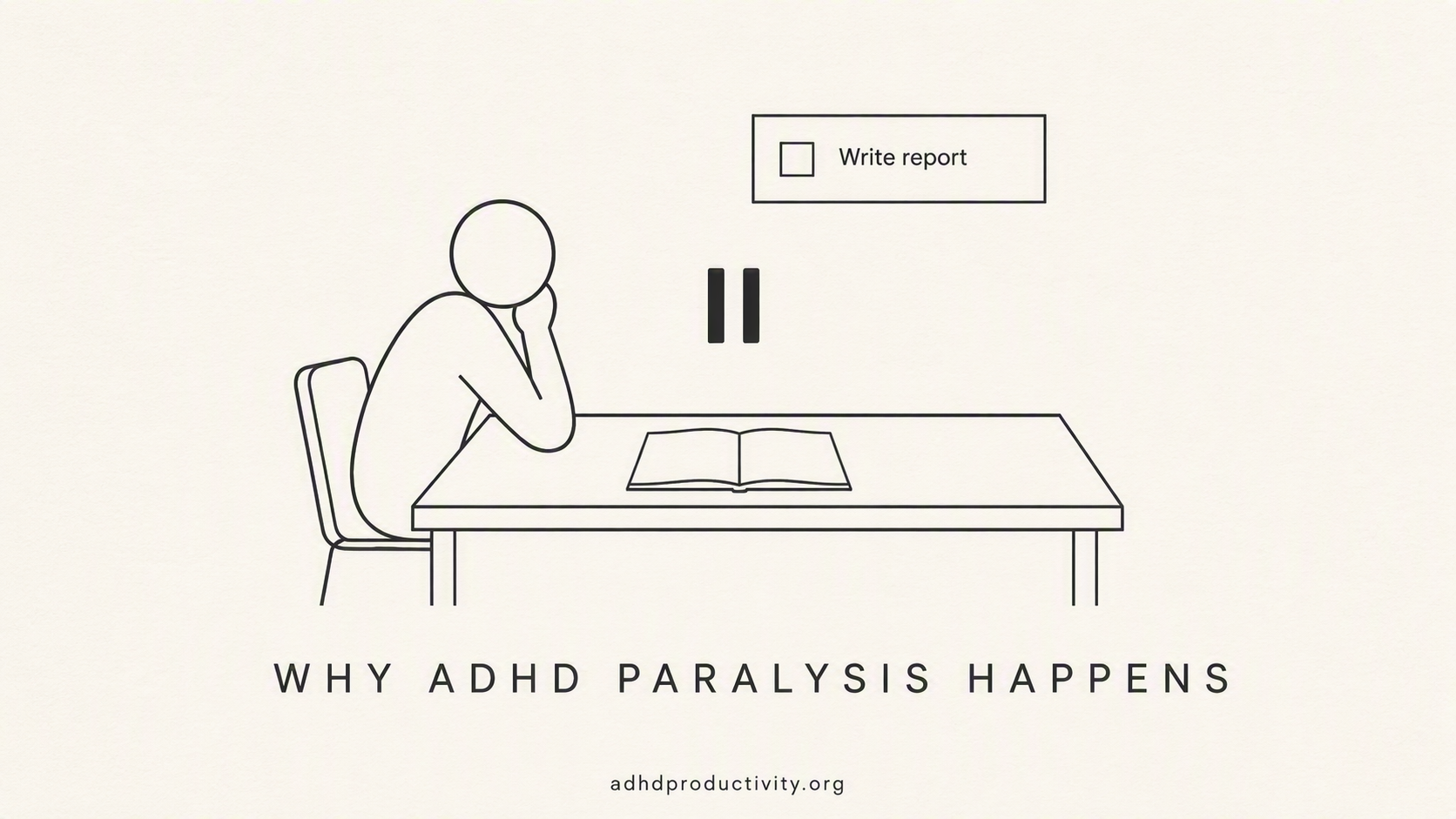
Your working memory runs out of room
Working memory is the mental whiteboard you use to hold a plan while you execute it. In ADHD it's smaller and more easily wiped. A meta-analytic review in Neuropsychology pooled 38 studies of adults and found moderate-magnitude deficits across both working memory domains that persist into adulthood.
So when a task requires holding six variables at once — what's the deadline, who needs to approve it, where's the file, what did they say last time — the whiteboard fills, then blanks. And a blank whiteboard feels exactly like freezing.
This is also why the paralysis gets worse as the task gets vaguer. "Do taxes" needs a whole whiteboard. "Open the folder labeled 2025 receipts" needs about an inch of it.
Delay makes tasks aversive
There's a real, measured tendency in ADHD to take the small immediate reward over the larger delayed one. A meta-analysis in the Journal of Attention Disorders covering 37 group comparisons and 3,763 participants found small-to-medium effect sizes for choosing smaller sooner rewards over larger later ones. The authors point to delay aversion as a driver.
Most of the tasks that paralyze us pay out late. Write the report, get approval in a week. Start the tax return, feel relief in April. Your brain is being asked to accept a delayed, abstract reward, and it's registering an objection.
The task has feelings attached to it
Emotion dysregulation shows up repeatedly in adult ADHD research. A systematic review in PLoS One looking at 22 studies found adults with ADHD use non-adaptive emotion regulation strategies more often than people without ADHD symptoms, with dysregulation tracking symptom severity and executive functioning difficulties.
-> The task you're frozen on is usually not the hardest one on your list. It's the one with dread, shame, or conflict attached. Reply to the client who was annoyed last time. Book the appointment you should have booked in March. The avoidance is doing a job. It's making a bad feeling stop, right now, at the cost of a worse one later.
Too many choices, no filter
Decision load deserves its own line. A survey study presented in European Psychiatry asked 50 adults with ADHD about decision-making and found 82% reported frequent difficulty deciding, with 68% saying decision paralysis significantly affected their work performance. About a third hit it daily.
How is this different from laziness, burnout, or depression?
| What it feels like | Key tell | What helps | |
|---|---|---|---|
| ADHD paralysis | Want to start, can't | Episodic. You unfreeze when the task shrinks or the deadline arrives | Smaller first step, external structure |
| Laziness | Don't want to, don't care | You'd happily do the task if paid enough | Not a real category for most of us |
| ADHD burnout | Depleted, nothing left | Persistent across weeks, includes physical exhaustion | Recovery and load reduction, not tactics |
| Depression | Flat, no pleasure anywhere | Affects things you normally enjoy, not just chores | Clinical support |
That "laziness" row is a bit of a joke, but only a bit. If you offered me $10,000 to write the four-hour email, I'd have written it in nine minutes. That's not a motivation deficit. That's a reward-timing problem, which we covered in more detail in executive dysfunction vs. laziness.
The burnout distinction is the one to take seriously. If you're frozen on everything for weeks, including things you like, the tactics below won't touch it. Start with ADHD burnout instead.
How do you get out of ADHD paralysis right now?
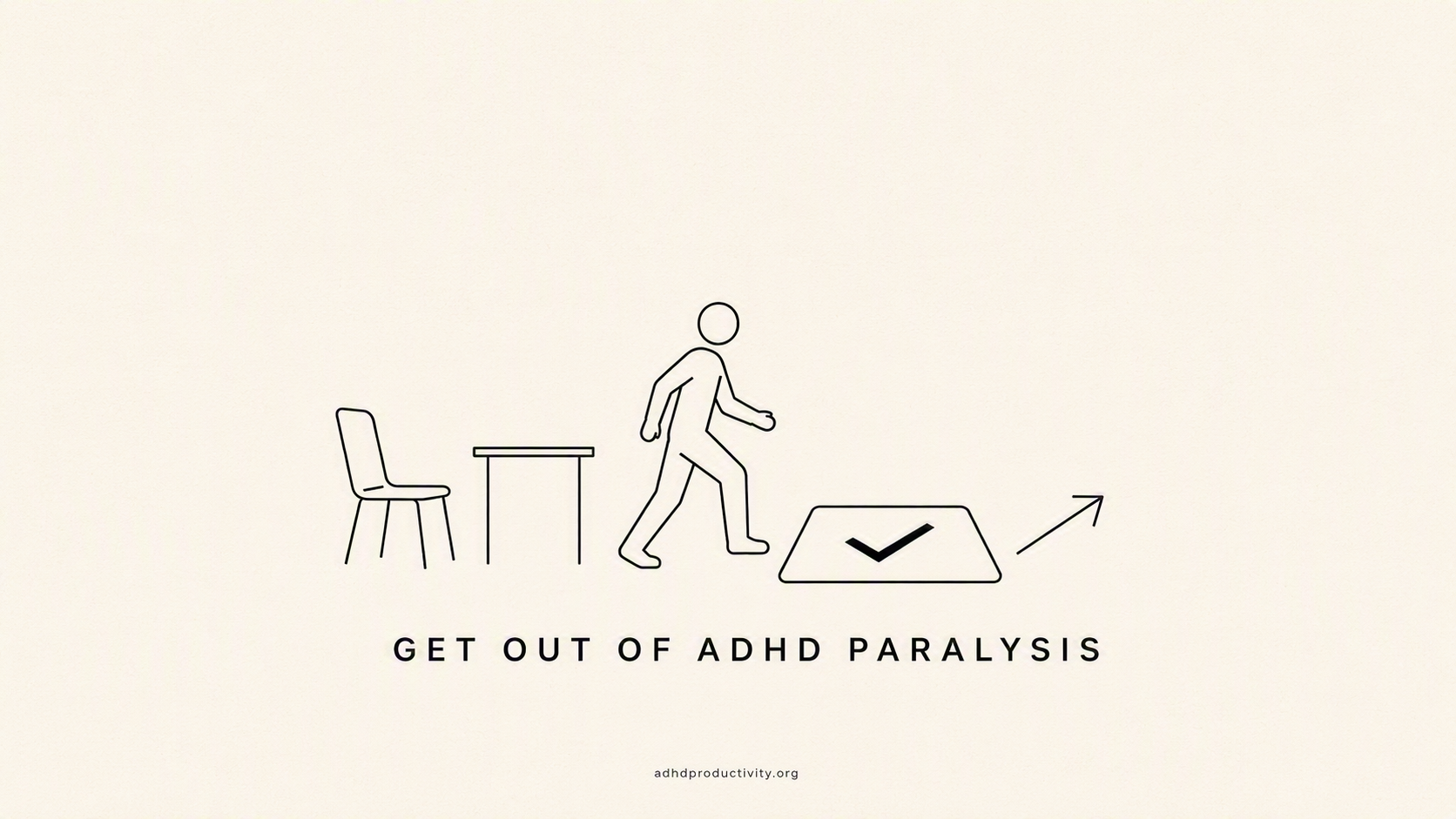
Minute 1-2: Turn the input down
Before you try to think your way out, reduce what's coming in.
- Stand up and move to a different room, or at minimum a different chair
- Close every tab that isn't the task
- Put the phone somewhere that requires standing up to reach
- Noise-cancelling headphones, or silence, whichever your brain prefers
You're not procrastinating by doing this. Mental paralysis is a bandwidth problem, and you cannot plan your way out of a bandwidth problem while the bandwidth is still full.
Minute 3-4: Shrink the task until it's stupid
Whatever step you're considering, it's too big. Cut it in half. Then cut it again.
- "Do taxes" → "open the 2025 receipts folder"
- "Write the proposal" → "open a blank doc and type the client's name"
- "Clean the kitchen" → "put four things in the dishwasher"
- "Reply to Sarah" → "open the email and read it"
The test: if you can't picture yourself physically doing it in the next 60 seconds, it's still too big. A step that feels embarrassingly small is a step that's correctly sized.
We've written a fuller version of this approach, including how to use AI to do the chopping for you, in using AI to break down tasks. Tools like Saner.AI are useful at this specific moment. You dump the messy task in as a note or voice memo and get back a concrete first step, which removes the exact planning step your working memory can't currently hold.
Minute 5: Set a timer for ten minutes

Not twenty-five. Ten. A ten-minute commitment is short enough that your brain doesn't file it under "delayed, unpleasant." You're allowed to stop when it rings, and you should actually mean that, or the trick stops working after a week.
In my experience about 70% of the time I keep going past the timer. The other 30% I stop at ten minutes, and ten minutes of a task I was frozen on for two hours is still a win.
Minute 6: If it's a choice, use the two-option rule
For choice paralysis specifically: cut your options to two, then pick by coin flip if you have to.
- Two restaurants, not twelve
- Two possible next tasks, not the whole list
- Two tools to evaluate, with a hard 20-minute cap
Most decisions that paralyze us are reversible and low-stakes. If you stuck on reducing the choice, Saner.ai can be a good accommodation because it gives you a day plan every morning - so you have some concrete thigns to work on, not a 100 things
Minute 7-10: Borrow a body or move yours
Body doubling. Work alongside someone, in person or on video, both doing your own thing. The mechanism is mostly external accountability plus a reduction in the "nobody would notice if I stopped" problem. I covered the how in body doubling for ADHD.
Or move. A meta-analysis in the Journal of Global Health covering 14 studies of adults with ADHD found physical activity improved inhibitory control, with chronic exercise showing a large effect and acute exercise a moderate one. That's inhibitory control specifically, not a general cure for stuckness, and the samples were small.
How do you have fewer paralysis episodes in the first place?
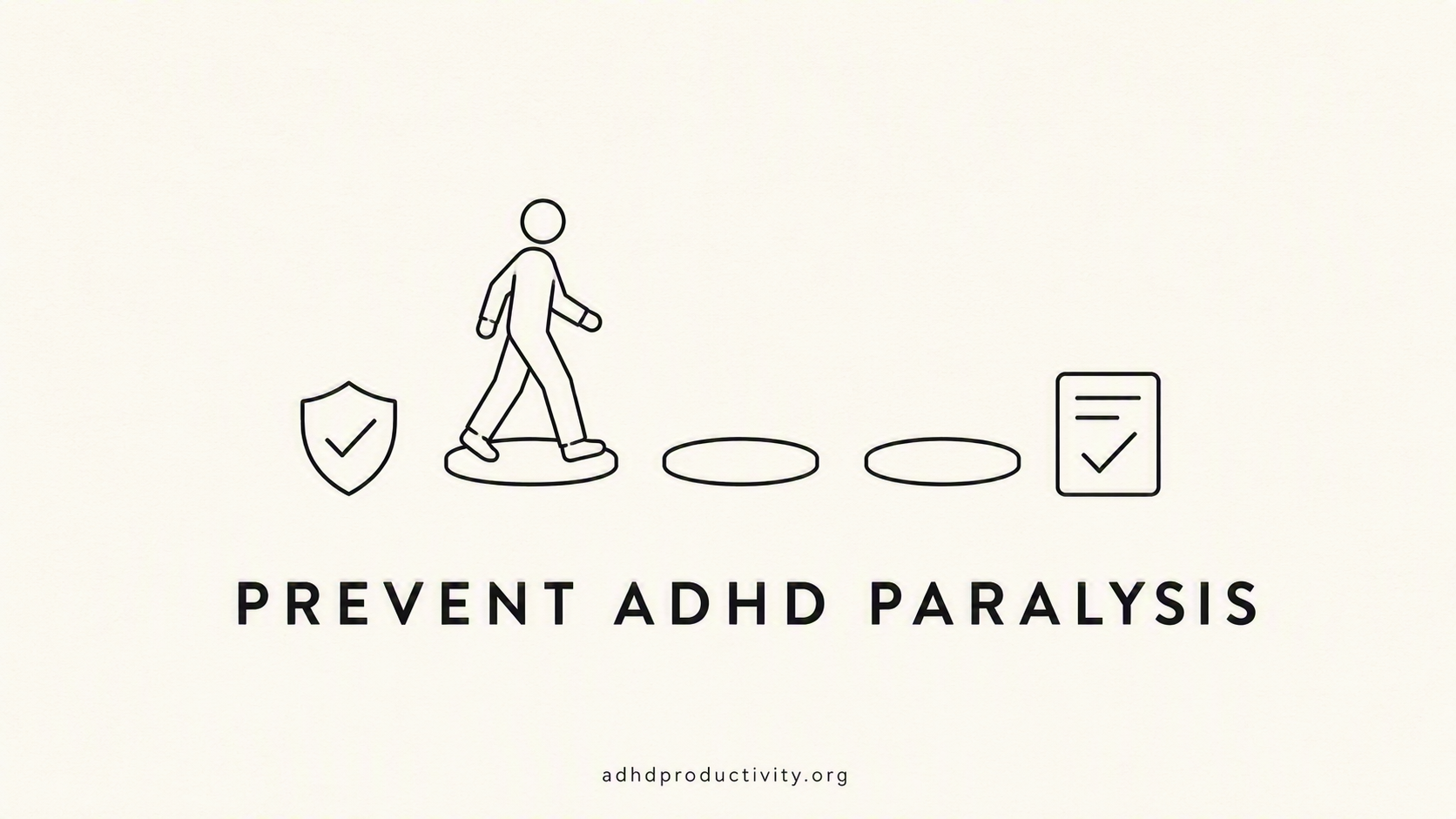
Stop storing intentions in your head
This is the highest-leverage habit on the list. A review in Psychonomic Bulletin & Review on intention offloading found participants relying on internal memory forgot intentions about 45% of the time, versus roughly 5% when using external reminders, nearly an order of magnitude better.
Every commitment living in your head is consuming working memory you need for the task in front of you. Get them out:
- One capture location, not four. Notes app, paper, voice memo, whatever. Pick one
- Capture in under five seconds or you won't do it
- Review the pile once a day, at a fixed time
Which system matters much less than whether you actually use it. I compared a bunch in the best ADHD task management apps, and the conclusion was that consistency beats features every time.
Write if-then plans instead of to-do items
Implementation intentions are the "if X happens, I will do Y" format. Gollwitzer and Sheeran's meta-analysis of 94 studies found a medium-to-large effect on goal attainment (d = .65), which is a genuinely large finding for something this simple.
The reformat:
- ❌ "Work on the proposal"
- ✅ "If it's 9am and I've made coffee, I open the proposal doc and write the first heading"
You're pre-loading the decision so the frozen version of you doesn't have to make it. Anchor to something that already reliably happens: after coffee, after the standup, when you sit down after lunch.
Build a handful of these into your week rather than your day. How to plan a week with ADHD walks through the setup.
Pre-decide the recurring stuff
Every decision you make once and reuse is a decision that can't paralyze you later.
- A default lunch, three or four rotating
- A default first task of the morning
- A default answer to low-stakes requests (mine is "let me check and get back to you tomorrow")
- A default work uniform, if you can get away with it
This sounds joyless written down. In practice it frees up the decision-making for things you actually care about.
Keep the visible list under five items
A 40-item list is a choice paralysis generator. Keep today's list to three to five things, and put everything else somewhere you can't see it. The full list still exists. It just isn't in your face while you're trying to start.
If time estimation is part of your problem, and for most of us it is, ADHD time blindness covers why our sense of how long things take is so unreliable, and what to do about it.
Protect your first working hour
Whatever your best cognitive window is, spend it on the thing most likely to paralyze you. Not email. Email is where good hours go to die, though AI for email with ADHD has some useful workarounds if your inbox is the thing freezing you.
What if none of this works?
- Lower the bar and bank something. If the real task is dead, do a small adjacent one. Sending one email when you'd planned eight is not failure. It's Tuesday.
- Check the basics. Sleep, food, and whether you've taken your medication if you're prescribed some. A shocking percentage of my worst paralysis days trace back to skipping lunch.
- Ask whether the task is wrong. Sometimes the freeze is information. You don't want the job, you shouldn't take the project, the deadline isn't real. Not always. But sometimes.
- Consider that it might be workload. If you're frozen on everything, your load may simply be too high. ADHD accommodations at work covers what's reasonable to ask for.
- Get help if it's persistent. ADHD coaching and CBT-based approaches both have reasonable support for adult ADHD. Long-running paralysis is worth raising with a clinician rather than white-knuckling.
I still get stuck. Regularly. Anyone selling you total freedom from this is selling something, and be aware of that
Your action steps for ADHD paralysis
If you're frozen right now:
- Change rooms and close your tabs
- Cut the task until the first step takes under 60 seconds
- Set a ten-minute timer and mean it
- If it's a choice, reduce to two options and flip a coin
- If still stuck, walk for ten minutes
This week:
- Pick one capture location and use it for everything
- Write three if-then plans for your most-avoided tasks
- Cut today's visible list to five items
- Pre-decide one recurring daily choice
Frequently asked questions
Is ADHD paralysis a real diagnosis?
No. It's a community term for a real experience. But the underlying mechanisms (working memory limits, delay aversion, emotion dysregulation) are all well documented in ADHD research.
How long does an episode usually last?
It varies enormously. Minutes to full days. Episodes that resolve when the task shrinks or a deadline arrives are typical paralysis. If you're frozen on everything for multiple weeks, including things you usually enjoy, that pattern looks more like burnout or depression and deserves a clinician's input.
Why can I hyperfocus for six hours but not start a ten-minute task?
Because ADHD affects the regulation of attention, not the amount of it. Hyperfocus happens when a task provides immediate, continuous feedback, the exact opposite of the delayed, abstract payoff that triggers paralysis. Same brain, different reward structure.
Does medication fix ADHD paralysis?
Medication helps many people with the underlying executive function difficulties, which can reduce how often paralysis hits. It doesn't remove the need for external structure. Most people I know who do well use both. That's a conversation for your prescriber, not a blog.
What's the single fastest thing to try?
Shrink the first step until it takes under 60 seconds, then do only that. It bypasses the working memory demand and the delay-aversion problem at the same time.
Is ADHD paralysis the same as procrastination?
Related but not identical. Procrastination usually involves choosing something more enjoyable instead. Paralysis often involves doing nothing at all. Sitting there, aware of the task, unable to move toward it or away from it. Reorganizing a desk drawer for ninety minutes sits somewhere in between, and I'd know.
Sources:
- ADHD and working memory in adults: a meta-analytic review, Neuropsychology
- Marx et al., ADHD and the Choice of Small Immediate Over Larger Delayed Rewards, J. Attention Disorders
- Soler-Gutiérrez et al., Emotion dysregulation as a core symptom of adult ADHD, PLoS One
- Oroian et al., ADHD and Decision Paralysis, European Psychiatry
- Gilbert et al., Outsourcing Memory to External Tools, Psychonomic Bulletin & Review
- Gollwitzer & Sheeran, Implementation Intentions and Goal Achievement (NCI)
- Yang et al., Physical activity and inhibitory control in adult ADHD, J. Global Health
- NIMH — ADHD
- Evertune — Google's March 2026 Core Update content guide
- Enrich Labs — GEO Complete 2026 Guide