ADHD Brain Dump: How to do it properly

My first brain dump was a single sheet of printer paper with 61 items on it. "Call the landloard" sat right under "figure out what I want from life." I felt great. Then I lost the paper.

That's the problem with most brain dump advice. It tells you to write everything down and stops there, like the writing is the cure. It isn't. The writing is step one of three, and the other two are where people with ADHD get their actual relief.
This guide covers the version that works for me: how to do the dump, what to do with the mess afterward, a copy-paste template, and an honest comparison of the apps worth using for it.
Quick answer: what is an ADHD brain dump?
The dump gets things out of unreliable working memory. The processing step, where you decide when and how each important item happens, is what quiets the mental noise.
A 2011 study in the Journal of Personality and Social Psychology found that a specific plan for an unfinished goal, more than a bare list item, is what stops it from nagging you.
Quick version:
- Set a 10-minute timer and write everything. No sorting.
- Spend 5 minutes sorting into four buckets: do, schedule, park, delete.
- Give the top 1 to 3 items a specific "when and where."
- Keep the dump in one place you'll actually open again.
Why does your ADHD brain need a dump at all?
Because your and my head is a terrible filing cabinet, and we already know this.
The National Institute of Mental Health lists "trouble remembering daily tasks," "frequently losing things or being forgetful in activities," and "poor time management, planning, or organization" among the ways ADHD shows up in adults. None of that is a character flaw. It's the condition doing what it does.
A meta-analysis by Skodzik, Holling and Pedersen in the Journal of Attention Disorders found that adults with ADHD scored lower on verbal long-term memory tasks, and the authors traced the problem to encoding, the moment information goes in, rather than retrieval.
👉 The thought "I need to renew my passport" may never get properly stored in the first place. So waiting to "remember it later" is a bad bet.
Does writing things down actually calm your brain?
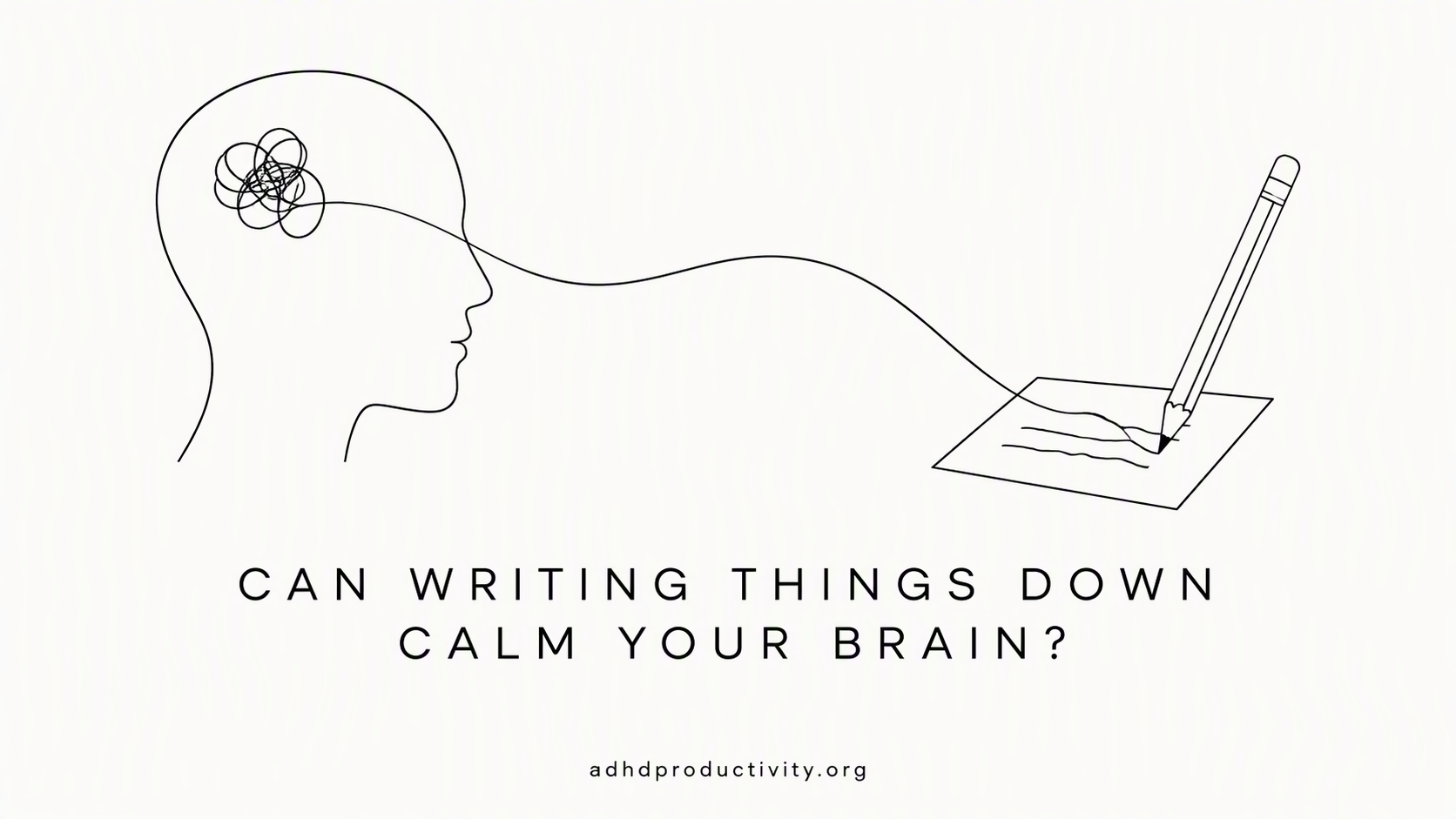
Partly. Two studies are worth knowing:
- Plans beat lists. In a set of experiments published in the Journal of Personality and Social Psychology, Masicampo and Baumeister (2011) found that unfulfilled goals kept intruding on people's thoughts and hurt their performance on other tasks. Letting participants make a specific plan for the goal eliminated those effects.
- Specific to-do lists at bedtime helped people fall asleep. In a sleep-lab study of 57 young adults led by Michael Scullin at Baylor with Emory's Donald Bliwise, people who spent five minutes writing a to-do list before bed fell asleep faster than people who wrote about tasks they'd already finished. The more specific the list, the faster they dropped off.
How do you do an ADHD brain dump? (The 3-step method)
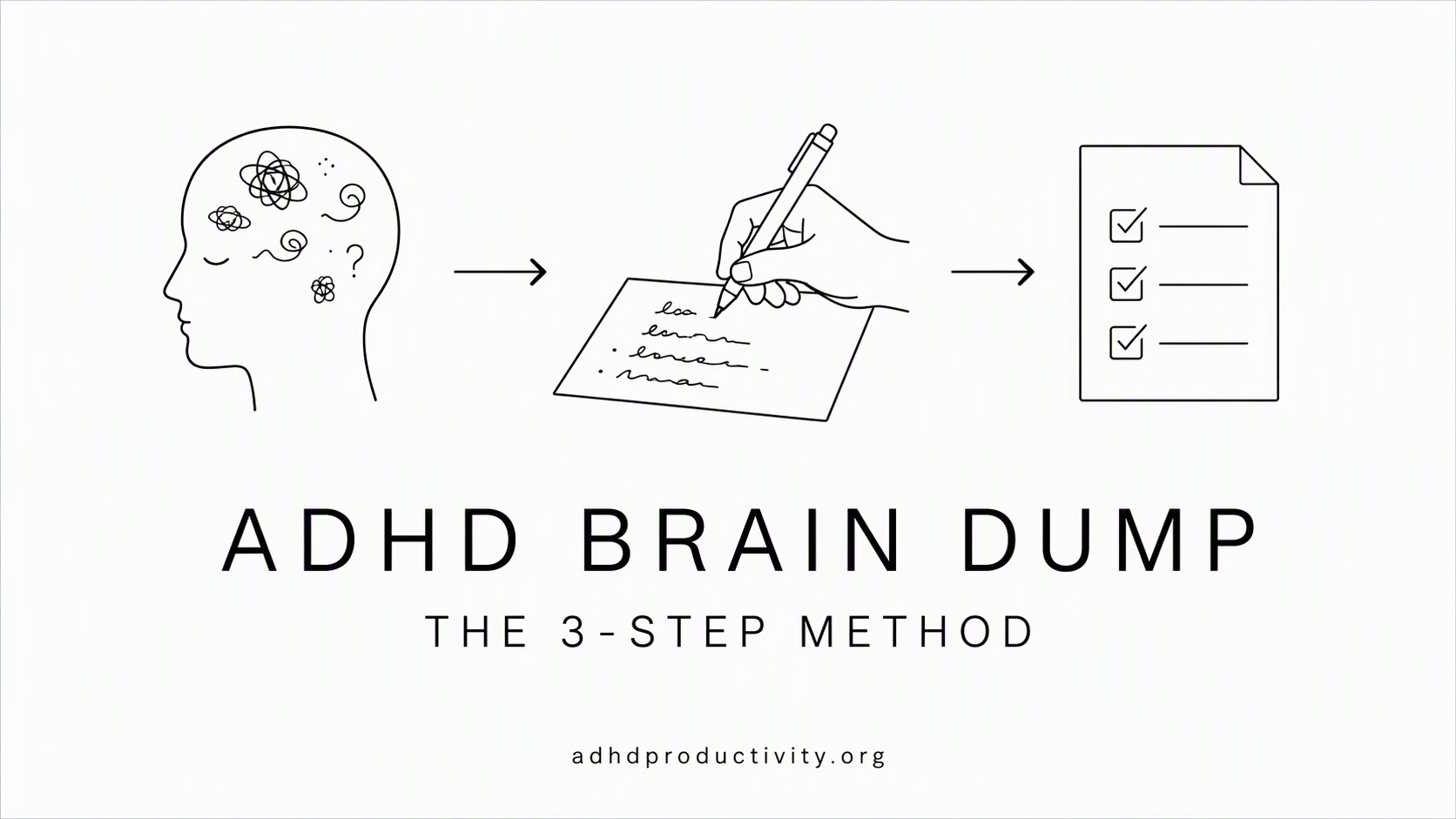
Step 1: Dump (10 minutes, timer on)
Set a timer. Then write everything that's taking up space in your head. Everything.
What counts:
- Tasks, big and small ("reply to Sam," "rebuild the website")
- Errands and admin (the parking ticket, the library book, the insurance form)
- Worries ("is my boss annoyed with me?")
- Ideas you don't want to lose
- Things you're waiting on from other people
- Stuff you keep meaning to look up
Rules for this step:
- No sorting. The moment you start categorizing, your brain switches from capture mode to judging mode, and judging is slow.
- No editing. "Fix the thing with the car" is a perfectly good entry.
- Duplicates are fine. You'll clean them up later.
- Use prompts if you stall. Walk through your day mentally: phone, email, kitchen, car, work desk, family, money, health appointments, home repairs. Each place shakes something loose.
If typing is the bottleneck, talk. I do most of my dumps out loud now while walking around the kitchen

>> My guide to voice-to-text tools for ADHD compares the options if you want to go that route.
Step 2: Sort into four buckets (5 minutes)
Now you get to judge. Go down the list and tag every line with one of four labels:
| Bucket | What goes here | What you do with it |
|---|---|---|
| Do | Under 10 minutes, and it matters this week | Pick 1 to 3 for today |
| Schedule | Matters, but takes real time or has a date | Give it a day and time |
| Park | Ideas, someday stuff, "would be nice" | Move to a parking list you review weekly |
| Delete | No longer true, not yours, or you were never going to do it | Cross it out. Enjoy that. |
Two tips from getting this wrong a lot:
- Worries go in Schedule or Delete, not Do. "Is my boss annoyed?" becomes "Ask Priya in Thursday's 1:1 how the launch felt" or it gets crossed out. A worry with no action attached just sits there humming.
- Be ruthless with Delete. On a typical dump, roughly a third of my list ends up deleted or parked. That's normal, and it's the part that makes the list feel survivable.
>> If you freeze on deciding what goes first, our post on how to prioritize tasks with ADHD has a few quick ranking methods that don't need a spreadsheet.
Step 3: Plan the top items (5 minutes)
This is the step the research actually backs, and the one almost everyone skips.
For your top 1 to 3 items, write a sentence with a when, a where and a first physical action:
- Vague: "Taxes."
- Specific: "Tuesday 7pm at the kitchen table, open the tax folder and find last year's return."
That second version is much easier to start, because the first action is already decided. If the first action still feels too big, break it down further.
A tool like Saner.AI can do that for you in seconds. You can check my guide to using AI to break down tasks.
Then put the scheduled items on your actual calendar. If you like the idea of giving everything a slot, ADHD time blocking is the natural next step.
ADHD brain dump template
Paste this into a note, a doc, or print it. Fill the top half fast, the bottom half slow.
BRAIN DUMP: [date]
Timer: 10 min

DUMP (no sorting, no editing):
-
-
-
(keep going)

---------------------------------
SORT (tag each line: D / S / P / X)
D = Do (under 10 min, this week)
S = Schedule (needs a day + time)
P = Park (someday / ideas)
X = Delete

---------------------------------
TOP 3 PLANS
1. What: ________  When: ________  Where: ________
   First action: ________
2. What: ________  When: ________  Where: ________
   First action: ________
3. What: ________  When: ________  Where: ________
   First action: ________

PARKING LIST (review on: ________)
-
When should you do a brain dump?

Pick the moments when your head is fullest. For most people with ADHD that's one of these:
- Before bed, if your brain starts a to-do slideshow the second the light goes off. Keep it short and specific, per the Scullin study. Our ADHD and sleep guide has more on wind-down routines.
- Monday morning or Sunday evening, as the first step of a weekly plan. Our how to plan a week with ADHD walkthrough uses a 7-minute dump as step one.
- When you're frozen. If you've been staring at your screen for 40 minutes, a dump can show you that the problem is 14 small things, not one impossible thing. If you're fully stuck, start with our guide to ADHD paralysis.
- Mid-day reset, after a meeting-heavy morning dumps 20 new obligations on you.
How often? I do a big one weekly and tiny two-minute ones whenever my head feels loud.
What are the best brain dump apps for ADHD?
Paper is a legitimate answer. But apps solve the two places dumps fail: capture speed (you can talk instead of type) and the "where did I put it" problem. Here's how the main options compare for brain dumping specifically.
| App | Best for | Voice capture | Sorts the dump for you? | Price (check current) |
|---|---|---|---|---|
| Paper + pen | Zero setup, zero distraction | No | No | Basically free |
| Apple Notes / Google Keep | Quick capture you already have installed | Yes, via phone dictation | No | Free |
| Goblin Tools (Compiler) | Turning a messy paragraph into a list | Via device dictation | Yes, into a task list | Free web; small fee for mobile/Pro |
| Todoist (Ramble) | People who already live in Todoist | Yes, built in | Turns speech into tasks with dates | Free plan with limited Ramble sessions; Pro for unlimited |
| TickTick | Dump-then-schedule in one app with a calendar | Via device dictation | No (manual sorting) | Free plan; Premium paid yearly |
| Saner.AI | Mixed dumps of tasks, notes and ideas that need filing | Yes | Yes, extracts tasks and organizes notes | Free plan; paid from $8/month |
Paper, Apple Notes or Google Keep
Start here if you've never done a brain dump. No setup means no excuse. The weakness is the processing step: nothing reminds you the dump exists, and a note called "stuff" from March is where good intentions go to retire.
Saner.AI
I use Saner.AI for my messier dumps, the ones where tasks, half-ideas and "remember that Jo's birthday is the 14th" all come out in one breath. You can talk or type, and it pulls out the tasks and files the notes, so the processing step starts half-done. That's the part I care about, because sorting is exactly where my dumps used to die.
My best AI task manager for ADHD review goes deeper.
Goblin Tools
Goblin Tools' Compiler takes a messy wall of text and turns it into a tidy task list. Its Magic ToDo can then break any single item into smaller steps. The free web version needs no account, which is great for a one-off dump, but anything you don't save is gone when you close the tab.
I cover it in depth in our Goblin Tools review.
Todoist with Ramble
Todoist's Ramble feature lets you speak a stream of tasks and turns them into separate to-dos, pulling out dates as you talk. If Todoist is already your task app, this is a very good brain dump setup. The free plan includes limited Ramble sessions; Pro gives unlimited. If Todoist itself has never stuck for you, our Todoist alternatives for ADHD roundup covers what else is out there
TickTick
TickTick is strong for step 3, because the list and the calendar sit in the same app, so moving a "Schedule" item to Tuesday 7pm is a drag. It won't sort the dump for you, though. You do the four-bucket pass yourself.
How to pick these
- You've never done a dump: paper or Apple Notes.
- You hate sorting: Goblin Tools Compiler (free) or Saner.AI.
- You want the dump and the calendar together: TickTick.
The best app is the one you'll open next week.
Common brain dump mistakes (and quick fixes)

- Dumping and never processing. Fix: never end a session without the Top 3 Plans box filled in, even if it's just one plan.
- Dumps scattered everywhere. Three notebooks, two apps and the back of a receipt. Fix: one home for dumps. Just one.
- Turning the dump into a reorganize-my-whole-life project. Fix: the timer. When it rings, you stop, mid-sentence if needed.
- Treating every item as a task. Worries and ideas aren't tasks. Fix: the Park and Delete buckets exist for a reason.
- Expecting the dump to make you start. It clears the fog; it doesn't push you off the couch. For that, see our guide to ADHD task initiation.
- Building a whole system before doing one dump. If you want a full system later, our Getting Things Done for ADHD guide shows a trimmed-down version. For today, one dump is enough.
Frequently asked questions
What is the difference between a brain dump and a to-do list?
A to-do list is already filtered: it holds things you've decided to do. A brain dump is unfiltered. It includes worries, ideas, and stuff you'll end up deleting. The dump comes first, and a short to-do list is one of the things it produces.
How long should an ADHD brain dump take?
Around 10 minutes for the dump and 10 more for sorting and planning. Shorter is fine. A two-minute dump before bed counts. Use a timer so it doesn't sprawl into an afternoon.
Is a brain dump good for ADHD anxiety?
Getting worries onto paper can make them feel more manageable, and research on plan-making suggests that deciding a concrete next step for an unfinished goal reduces how much it intrudes on your thoughts. That said, a brain dump is a productivity habit, not a treatment. If anxiety is persistent or heavy, talk to a doctor or therapist.
Should I brain dump on paper or in an app?
Paper is faster to start and has no notifications. Apps are better for voice capture, searching later, and turning items into scheduled tasks. Many people dump on paper and process in an app. Pick whichever you'll still be using in a month.
What is the best free brain dump app for ADHD?
For pure capture, the notes app already on your phone. For turning a messy dump into a clean list, Saner.AI. Goblin, Todoist and TickTick are ok too
How often should I do a brain dump?
A full dump once a week works well for most people, plus quick mini-dumps whenever your head feels crowded. Daily full dumps tend to become a chore and get abandoned.
Do brain dumps actually work, or is it just a TikTok trend?
The core idea has decent support: specific plans for unfinished goals reduce mental intrusion (Masicampo and Baumeister, 2011), and writing a specific to-do list before bed helped people fall asleep faster (Scullin et al., 2018). The popular claim that it works because of the Zeigarnik effect is weaker; a 2025 meta-analysis didn't find a general memory advantage for unfinished tasks.
Conclusion
Don't buy an app first. Don't print a fancy planner. Do this:
- Set a 10-minute timer right now.
- Write or say everything in your head. No sorting.
- Tag each line: Do, Schedule, Park, Delete.
- Write one specific plan: what, when, where, first action.
- Put the dump somewhere you'll see it again on Sunday.
That's it. Twenty minutes, and your head gets a little quieter.
This article is for general information and isn't medical advice. See my medical disclaimer.
Sources
- National Institute of Mental Health. Attention-Deficit/Hyperactivity Disorder in Adults: What You Need to Know.
- Skodzik, T., Holling, H., & Pedersen, A. Long-Term Memory Performance in Adult ADHD: A Meta-Analysis. Journal of Attention Disorders.
- Ghibellini, R., & Meier, B. (2025). Interruption, recall and resumption: a meta-analysis of the Zeigarnik and Ovsiankina effects. Humanities and Social Sciences Communications.
- Masicampo, E. J., & Baumeister, R. F. (2011). Consider it done! Plan making can eliminate the cognitive effects of unfulfilled goals. Journal of Personality and Social Psychology, 101(4), 667–683.
- Scullin, M. K., Krueger, M. L., Ballard, H. K., Pruett, N., & Bliwise, D. L. (2018). The effects of bedtime writing on difficulty falling asleep: A polysomnographic study comparing to-do lists and completed activity lists. Journal of Experimental Psychology: General.