Getting Things Done for ADHD: How I customize it for my brain

💡Quick answer: GTD’s core loop, capture everything, decide the next physical action, review often, is sound and backed by real cognitive science. What breaks it for ADHD brains is the scaffolding David Allen built around that loop: multiple context lists, a pristine reference filing system, and a weekly review that assumes you’ll remember to sit down and do it. Keep the loop. Cut almost everything else. Rebuild the rest around external, not internal, structure.
I read Getting Things Done for the first time nine years ago, in a Sunday, and by Tuesday I had built the most beautiful system of nested folders and context tags you’ve ever seen. By Thursday I had abandoned it completely and was back to sticky notes stuck to my monitor like a ransom note made of chores.
That’s an ADHD problem wearing a GTD costume. And once I figured out which parts of the method were fighting my brain instead of helping it, the system finally stuck. Here’s the breakdown.
What GTD actually asks of you
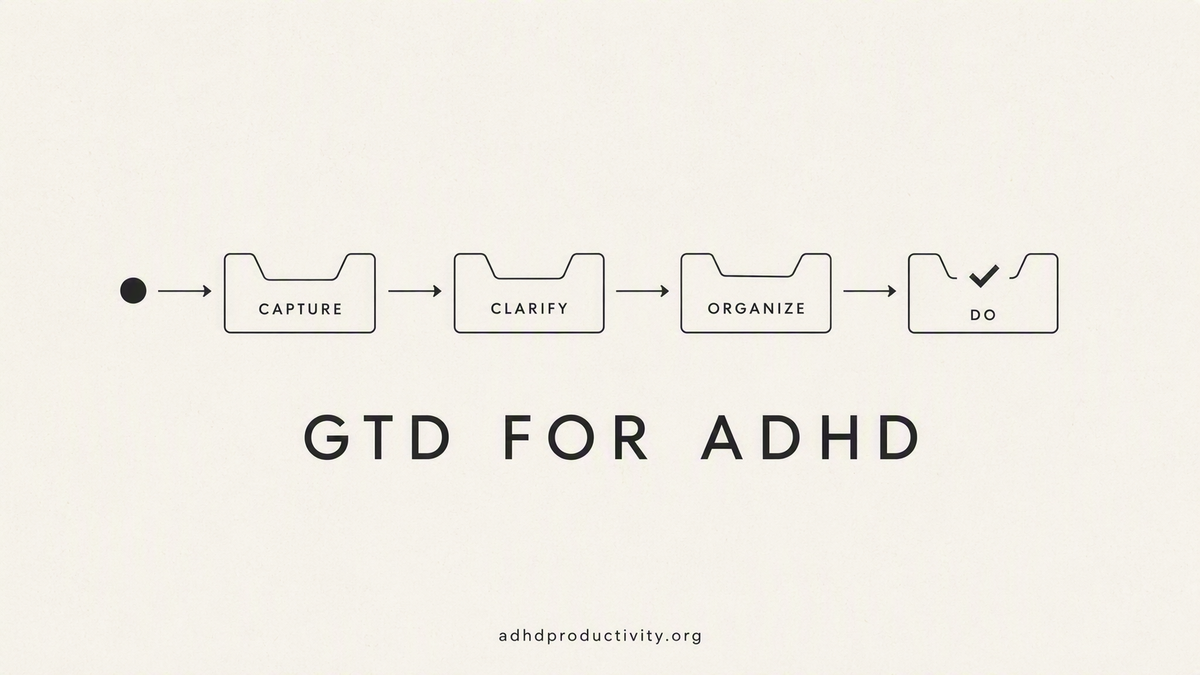
Five moves: capture everything that has your attention, clarify what each thing actually requires, organize it into lists, reflect on those lists regularly, and engage by choosing what to do next. It’s a good model. The failure point for ADHD is that GTD was written for a brain that reliably remembers to check its lists, sustains a filing habit over months, and doesn’t need external pressure to sit down and review.
Ours doesn’t work that way, and there’s a reason why.
Why the standard version breaks
Working memory, the mental workspace that holds information active while you use it, is one of the most consistently measured deficits in ADHD. A 2013 meta-analysis in Neuropsychology pooling 38 studies found large, reliable working-memory impairments in adults with ADHD across both verbal and spatial tasks (Alderson et al., 2013). That’s the mechanism behind the GTD failure. A system with six context lists, a tickler file, and a weekly two-hour review requires you to hold and juggle more open threads than your working memory is built to carry, and it collapses under its own architecture before it ever gets a chance to help you.
So the fix is redesign.
What to keep in GTD for ADHD
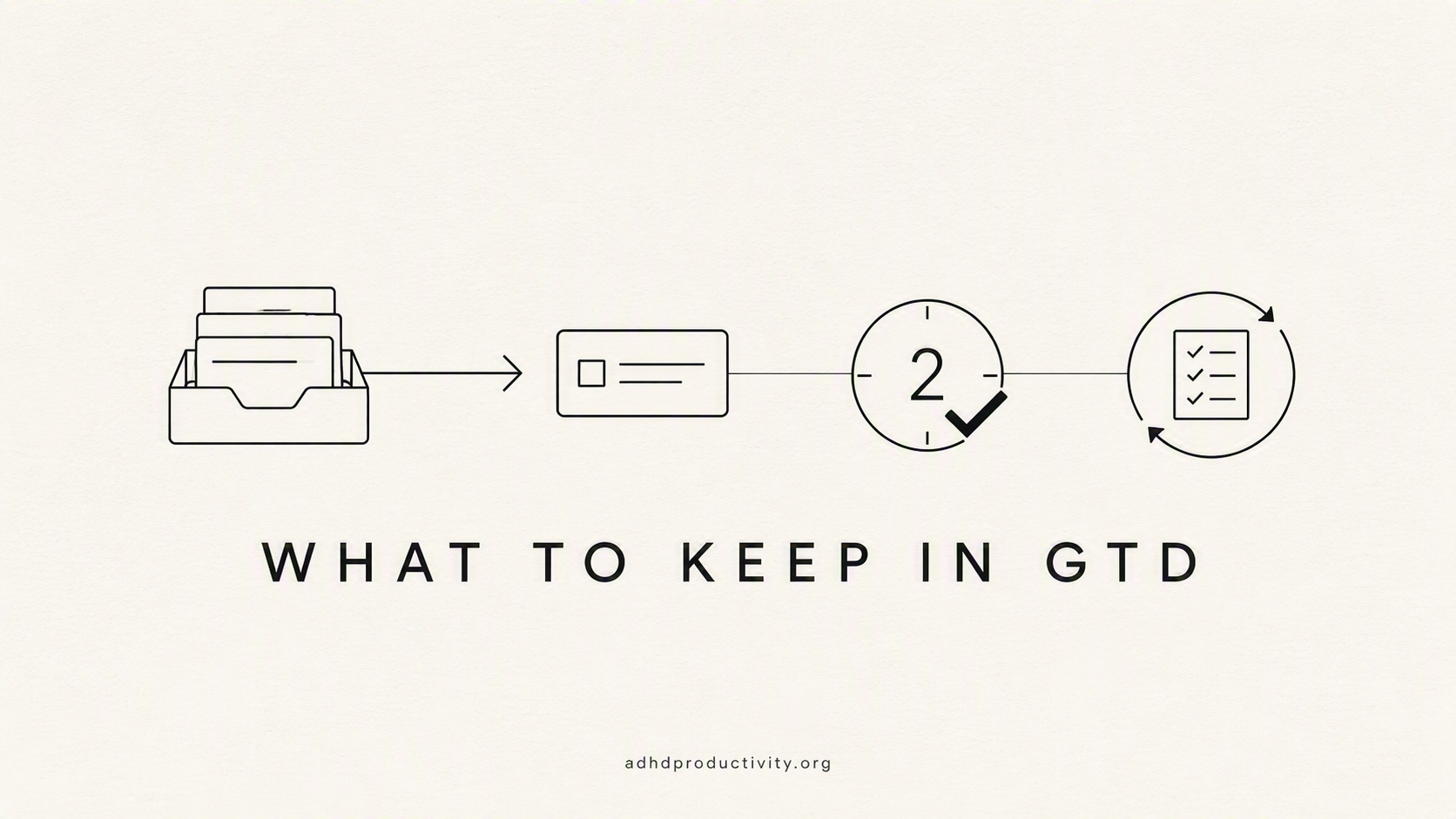
Capture everything, immediately, in one place. This is the single highest-value habit in the whole method, and it has direct experimental backing. In a series of studies published in the Journal of Personality and Social Psychology, unfinished goals caused measurable intrusive thoughts and worse performance on unrelated tasks, and simply writing a specific plan for the unfinished item eliminated the effect almost as well as finishing it did (Masicampo & Baumeister, 2011). Your brain doesn’t need the task done. It needs proof the task won’t be forgotten. One inbox does that job.
If writing things down is the bottleneck, not the discipline, voice capture removes a step your brain is bad at instead of asking you to get better at it.
Next-action thinking. GTD’s insistence that every item on your list be a physical, startable action (“email Sarah the invoice,” not “handle Sarah”) isn’t a nice-to-have. Breaking a task down to its next concrete step is a documented component of the cognitive behavioral protocol that beat an active control condition in a randomized trial of adults with ADHD, on top of medication (Safren et al., 2010, JAMA). Vague tasks are where task initiation goes to die.
The two-minute rule. If something takes less than two minutes, do it now. Keep this, but for a different reason than Allen gives. Every time you defer a two-minute task, you pay it back later as a full context switch, and switching tasks carries a measurable cost in both speed and error rate that doesn’t fully go away even when you see the switch coming (Monsell, 2003, Trends in Cognitive Sciences). Doing the small thing now is cheaper than doing it later. Every time.
Some form of periodic review.
What to cut in GTD for ADHD
Context lists. @calls, @errands, @computer, @home, @waiting-for. This is the part of GTD that turns a to-do list into a filing exam. Every context switch between lists is another decision, and ADHD brains already spend more of their limited executive function on switching than a neurotypical brain does. One list. Maybe two if you genuinely split home and work life. That’s the ceiling.
The Someday/Maybe list, unmodified. In theory it’s a place for ideas you’re not ready to act on. In practice it becomes a 300-item guilt archive you never open, which quietly confirms the thing ADHD already whispers at you: that you don’t finish things. Either put a hard cap on it (20 items, no more, something falls off when something new goes on) or delete it and trust that ideas worth having will come back.
The pristine reference filing system. Allen’s original system assumes years of consistent folder discipline. If you have ADHD, you already know how that goes: perfect for eleven days, then a pile. Use search instead of filing. A tool that tags and files things automatically does the job. I use Saner.ai for this cause it auto-tags captured notes and tasks instead of asking you to build and maintain folders, which is the maintenance step that kills most GTD setups for ADHD users.
The 60-to-90-minute weekly review, done all at once. This is the biggest reason GTD dies for ADHD users around week three. It asks you to reliably schedule and sustain attention through a long, low-stimulation administrative task, which is close to a textbook description of what ADHD makes hard. Replace it with something smaller you’ll actually do. More on that next.
Trusting a list you never look at. A perfect system nobody opens is not a system. If time blindness means you don’t naturally think to check your list, the fix isn’t more discipline. It’s putting the list somewhere it interrupts you, not somewhere it waits patiently to be ignored.
The ADHD-modified GTD system, step by step
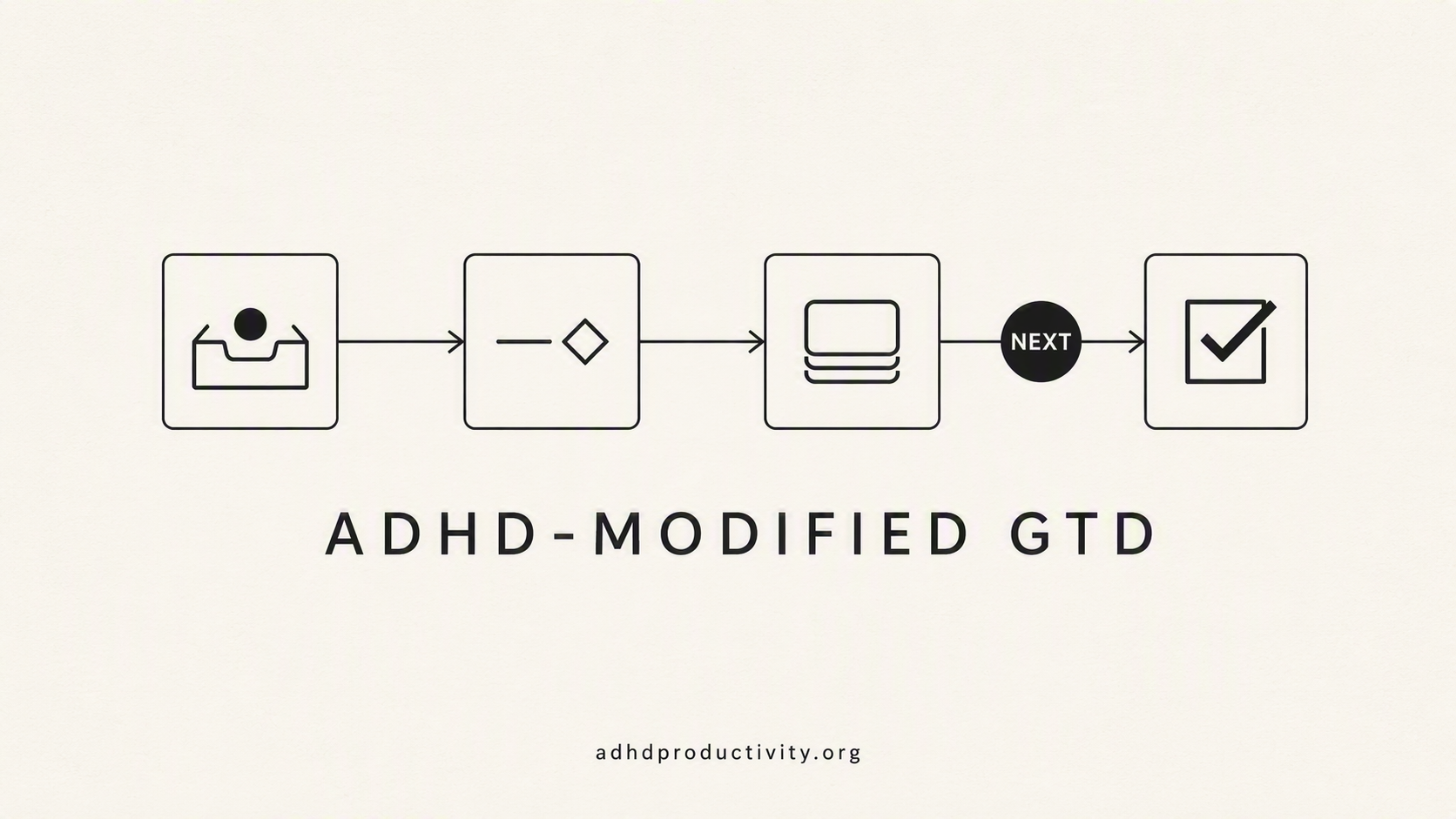
Here’s what I actually run, and what I’d suggest you build toward instead of the textbook version.
- One inbox. Paper, an app, or voice memos, doesn’t matter which, as long as it’s the only place things land. Two inboxes means neither one is trustworthy.
- Process daily, ten minutes, same time. Not weekly. Weekly is where the ritual goes to die. Attach it to something you already do, right after coffee, right before you close your laptop, so it rides on an existing habit instead of needing its own.
- Three lists, maximum. Today, This Week, Someday (capped at 20). That’s the whole system. Resist the urge to add a fourth. You will feel the urge. Resist it anyway.
- Every item gets a next physical action, not a project name. “Plan birthday party” sits on a list forever. “Text Maya the restaurant options” gets done on a Tuesday.
- Pick your next task by energy, not by priority. Standard GTD assumes stable energy through the day. It isn’t. If your brain has fuel for a hard task, do the hard one now, whatever the theoretical priority order says. Planning a week around actual energy beats planning it around a priority column that ignores whether you can currently function.
- If you’re stuck on processing your inbox, don’t push through alone. Body doubling, working alongside someone else even if they’re doing something unrelated, is one of the more reliable ways to get through exactly this kind of low-stimulation admin task.
- Automate the filing you know you won’t maintain. Whatever tool you use, pick one that tags for you rather than one that trusts you to build a taxonomy. You already know which of those two you are.
Common ways this still goes wrong
- You skip the daily ten minutes for three days, then try to do a 45-minute catch-up session that feels exactly like the weekly review you just cut. If you miss a day, the fix is doing tomorrow’s ten minutes, not doubling up.
- You use the Someday list as a place to hide fear instead of ideas. If something’s been sitting there for two months and you flinch every time you see it, that’s not a someday task. That’s a decision you’re avoiding making.
- You treat this like a personality fix instead of a systems fix. It isn’t one. Executive dysfunction is a measurable thing, not a character flaw, and the whole point of this rebuild is putting structure outside your head where it doesn’t depend on willpower you may not have that day.
FAQ
Does GTD actually work for ADHD, or should I skip it entirely? The core loop works. Capture, clarify into a next action, review often, engage. What fails is the unmodified scaffolding: multiple context lists, a heavy filing system, and an infrequent, long review session. Strip those out and the rest holds up.
How is this different from just using a regular to-do list app? Most to-do apps let you build the exact context-list sprawl that sinks GTD for ADHD brains. The fix here isn’t the app. It’s the constraint: one inbox, three lists, a daily ten-minute touch instead of a weekly hour.
What if I miss my daily review? Do tomorrow’s ten minutes. Don’t try to make up for the missed one. A GTD system that requires a perfect streak isn’t a GTD system, it’s a diet, and it’ll fail the same way.
Is the Someday list worth keeping at all? Yes, capped. An uncapped Someday list becomes an archive of things you feel guilty about. A capped one stays a genuine holding pen for ideas you’re not ready for yet.
Do I need a fancy app to make this work? No. Paper works fine for capture and next actions. Where a tool actually earns its keep is filing and search, since that’s the maintenance step ADHD brains drop first.
I’m not a doctor and this isn’t medical advice. It’s what’s worked for me and for the clients I coach, built around research on ADHD and executive function. If you’re dealing with a diagnosis or medication questions, that’s a conversation for a clinician. See the medical disclaimer for the full version, and the ADHD productivity glossary if any of the terms above are new to you.
Sources
- Alderson, R. M., Kasper, L. J., Hudec, K. L., & Patros, C. H. G. (2013). Attention-deficit/hyperactivity disorder (ADHD) and working memory in adults: A meta-analytic review. Neuropsychology, 27(3), 287–302. PubMed
- Masicampo, E. J., & Baumeister, R. F. (2011). Consider it done! Plan making can eliminate the cognitive effects of unfulfilled goals. Journal of Personality and Social Psychology, 101(4), 667–683. DOI
- Safren, S. A., Sprich, S., Mimiaga, M. J., Surman, C., Knouse, L., Groves, M., & Otto, M. W. (2010). Cognitive behavioral therapy vs relaxation with educational support for medication-treated adults with ADHD and persistent symptoms: A randomized controlled trial. JAMA, 304(8), 875–880. PubMed
- Monsell, S. (2003). Task switching. Trends in Cognitive Sciences, 7(3), 134–140. Cell Press