ADHD Waiting Mode: and How to Get Back your day

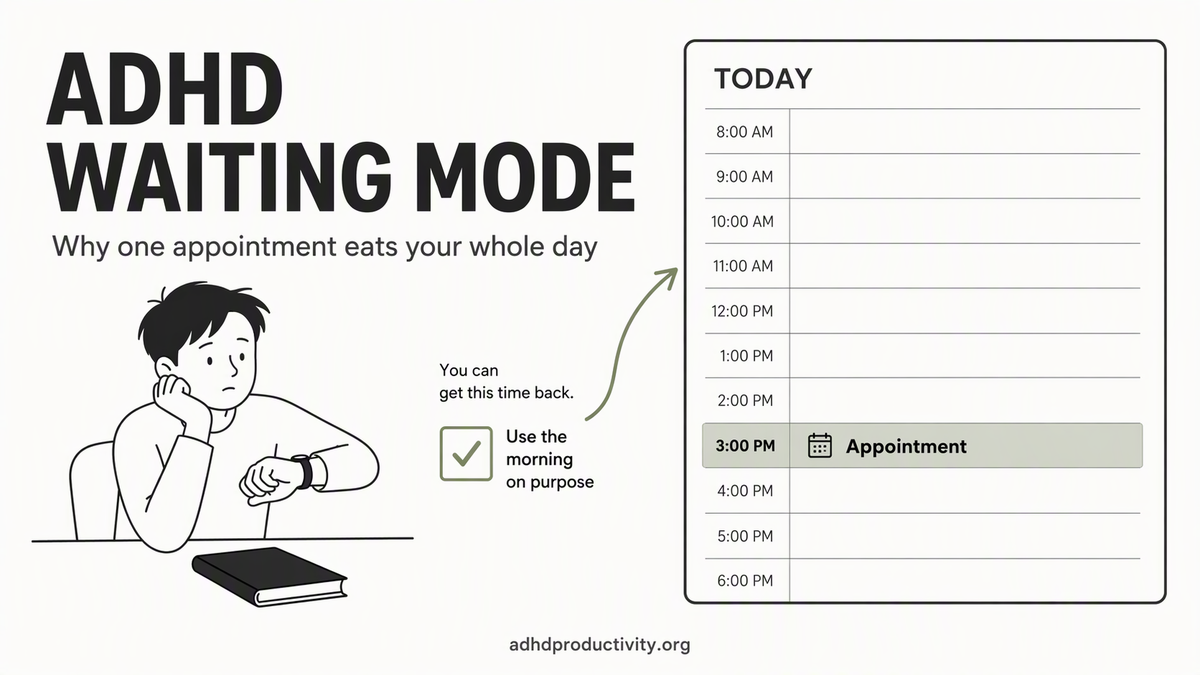
I had an insurent appointment at 3:40 on a Tuesday. One appointment. Forty minutes, tops.
I got nothing done that day. Not "less than usual." Nothing. I opened my laptop at 9, looked at a draft, decided there wasn't really enough time to start it properly, checked the clock, made coffee, checked the clock again, and it was 2:15 and I was standing in the kitchen eating crackers over the sink, still "waiting."

If that sounds familiar, you've met waiting mode.
This guide covers what it is, what the research does and doesn't say about it, and a set of fixes you can use tomorrow morning, even if the thing you're waiting for is at 4pm.
What is ADHD waiting mode?
ADHD waiting mode is the state where a single upcoming commitment, like an appointment, a call, or a delivery window, blocks you from doing anything meaningful in the hours before it.
You aren't busy. You're also not resting. You're on hold, checking the clock, unable to start anything because some part of your brain has decided the appointment is the only thing that counts today.
Key points:
- It's a community term, not a diagnosis. I searched and couldn't find a peer-reviewed study that measures "waiting mode" as its own thing.
- The ingredients behind it are well studied in ADHD: trouble judging time, trouble planning around a future intention, and a strong dislike of waiting.
- The fix is to take the appointment out of your head and put its full logistics somewhere external, early in the day.
- Then you give the waiting hours a job with a hard stop you trust.
What does waiting mode feel like?

People describe it in slightly different ways, but the pattern is consistent:
- You have one thing at 2pm and the whole morning feels "used up" already.
- You avoid starting real work because "I'll just get interrupted."
- You check the time far more often than you need to. Every few minutes, sometimes.
- You do low-value filler (scrolling, tidying one drawer, re-reading emails) and feel guilty about it.
- When the appointment finally ends, you're oddly exhausted, even though you did almost nothing.
- Some people get it for whole days around a flight, a party, or a parcel with a "between 8am and 6pm" delivery window. That last one is a special kind of hostage situation.
It also isn't the same as ADHD paralysis, though they overlap. Paralysis usually shows up with too many options or a task that feels huge. Waiting mode can happen on a light day with one small, pleasant thing on the calendar. Lunch with a friend can do it.
Why "just do something until then" doesn't work
Every non-ADHD person in your life has offered this advice lol. It's reasonable advice for their brain.
It fails for us because "something" is undefined.
Undefined tasks are the hardest kind to start, which we cover in detail in ADHD task initiation. And "until then" has no felt end point, because the end point lives in a part of your brain that, per the timing research, is guessing.
It also isn't laziness. If you've ever spent a whole morning trying to start and failing, you already know that.
My breakdown of executive dysfunction vs laziness is worth sending to whoever keeps saying "just do something."
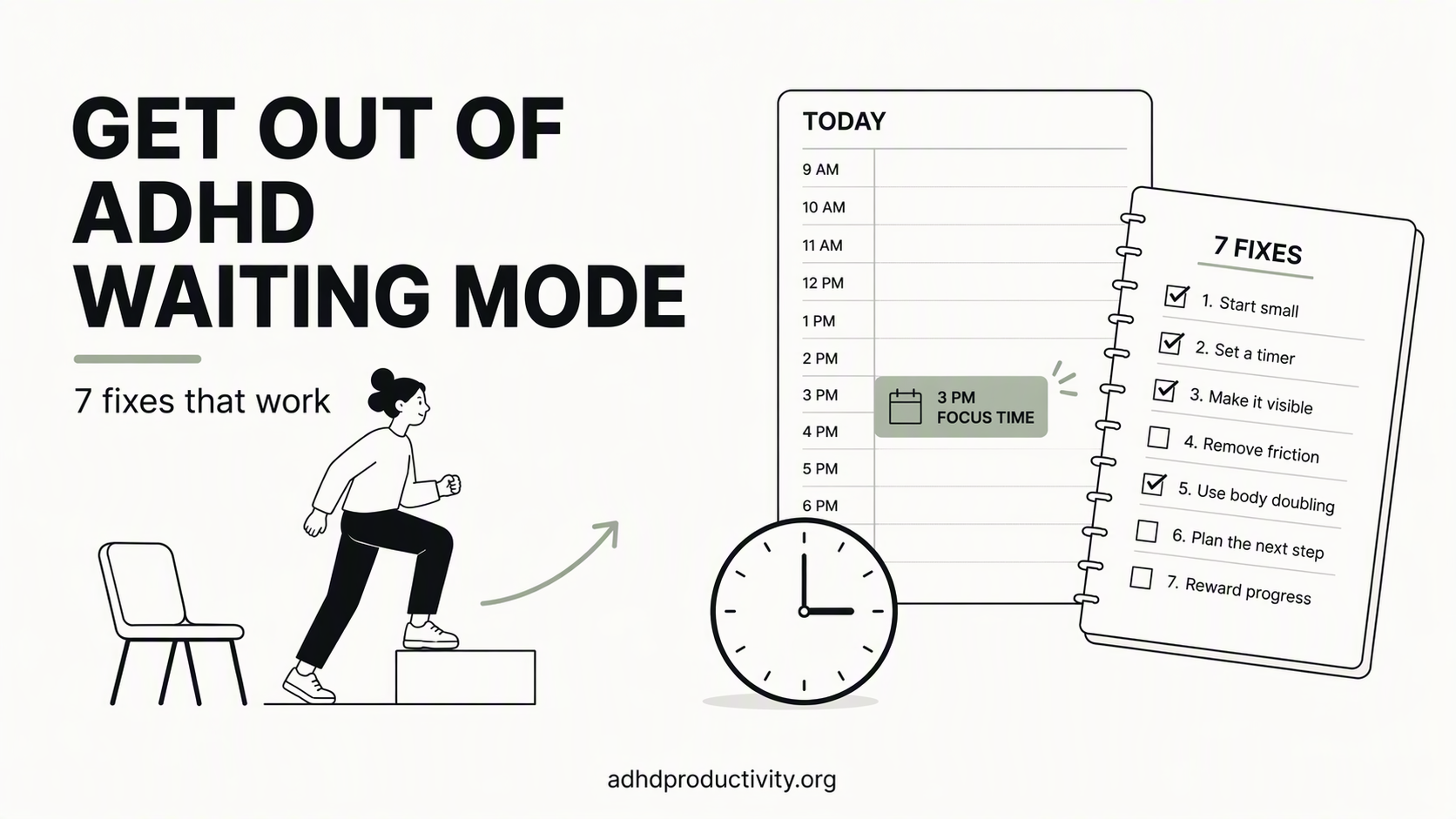
How to get out of ADHD waiting mode: 7 fixes that work
Fix 1: Write the full logistics of the appointment, first thing
Not "dentist 3:40." The whole chain. Five minutes, in the morning:
- Appointment time: 3:40
- Travel time: 20 minutes, plus 10 minutes of buffer because parking is a nightmare
- Leave the house: 3:10
- Stop working: 2:55
- Things to bring: insurance card, phone charger, headphones
- What I'm doing right after: groceries on the way home
This directly targets the planning gap from the Fuermaier study. Once the plan exists outside your head, your brain has less reason to keep rehearsing it. It sounds too simple. It's the one fix I'd keep if I could only keep one.
If writing it out feels like a lot, dump it all into one messy note first. My ADHD brain dump guide shows how to do that without turning it into a project.
Fix 2: Set two alarms, with labels

Clock-watching happens because you don't trust yourself to notice the time. So stop asking yourself to.
- Alarm 1 (the wrap-up alarm): 15 minutes before "stop working." Label: "Finish the sentence you're on. Save. Shoes."
- Alarm 2 (the leave alarm): the actual leave time. Label: "Leave now. Keys, card, headphones."
The label matters. An alarm that just says "Dentist" forces you to reconstruct the plan in a panic. An alarm that tells you the next physical action doesn't.
Once both are set, say it out loud: "The alarms are watching the clock. I'm not." Feels silly. Helps anyway. If you want an app that's better at this than the stock clock, I compared options in best reminder apps for ADHD.
Fix 3: Turn the morning into if-then plans
There's ADHD-specific evidence too. In two studies of children with ADHD, Caterina Gawrilow and Gollwitzer found that if-then plans improved response inhibition on a lab task, up to the level of children without ADHD, and the combination with stimulant medication produced the best performance (Gawrilow & Gollwitzer, 2008).
Waiting-mode versions:
- "If the wrap-up alarm goes off, then I save the file and put my shoes on."
- "If I notice I'm checking the clock, then I look at my alarm list instead and go back to the task."
- "If I finish the task before the alarm, then I start the next item on my short list, not my phone."
Two or three is plenty. Ten if-then plans is just a to-do list wearing a costume.
Fix 4: Give the gap a defined job with a defined size
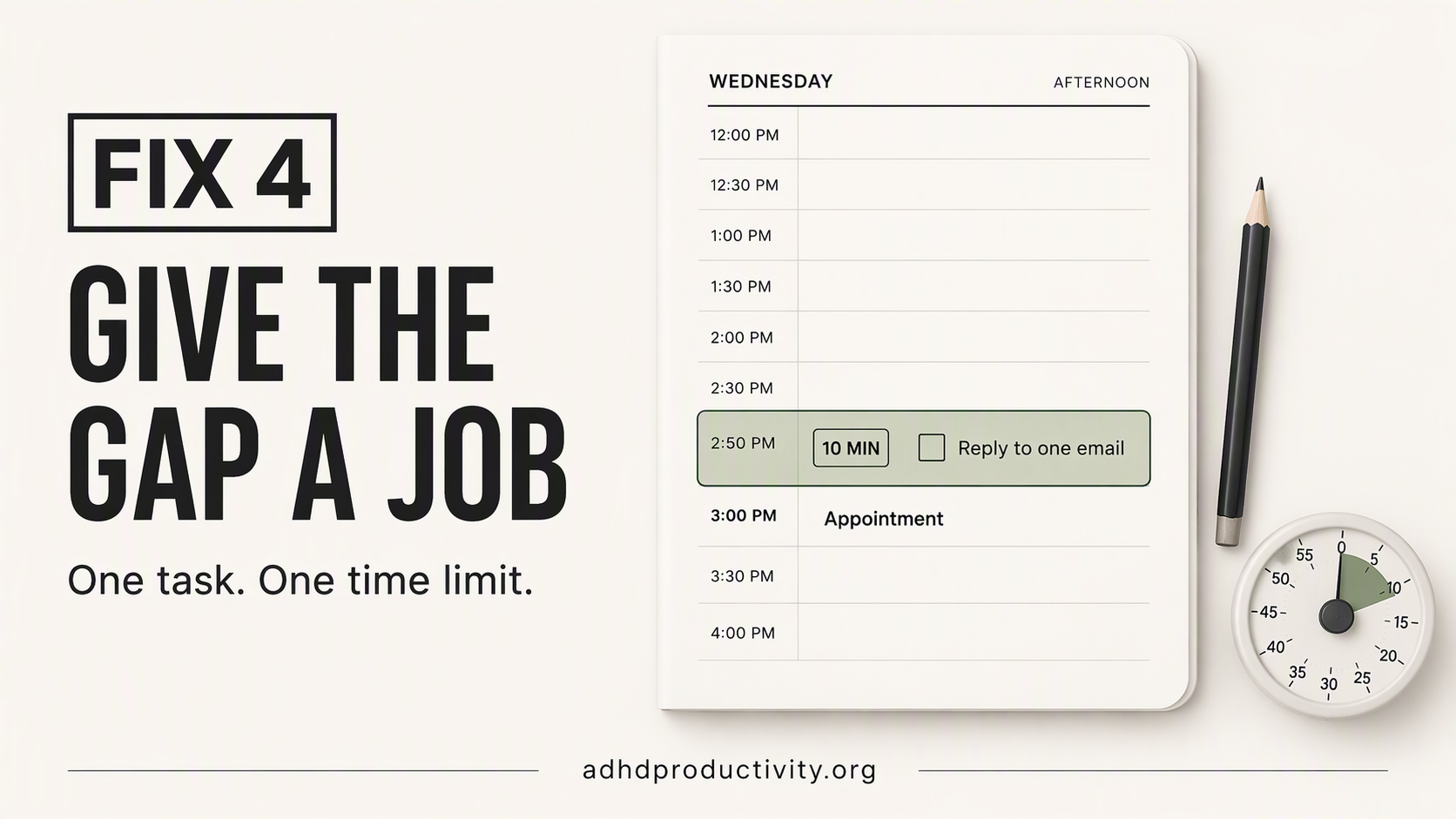
Count backwards from your "stop working" time and fill it with chunks that end cleanly.
Good waiting-mode tasks:
- Have a clear finish line (reply to these 4 emails, not "do email")
- Can be dropped mid-way without disaster
- Need no ramp-up time
Bad waiting-mode tasks:
- Anything that needs deep focus to get going. You'll spend the whole gap warming up.
- Anything with no natural stopping point. Hello, hyperfocus. See ADHD hyperfocus for why this goes wrong right before you have to leave.
A good shortcut: keep a pre-made "short tasks" list for exactly these days.
>> A dopamine menu works well here too, as long as you pick the "appetizers" and not the "Netflix series" options.
Fix 5: Time-block the day around the appointment, not the other way round
Waiting mode thrives when the day has one fixed point and nothing else. Add more fixed points.
Example for that 3:40 dentist day:
| Time | Block | Notes |
|---|---|---|
| 9:00 to 9:10 | Write appointment logistics, set alarms | Fix 1 and Fix 2 |
| 9:10 to 11:30 | Real work: one meaningful task | Phone in another room |
| 11:30 to 12:30 | Lunch, walk | Out of the house if you can |
| 12:30 to 2:40 | Short tasks from the list | Each one under 30 minutes |
| 2:40 | Wrap-up alarm | Save, shoes |
| 2:55 to 3:10 | Get ready, leave | Leave alarm at 3:10 |
| After | Groceries on the way home | Already decided |
The morning block is where most of the value is. People in waiting mode often assume the morning is "too close" to the appointment for real work. Five and a half hours isn't close. That's most of a workday. If you're new to blocking, start with our guide to ADHD time blocking.
Fix 6: Get someone else in the room

Waiting mode feeds on solitude. A second person, even on video, changes the room. Body doubling hasn't been tested much in rigorous trials, so I won't promise more than that, but plenty of people with ADHD swear by it, me included. Book a 60-minute session for the morning block.
My body doubling for ADHD guide covers how to set one up.
Fix 7: Move the appointment (yes, really)
If waiting mode reliably wipes out the day, schedule appointments where they cost the least:
- First thing in the morning, so there's no gap to wait through
- Directly after something else that's already fixed, like a school run or a standing meeting
- Bundled together: dentist, pharmacy and haircut on one afternoon, so one day gets eaten instead of three
This won't always be possible. A specialist with one opening in six weeks gets to set the time. But for anything flexible, ask for the first slot of the day.
What if you're already stuck in waiting mode right now?
Say it's 11:40, the appointment is at 2, and you've done nothing. No judgment. Here's the rescue version:
- Stand up. Physically leave the chair. Get water.
- Write the logistics from Fix 1. Two minutes, bullet points.
- Set the two alarms from Fix 2.
- Pick one task under 20 minutes and do only that.
- When it's done, pick another, or take a real break with an end time.
Can AI tools help with waiting mode?
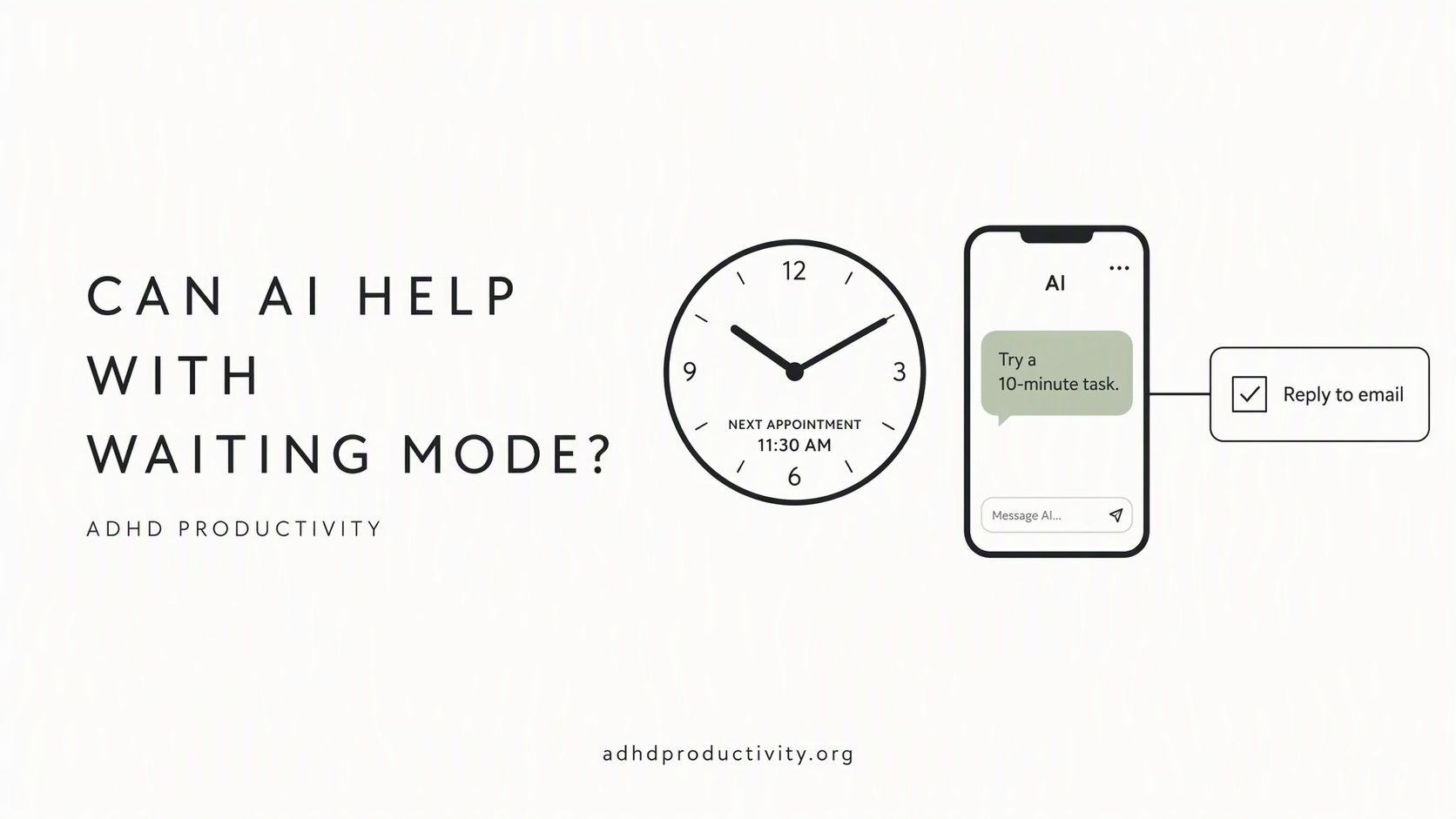
Some. The useful part is offloading the planning step.
What helps in practice:
- A calendar that shows travel time and buffers around the appointment. Several are covered in our best AI calendar for ADHD roundup.
- Reminders that name the next action ("Leave now, keys") instead of the event.
- An assistant that builds the day plan for you when you don't have the energy to.
That last one is where Saner.ai fits. Its AI assistant can pull from your calendar, Gmail, Slack and Drive, and you can ask it to schedule your day around what's already there. It proactively plans your day and checks in.
For waiting mode, the useful move is simple: you tell it "dentist at 3:40, 20 minutes away," and ask it to plan the morning with real work blocks and a stop time.
When waiting mode is a sign of something bigger
Most waiting mode is annoying and fixable. But talk to your doctor or therapist if:
- It's spreading to most days, including ones with nothing booked
- You're missing appointments or work because of it
- The waiting comes with strong dread or anxiety on top of the restlessness
- You're running on empty in general. Check our post on ADHD burnout, because constant low-grade waiting can be one piece of a bigger exhaustion picture
I'm a writer, not a clinician. This guide is practical advice, not a diagnosis. See our medical disclaimer.
Frequently asked questions
Is ADHD waiting mode real?
The experience is very real and widely reported. The term isn't clinical, and I found no study measuring it directly. The underlying problems, like weaker time estimation (Marx et al., 2021) and difficulty planning delayed intentions (Fuermaier et al., 2013), are well documented in ADHD.
Do only people with ADHD get waiting mode?
No. It comes up a lot in autistic communities too, and plenty of people with no diagnosis get a milder version before big events. Whether it hits ADHD brains harder hasn't been measured. That's based on how people describe it, not on data.
How do I stop waiting mode before an appointment?
Write out the full logistics (leave time, stop-working time, what to bring) first thing in the morning. Set two labeled alarms. Then fill the gap with tasks that have clear endings. Those three steps handle most cases.
Why do I feel so tired after a waiting-mode day?
Nobody has studied this exact question. My best guess: hours of low-level monitoring, clock-checking and guilt cost effort, even if nothing "happened." Treat it as a sign to schedule the next appointment better, not as a sign you're lazy.
Does ADHD medication help with waiting mode?
There's no research on medication and waiting mode specifically, so I can't tell you. In the Gawrilow and Gollwitzer studies, children with ADHD who combined if-then plans with stimulant medication showed the best performance on a lab inhibition task (Gawrilow & Gollwitzer, 2008). That's interesting but a long way from "your 3pm dentist." Ask your prescriber.
What's the best app for ADHD waiting mode?
Your phone's built-in alarms, with clear labels, do most of the work. A calendar that shows travel time helps more. An AI planner like Saner.AI helps if planning the day is the step you keep skipping.
Sources
- Marx, I., Cortese, S., Koelch, M. G., & Hacker, T. (2021). Meta-analysis: Altered perceptual timing abilities in attention-deficit/hyperactivity disorder. Journal of the American Academy of Child & Adolescent Psychiatry. eprints.soton.ac.uk/456003
- Fuermaier, A. B. M., et al. (2013). Complex prospective memory in adults with attention deficit hyperactivity disorder. PLoS ONE, 8(3), e58338. journals.plos.org
- Sonuga-Barke, E. J. S. (2002). Psychological heterogeneity in AD/HD: A dual pathway model of behaviour and cognition. Behavioural Brain Research, 130(1-2), 29-36. eprints.soton.ac.uk/18277
- Gollwitzer, P. M., & Sheeran, P. (2006). Implementation intentions and goal achievement: A meta-analysis of effects and processes. Advances in Experimental Social Psychology, 38, 69-119. kops.uni-konstanz.de
- Gawrilow, C., & Gollwitzer, P. M. (2008). Implementation intentions facilitate response inhibition in ADHD children. Cognitive Therapy and Research, 32, 261-280. socmot.uni-konstanz.de