ADHD Phone Addiction: How to cut that?

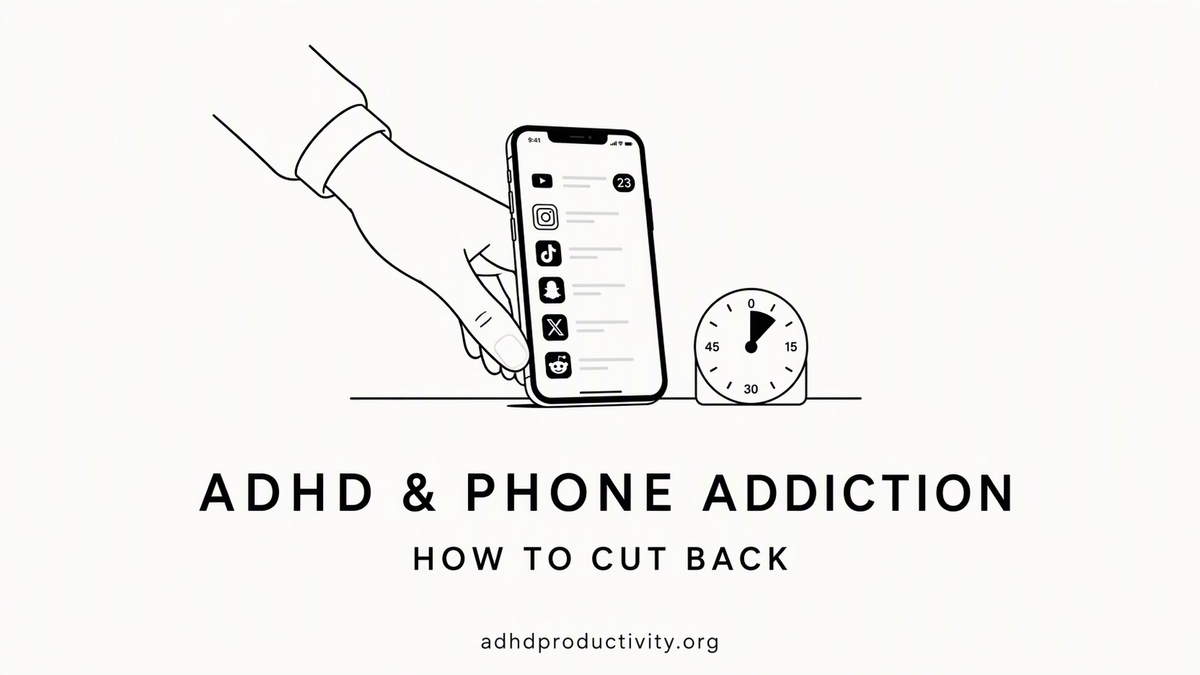
I picked up my phone to check the weather. Forty minutes later I knew a great deal about a man in Ohio who restores vintage vending machines. I still didn't know the weather. I went outside in a T-shirt. It was raining.

If you have ADHD, you probably have a version of this story every day. For us, the phone is the most perfectly designed distraction ever made, and it lives in our pocket.
This post covers what the research actually says about ADHD and phones (including the "do phones cause ADHD?" question), why ADHD brains get hooked so hard, and a practical plan to break the loop.
Quick answer: how do you break phone addiction with ADHD?
You win it by changing the environment around the phone. In practice:
- Kill most notifications. In one experiment, people reported more inattention and hyperactivity during the week their phone alerts were on.
- Put distance between you and the phone during work, meals and the hour before bed. Another room beats another pocket.
- Make the first tap harder for your worst apps: log out, move them off the home screen, or add a delay app.
- Give your hands and brain a replacement for the moments you normally reach for the phone.
- Decide your phone rules once, when calm, not 40 times a day when bored.
And no, your phone almost certainly didn't give you ADHD. More on that below.
Do phones cause ADHD?

Short answer: there's no good evidence that phones cause ADHD. There is evidence that heavy, constant phone use goes along with more ADHD-like symptoms, and that notifications can make attention worse in the short term. Those are different claims, and the internet mixes them up constantly.
What the biggest study found
The study people usually mean when they say "screens cause ADHD" is a 2018 paper in JAMA. Researchers followed 2,587 Los Angeles high school students who didn't have significant ADHD symptoms at the start, for about two years.
Students who used more kinds of digital media "many times a day" were more likely to report ADHD symptoms later. Among teens with no high-frequency media use, 4.6% later reported ADHD symptoms. Among the small group who used all 14 activities at high frequency, it was 10.5%.
That sounds alarming until you read the authors' own conclusion: the association was "statistically significant but modest," and they said more research is needed to know whether it's causal. A few other limits worth knowing:
- Symptoms were self-reported. Teens filled out a symptom checklist. Nobody was diagnosed with ADHD.
- It was teenagers, in one region of California, not adults.
- Reverse causation is possible. People who are already restless and novelty-seeking may simply reach for phones more.
So the real version is this: heavy digital media use and ADHD-type symptoms travel together, and it's possible the phone makes things worse. "Your phone gave you ADHD" isn't supported. ADHD is a neurodevelopmental condition. It starts long before anyone hands you an iPhone.
What an actual experiment found

Correlational studies can't tell you what causes what. So in 2016, researchers at the University of Virginia and the University of British Columbia ran an experiment on phone notifications with 221 students from the general population, not people diagnosed with ADHD.
For one week, participants kept alerts on and their phones within reach. For another week, alerts off and phones out of sight. During the alerts-on week, they reported higher levels of both inattention and hyperactivity. Higher inattention, in turn, went along with feeling less productive.
First, the authors were explicit that their results don't mean phones cause ADHD, and don't mean silencing notifications treats it. Second, they warned that turning alerts off doesn't work for everyone: some people get anxious about missing things and check their phones more. Remember that one. It comes back later.
Why this matters if you already have ADHD
If notifications nudge attention in the wrong direction even for people without ADHD, imagine what they do to a brain that already struggles to filter distractions. The phone doesn't create your ADHD. It just finds every weak spot your ADHD already has and pushes on it, dozens of times a day.
Why is phone addiction so much worse with ADHD?
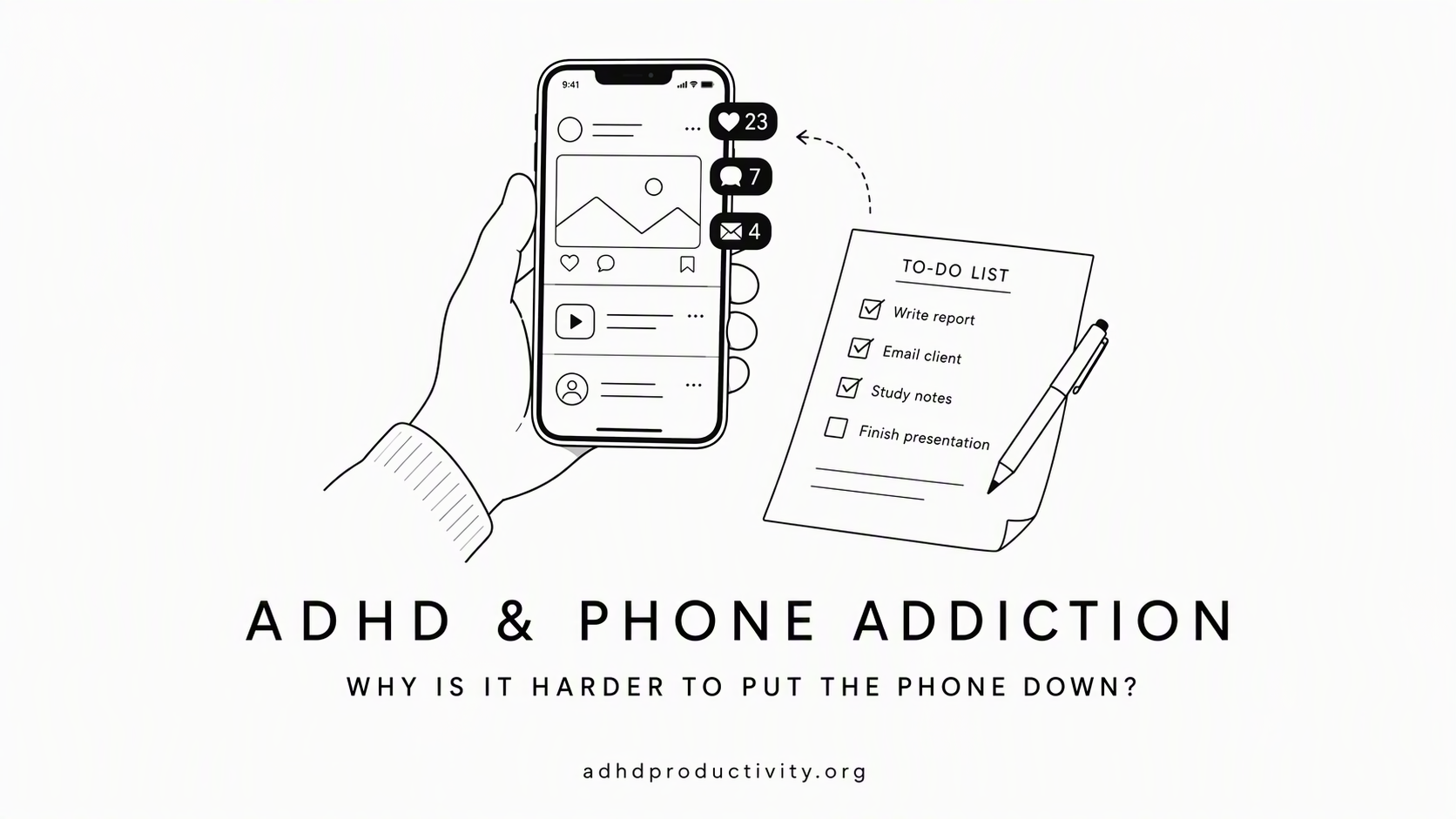
A quick note on words: I'm using "addiction" the way most people do, to mean "I can't stop doing this even though I want to."
It's a novelty machine
Every swipe is new. A new video, a new post, a new notification. ADHD brains tend to chase novelty and get bored fast, and an infinite feed never runs out of new. Your boring task loses that fight every time.
Time disappears inside it
The feed has no natural end point and no clock you can feel. If you already struggle with ADHD time blindness, you're scrolling inside a system that hides time from you. Five minutes becomes forty without any sense of transition.
It's the easiest way out of a hard task
Starting a dull task is hard for ADHD brains. The phone is the fastest exit available. You don't even decide to check it. Your hand does it for you. That's why phone use spikes right at the moment you're supposed to begin something, which is also where ADHD task initiation struggles live.
It feeds hyperfocus in the wrong direction
ADHD also means getting locked onto something interesting and being unable to stop. Phones are very good at triggering that lock. If you've ever looked up from a phone and realized an hour is gone, that's hyperfocus pointed at a feed instead of your work.
It steals your evenings and then your sleep
Phone time stretches latest at night, when your guard is down. Many adults with ADHD already run on a delayed body clock, which I covered in ADHD and sleep. A phone in bed pushes that even later, and a tired brain the next day reaches for the phone even more. It's a loop.
The ADHD phone plan: 6 changes that work
1. Turn off almost every notification
Go to your notification settings and switch off everything except calls and messages from real people you care about. No news alerts. No "someone liked your post." No shopping app telling you about a sale.
2. Create physical distance

The phone in your pocket gets checked. The phone in another room mostly doesn't. Try these zones:
- Work blocks: phone in a drawer, a bag or another room.
- Meals: phone face down across the room, or in a basket by the door.
- Bedtime: charger outside the bedroom. Buy a $10 alarm clock if your phone is your alarm.
Distance works because it adds a step. With ADHD, one extra step is often enough to break an automatic reach.
3. Make your worst apps harder to open
You know which two or three apps eat your time. Make them annoying to open:
- Move them off the home screen into a folder on the last page.
- Log out after each use, so opening them means typing a password.
- Delete the app and use the browser version, which is usually clunkier.
- Add a delay app that makes you pause before the app opens. My focus apps roundup compares options like one sec, Opal and Freedom, so I won't repeat it here.
You're not banning anything. You're adding friction so the reach becomes a choice instead of a reflex.
4. Build a replacement for the reach
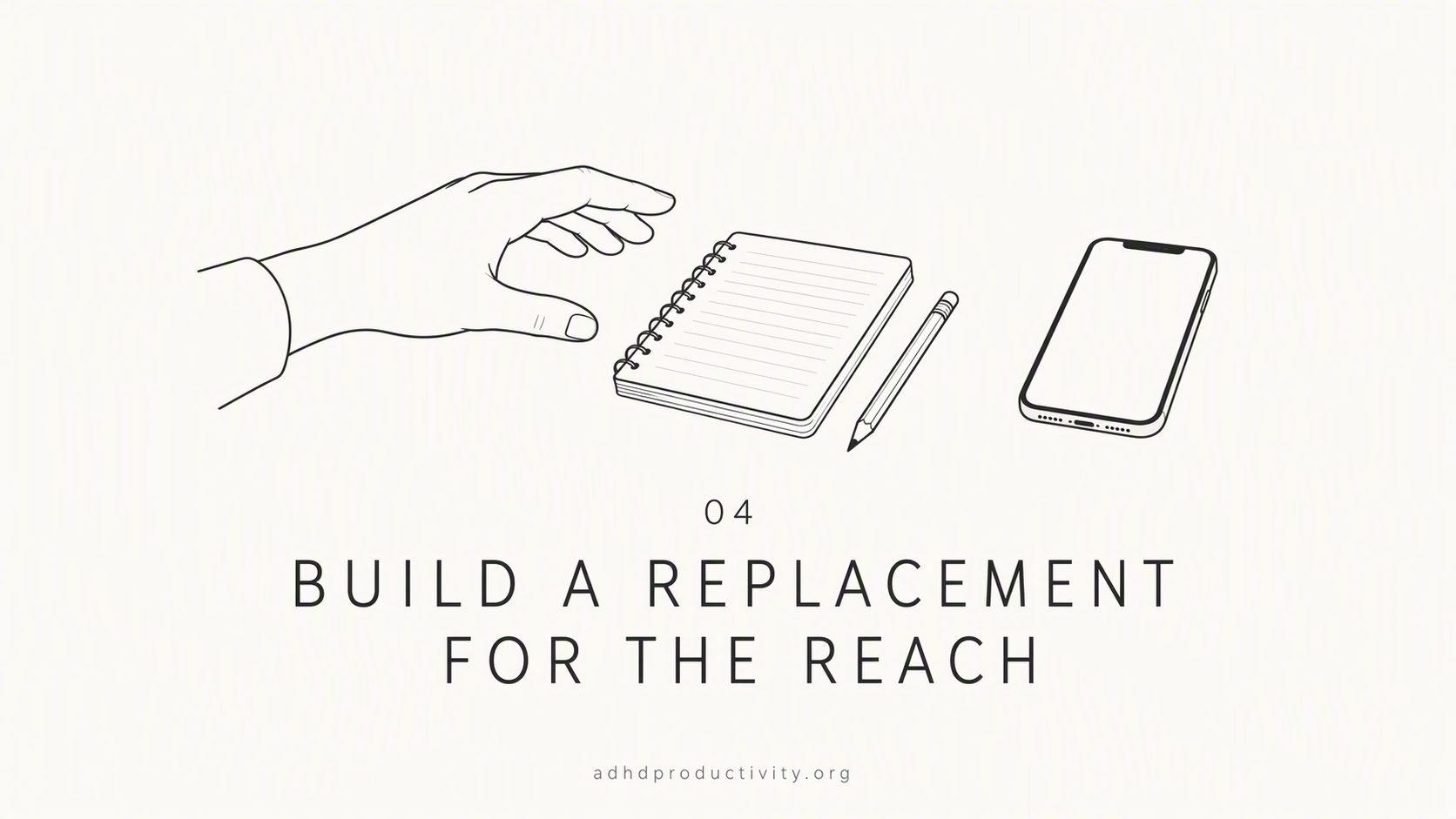
The urge to grab your phone is usually a need: stimulation, a break, an escape from something hard. If you take the phone away without replacing what it gave you, the urge wins.
Make a short list of quick, satisfying alternatives that aren't a feed. A dopamine menu is perfect for this. Mine includes a five-minute walk, a fidget toy, making tea and one round of a paper puzzle. When the urge hits, pick something from the list.
5. Separate "tool" from "trap"

You pick up your phone to do something useful, like adding a task or checking your calendar. Then a notification catches your eye and you're gone.
Fix this by moving useful jobs away from the phone where possible:
- Capture tasks somewhere other than your phone, like a notebook, or a voice note to an assistant that files it for you.
- Check your calendar on your laptop during work hours.
- Use a watch or a cheap clock for the time, so "what time is it?" doesn't become a 40-minute detour.
Personally, I dump thoughts into Saner.ai by voice so they land in my task list without opening a single social app.
A paper notebook works too. What matters is that capturing a thought doesn't require unlocking the most distracting device you own. For more on emptying your head safely, see my brain dump guide.
6. Make your phone boring

A dull phone is a phone you put down. A few settings help:
- Turn on grayscale in your accessibility settings. Colorful icons lose a lot of their pull.
- Strip the home screen down to tools only: maps, calendar, camera, messages.
- Turn off autoplay in every app that allows it.
What if your job lives on your phone?
Some of you are reading this thinking, "Great, but my clients text me, my team is on Slack, and I can't put my phone in a drawer." Fair.
If your phone is a work tool, split it instead of hiding it:
- Use focus modes. Most phones let you create a "Work" mode that only allows notifications from work apps and key people.
- Separate work and play apps onto different home screens, and let your work focus mode hide the play screen entirely.
- Batch replies. Unless your job is truly on-call, most messages can wait 30 to 60 minutes. Tell people your reply rhythm once, and they'll adapt.
- Keep your worst app off the work phone if you have two devices. A cheap second phone for social media sounds silly. It works.
The goal is the same: fewer surprises, fewer exits, fewer decisions in the moment.
What should you do when you relapse into scrolling?
When you notice you've lost 40 minutes, skip the guilt spiral. Guilt makes you feel bad, and feeling bad makes you reach for the phone to feel better. Instead:
- Put the phone in another room. Right now.
- Do one tiny physical thing. Stand up, drink water, walk to the window.
- Ask what you were avoiding. Usually there's a task you didn't want to start.
- Shrink that task to two minutes and start it.
If you're stuck in a frozen state and can't start anything at all, my post on ADHD paralysis goes deeper.
FAQ: ADHD and phone addiction
Are people with ADHD more prone to phone addiction?
Research links ADHD-type symptoms with heavier digital media use, and ADHD traits like novelty seeking, time blindness and trouble starting tasks make phones especially hard to put down. Phone overuse isn't unique to ADHD, but the pull tends to be stronger.
Can phones cause ADHD?
There's no good evidence that phones cause ADHD. A large 2018 JAMA study found a modest link between heavy digital media use in teens and later self-reported ADHD symptoms, but the authors said it may not be causal. ADHD is a neurodevelopmental condition with early developmental roots.
Does phone use make ADHD symptoms worse?
It can, at least in the short term. In a 2016 experiment, people reported more inattention and hyperactivity during a week with phone notifications on than during a week with them off and the phone out of sight.
Should I get a dumb phone if I have ADHD?
It can work, but it's a big switch, and plenty of people find it too inconvenient to stick with. Try the cheaper steps first: kill notifications, move your worst apps, and keep the phone out of the bedroom. If you still can't control it after a month, a basic phone is a reasonable experiment.
What's the best app to stop phone addiction with ADHD?
Delay apps like one sec, and blockers like Opal or Freedom, all help in different ways. My best focus apps for ADHD guide compares them. The settings changes in this post are free and work alongside any of them.
Is it bad to scroll before bed with ADHD?
It's one of the worst times. Late-night scrolling pushes bedtime later, and many adults with ADHD already struggle to fall asleep. Charging your phone outside the bedroom is one of the simplest changes you can make.
Takeaway

Don't try all at once. That's an ADHD trap too. Start here:
- Turn off every notification except calls and messages from people you care about.
- Move your charger out of the bedroom and buy a cheap alarm clock.
- Move your two worst apps off the home screen into a folder on the last page.
Then, this week, pick one if-then rule and stick with it.
Your phone was built by very smart people to keep you looking at it. You're not weak for losing that fight. But you can change the battlefield, and with ADHD, changing the battlefield is how you win. Also, check the weather before you go outside.