ADHD Meal Planning: A Lazy-Proof System for Feeding Yourself

It's 7:40 pm. The fridge holds half an onion, three eggs, and a jar of something that used to be pesto. You open a delivery app "just to look." Forty minutes and $31 later, you're eating noodles over the sink and wondering why this happens four nights a week.

I've been there so many times. Most meal planning advice is written for people who enjoy Sunday prep and own matching glass containers. This guide is for the rest of us.
Quick answer: how do you meal plan with ADHD?
ADHD meal planning works best when you plan less, not more. Skip the 21-meal weekly grid. Instead:
- Build a list of 10 to 15 "safe meals" you already know how to cook and will actually eat.
- Plan only 3 or 4 dinners per week and leave the other nights for leftovers, eggs on toast, or a freezer meal.
- Turn those meals into a fixed grocery list you reuse, so you never build one from scratch.
- Attach planning to something you already do every week (like a weekly reset), and keep it under 15 minutes.
- Stock a "default shelf" of no-cook backup food for the nights the plan collapses. It will collapse. That's fine.
The rest of this post shows you how to set each piece up, which apps are worth paying for, and where the popular "ADHD diet" advice goes wrong.
Why is meal planning so hard with ADHD?

Meal planning looks like one task. It's actually about eight: deciding what to eat, checking what you have, writing a list, getting to the store, remembering the list, cooking, and doing all that again in four days. Each step leans on planning, working memory, and sequencing.
A few specific failure points show up again and again:
- Decision overload at the worst moment. You decide what to eat when you're already hungry and tired. That's the moment your brain is least interested in choosing anything.
- Time blindness. "I'll cook at 6" quietly becomes 8:15. If time blindness is part of your life, you already know how this goes.
- Out of sight, out of mind. Food in the back of the fridge stops existing. Then it starts existing again, in a smellier form.
- Task initiation. Cooking has a high activation cost. The gap between "I should make dinner" and actually picking up a pan is the same gap we covered in our guide to ADHD task initiation.
- All-or-nothing plans. You plan seven perfect dinners, miss Tuesday, and abandon the whole thing by Wednesday.
The 5-part ADHD meal planning system
Part 1: Build your "safe meals" list (one-time, 20 minutes)

A safe meal is something you can cook half-asleep without a recipe. Write down 10 to 15 of them.
How to build the list fast:
- Open your bank app and look at the last month of grocery and takeout orders. What do you actually buy?
- Write down every meal you've made more than twice this year, however boring.
- Add 2 or 3 "upgraded takeout" meals: the thing you order, made at home with shortcuts. Fried rice with frozen veg. Quesadillas. Pasta with jarred sauce and a bag of spinach thrown in.
- Cross off anything that needs more than 30 minutes or more than 8 ingredients.
My list has a lot of eggs on it. and I like eggs lol
Keep the list somewhere you'll see it when you're hungry: taped inside a cupboard door, pinned in your notes app, or saved as a phone home screen widget. If it lives in a folder, it's dead to you.
Part 2: Plan 3 or 4 dinners, not 7
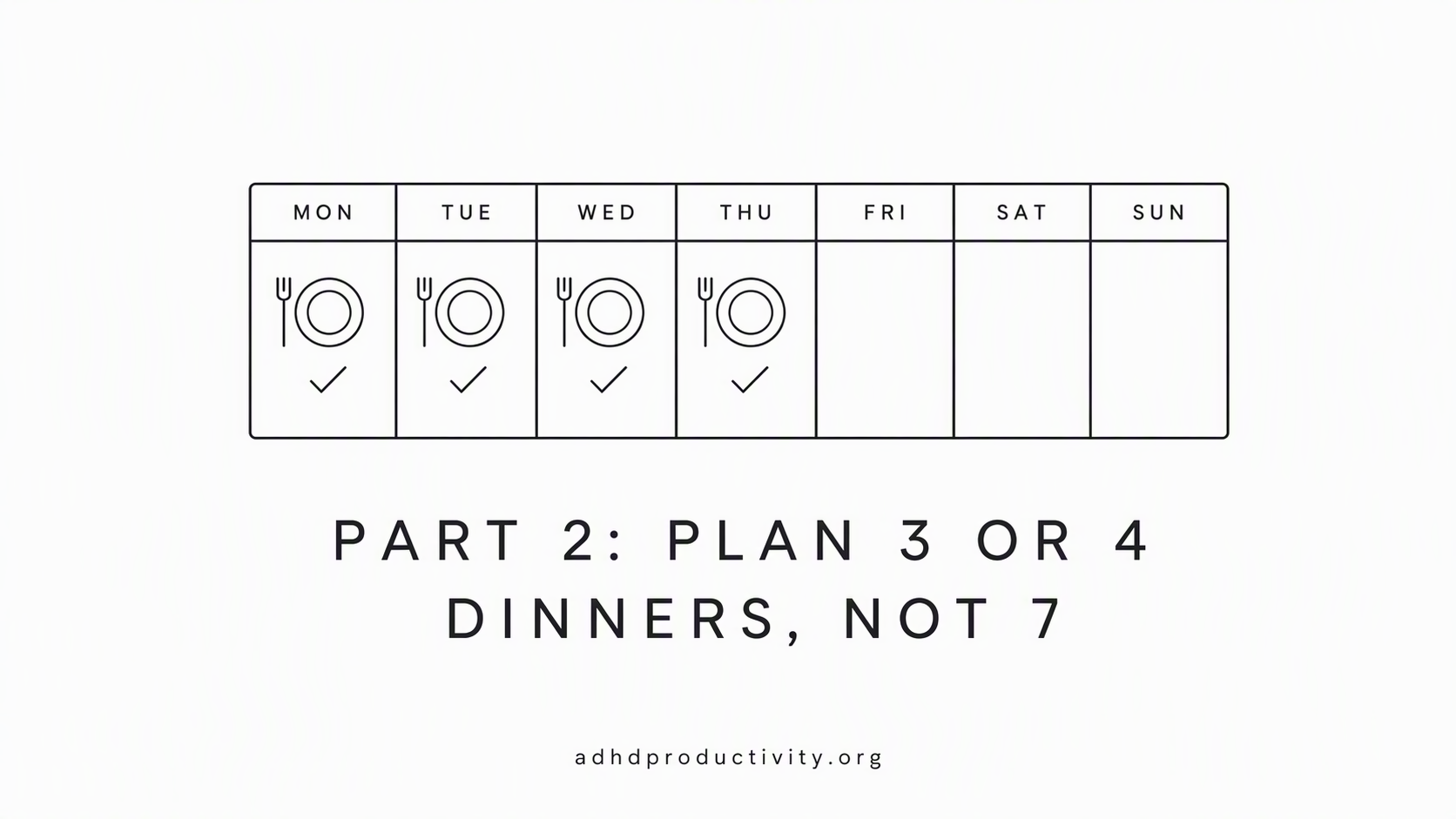
A full seven-day plan has no slack. One late meeting or one surprise dinner invite and the rest of the plan rots in the fridge with the cilantro.
Instead, use what I call a 3+2+2 week:
- 3 planned dinners from your safe meals list
- 2 leftover nights (cook double on two of the planned nights)
- 2 "free" nights: freezer meal, eggs, cereal, or yes, takeout you budgeted for on purpose
Planned takeout is not failure. It's a line item. Unplanned takeout at 9 pm because you gave up is the expensive kind.
If you want a broader framework for this, our guide to planning a week with ADHD uses the same idea of leaving deliberate empty space. Meals deserve that slack too.
Part 3: Make a master grocery list you never rewrite
Writing a grocery list from scratch every week is a working-memory test you'll fail on a busy Thursday. So don't.
Make one master list with every staple you buy, grouped by store section:
- Produce: onions, garlic, bagged salad, bananas, frozen veg
- Protein: eggs, chicken thighs, canned tuna, tofu, beans
- Carbs: rice, pasta, wraps, bread
- Fridge: cheese, yogurt, butter, milk
- Pantry: jarred sauce, stock cubes, soy sauce, peanut butter
- Backup shelf: see Part 5
Each week, you just uncheck what you're out of. Most list apps let you keep checked items and restore them, so you're editing, not writing.
Part 4: Anchor planning to an existing habit (15 minutes, once a week)

Planning that relies on remembering to plan will not happen. Tie it to something you already do weekly. This is just habit stacking pointed at food.
Good anchors:
- Right after your weekly calendar review
- Sunday coffee, before you check your phone
- While waiting for laundry to finish
The 15-minute routine:
- Look in the fridge (2 min). What has to be eaten first? That's dinner #1.
- Pick 2 more safe meals (3 min). Prefer ones that share ingredients with dinner #1.
- Update the master list (5 min). Uncheck what's gone, add ingredients for the 3 meals.
- Put the meals on your calendar (3 min). Literally an event called "Tuesday: fajitas." Add a reminder 90 minutes before so you can defrost things.
- Order or schedule the shop (2 min). Grocery delivery or click-and-collect removes the "remember the list in the store" step completely.
If you keep missing defrost windows, one of the best reminder apps for ADHD with location or repeating alerts is worth setting up for this alone.
When even 15 minutes feels like too much, do a 2-minute brain dump of "foods I'd eat this week" into your notes app. A messy list is better than no list.
Part 5: Stock a default shelf for the nights it all falls apart

Every plan breaks. The goal is to make the break land on something better than a $31 delivery.
A default shelf is a small stash of food that needs zero planning and minimal cooking. Keep it stocked like you would toilet paper.
Some ideas: Frozen dumplings or gyoza
- Microwave rice pouches plus canned beans or tuna
- Instant noodles plus a frozen veg bag and an egg
- Wraps, hummus, cheese, and pre-washed salad
- Greek yogurt, granola, fruit
- A couple of decent frozen ready meals you actually like
Think of it as a dopamine menu for food: a short list of pre-approved options so you don't have to make a decision while starving.
How do I meal prep with ADHD without hating it?
Full meal prep (five identical boxes of chicken and broccoli) fails a lot of ADHD brains for a simple reason: by tmr you're sick of it, and the boxes go in the bin. Try component prep instead.
Component prep means you cook building blocks, not meals:
- A big pot of rice or grains
- One tray of roasted veg
- One batch of protein (shredded chicken, cooked lentils, baked tofu)
- One sauce (peanut, yogurt-garlic, or just a good jar)
Then you assemble different combos each night: rice bowl Monday, wraps Tuesday, salad Wednesday. Same ingredients, different feeling. For me, that bit of variety is the difference between eating the prep and binning it.
Tips that make prep less miserable:
- Cap it at 45 minutes. Set a timer. When it rings, you stop.
- Use the oven as a babysitter. Tray bakes and sheet-pan meals let you walk away without burning anything.
- Prep with company. Call a friend, put a show on, or cook alongside someone. Body doubling works in the kitchen as well as at a desk.
- Clean as you go, a little. A full sink of dishes after prep is a reason to never prep again. Our guide on how to clean with ADHD has a "dishes to the sink, five minutes" trick that pairs well with this.
What if my ADHD medication kills my appetite?
Loss of appetite is listed by the NHS as a common side effect of methylphenidate in adults, and the NHS notes it may help to take the medicine with a meal. It also says to speak to your doctor if you're losing a lot of weight.
What that means for planning, in practical terms:
- Plan around your hungry windows, not the clock. If you're hungrier in the morning and late evening, make those the "real" meals.
- Keep easy calories on hand for times when you're not hungry but know you need to eat: yogurt, nut butter on toast, smoothies, cheese and crackers.
- Set an eating reminder. Appetite is not a reliable alarm when it's switched off.
- Talk to your prescriber about timing or dose if eating is a struggle. That's their job, not a meal planning app's.
I'm not a doctor, and this isn't medical advice. It's a reason to build your plan around how your day actually works.
Best meal planning apps for ADHD (2026 comparison)
You don't need an app. A whiteboard on the fridge works fine. But if you like apps, here's how the main options stack up for ADHD brains specifically. Prices were checked on October 3, 2026, and they change, so confirm before you buy.
| App | Price | Best for | ADHD upside | ADHD downside |
|---|---|---|---|---|
| AnyList | Free; Complete is $9.99/yr individual, $14.99/yr household (source) | Shared grocery lists | Meal calendar adds recipe ingredients straight to your list | Meal planning sits behind the paid tier |
| Plan to Eat | $5.95/mo or $49/yr (source) | Saving recipes from anywhere | Drag recipes onto a calendar and the shopping list builds itself | No free tier; importing your recipes takes a while |
| Paprika 3 | One-time purchase, sold separately per platform (source) | People who hate subscriptions | Pantry tracking, aisle-sorted lists, meal plans you can reuse | Buying it on phone and desktop means paying twice |
| Mealime | Shutting down October 21, 2026 (source) | Not recommended now | Was great for beginners | Personal data will be deleted at shutdown |
| Paper or a whiteboard | About $10 | Visual people | Always visible, zero logins | No reminders, no automatic list |
How to pick
- You live with someone: AnyList, for the shared list.
- You save recipes from Instagram and never cook them: Plan to Eat.
- You hate subscriptions: Paprika 3.
- You forget everything, including that you own an app: whiteboard on the fridge, plus phone reminders.
And if food money is the real problem, pair whichever you pick with one of the best budgeting apps for ADHD so you can see the takeout line shrink.
ADHD meal planning template (copy this)
Paste this into your notes app or print it.
Safe meals (10 to 15):
(keep going)
This week:
- Planned dinner 1 (use-it-up meal): ______
- Planned dinner 2: ______ (cook double)
- Planned dinner 3: ______ (cook double)
- Leftover nights: 2
- Free nights: 2 (budget for takeout: $____)
Defrost reminders: set 90 minutes before each planned dinner.
Default shelf check: dumplings / rice pouches / noodles / wraps / yogurt / ready meals
Weekly anchor: right after ______ (existing habit)
Common ADHD meal planning mistakes (and quick fixes)

- Planning 7 new recipes. Fix: max 1 new recipe per week. The rest come from your safe list.
- Buying ingredients for one recipe only. Fix: pick meals that share ingredients so leftovers become another meal.
- Hiding food. Fix: clear containers, front of the fridge, "eat first" shelf at eye level.
- Treating one bad night as total failure. Fix: that's what free nights and the default shelf are for. Restart the next day, not next Monday.
- Planning when hungry. Fix: plan after a meal, never before one.
- Burning out on a "perfect" system. If you're already running on empty, go easy on yourself before adding a new routine. Cereal for dinner counts.
FAQ
What is the easiest way to meal plan with ADHD?
Pick 3 dinners a week from a list of 10 to 15 meals you already know how to cook, cook double for leftovers, and keep a shelf of no-cook backup food. Do it in 15 minutes, attached to a weekly habit you already have.
What are good ADHD-friendly meals?
Meals with few ingredients, short cook times, and forgiving steps: sheet-pan tray bakes, stir-fries with frozen veg, quesadillas, pasta with jarred sauce, rice bowls, eggs on toast, and soups made in one pot. If a meal needs precise timing or lots of chopping, it isn't ADHD-friendly on a weekday.
Is there a meal planning app made for ADHD?
Not really. Most meal planning apps are general-purpose. The features that matter for ADHD are automatic grocery lists, reminders, a visible calendar, and low setup effort. AnyList, Plan to Eat, and Paprika 3 all cover the basics. Avoid starting with Mealime, which shuts down on October 21, 2026.
How do I stop food going bad in my fridge?
Keep a front-of-fridge "eat first" zone, use clear containers, and make your first planned dinner each week a meal that uses up what's already there. Buy less fresh produce and more frozen veg, which doesn't punish you for a chaotic week.
Will changing my diet fix ADHD?
Be careful with claims that a specific food causes or cures ADHD. For example, the U.S. National Center for Complementary and Integrative Health says it's unclear whether omega-3 supplements help ADHD, despite a lot of research. Talk to a doctor before making big dietary changes.
How do I eat when ADHD medication suppresses my appetite?
Plan meals for the times you're actually hungry, keep easy high-calorie snacks around, and set reminders to eat. The NHS lists loss of appetite as a common side effect of methylphenidate and suggests taking it with a meal. Speak to your doctor if you're losing weight.