ADHD Forgetfulness: Why you forget and the solution

Last month, I walked into the kitchen to get a glass of water, came out with a banana, and only remembered the water when I was thirsty again an hour later. Same week, I put my car keys in the fridge. Impressed.

If that sounds like your day, this post is for you. ADHD forgetfulness is real, it has a decent body of research behind it, and the fix is: you stop asking your brain to hold things and build a few places outside your head that hold them instead.
In this post: what the studies found, which popular ideas they contradict, and the exact systems I'd set up this week.
Quick answer: what is ADHD forgetfulness and how do you deal with it?
ADHD forgetfulness is the everyday pattern of losing items, dropping tasks mid-way, forgetting what people told you, and missing things you meant to do. The NHS lists "being easily distracted or forgetful" and "losing things often, like your wallet, mobile or keys" as symptoms of ADHD in adults.
Research points to three weak spots more than "bad memory" in general:
- Working memory (holding something in mind for a few seconds while you use it) shows one of the largest gaps in a review of 34 meta-analyses.
- Encoding (getting information stored in the first place) explains the long-term memory gap in adults, and retrieval looks fine, per a 2017 meta-analysis.
- Planning future intentions is where adults with ADHD struggled most in a prospective memory study, while remembering the plan itself was intact.
Is forgetfulness actually a symptom of ADHD?

Yes. It's a listed symptom.
- The CDC's list of ADHD signs includes "forget or lose things a lot" and describes the inattentive presentation as someone who "forgets details of daily routines."
- The NHS adult page lists forgetfulness and losing your wallet, phone or keys by name.
But, everybody forgets things. A forgetful week during a house move doesn't mean you have ADHD. Diagnosis looks at patterns over time, across settings, that cause real problems. If you've never been assessed and this post feels uncomfortably familiar, that's a reason to talk to a doctor, not a reason to self-diagnose from a blog.
Is "ADHD object permanence" real?
You've probably seen this one on TikTok: people with ADHD lack object permanence, so out of sight means it stops existing.
I'd retire the phrase. "Object permanence" is a term from infant development, the stage where a baby learns a hidden toy still exists. Adults with ADHD know the toy exists. And it doesn't appear in the NHS or CDC symptom descriptions.
Out of sight really does mean out of mind for a lot of us. The research above gives a better explanation: a weak scratchpad plus attention that goes wherever the loudest thing is. The fix is the same either way. Keep important things visible, or have a system that brings them back into view.
ADHD forgetfulness or something more serious?
If your memory has changed recently, especially later in life, don't assume it's ADHD. The National Institute on Aging draws a line between normal forgetfulness and signs of dementia:
| More typical of everyday forgetting | Worth raising with a doctor |
|---|---|
| Missing a monthly payment | Problems taking care of monthly bills |
| Losing things from time to time | Misplacing things often and being unable to find them |
| Forgetting which day it is and remembering later | Losing track of the date or time of year |
| Sometimes forgetting which word to use | Trouble having a conversation |
The NIA's rule is simple: see a doctor whenever changes in memory or thinking worry you. ADHD is lifelong. A sudden new pattern is a different conversation.
What are the 4 types of ADHD forgetting (and the fix for each)?
Most "I forget everything" problems fall into four buckets. Each one needs a different tool, which is why one big to-do app rarely fixes all of it.
| Type of forgetting | What it looks like | Weak spot | Main fix |
|---|---|---|---|
| Losing objects | Keys, phone, wallet, glasses | Working memory | Fixed homes and a launch pad |
| Losing your place | Forgot why you opened the tab | Working memory | Say it out loud, leave a breadcrumb |
| Losing information | What did she say about Friday? | Encoding | Capture within seconds, repeat back |
| Forgetting to do things | Missed the call, forgot the bins | Planning intentions | Specific "when X, I do Y" lines plus nagging reminders |
How do I stop losing my keys, phone and wallet?
1. Build one launch pad by the door
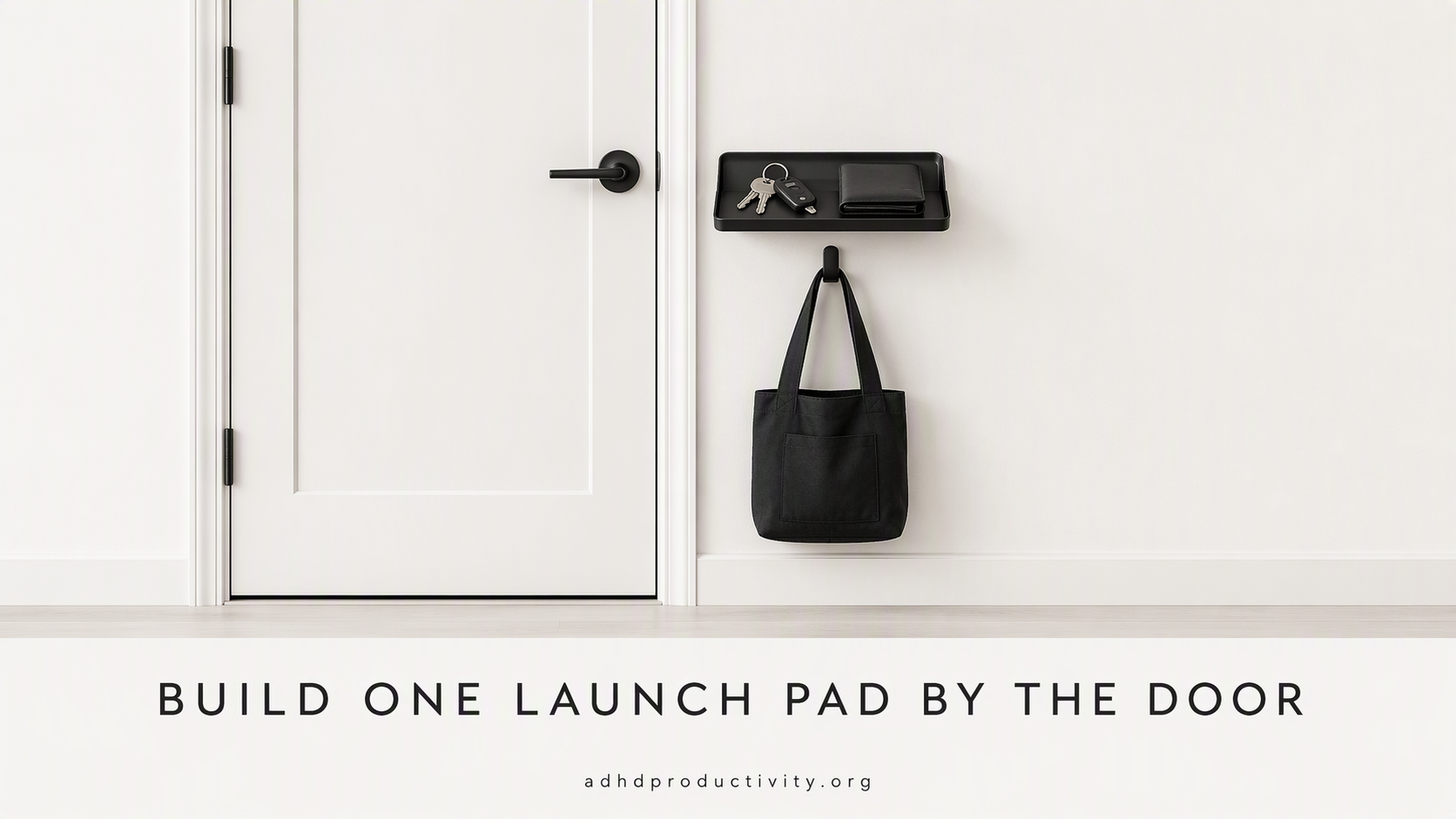
- A bowl, tray or wall hook within two steps of the door you actually use (not the front door you never use).
- Keys, wallet, earbuds and work badge live there. Nothing else, or it turns into a junk drawer within a week.
- Put a charging cable there too. Your phone now has a reason to go home.
2. Use the "hands empty" rule
When you walk in, your hands empty into the launch pad before they do anything else. Before you take your shoes off. Before you pet the dog. Sorry, buddy.

This works because it hooks the habit onto an event that already happens (walking through the door).
>> If you want to stack more habits on that moment, the habit stacking guide walks through how.
3. Do a pocket check out loud
Leaving the house: touch each pocket and say "phone, keys, wallet." Out loud, even if you feel silly. Saying it forces a little attention at the exact moment you'd otherwise drift, which is the encoding problem from earlier.
4. Buy doubles of cheap things
Chargers, reading glasses, nail clippers, scissors, pens. One per room you use them in. The ADHD tax on replacing lost stuff is real, and our ADHD tax breakdown covers where that money goes. A second $8 charger is cheaper than the 15 minutes you spend hunting the first one, every week.
5. Put a tracker on the expensive ones

A Bluetooth tracker on keys and wallet. Call it a backup. The launch pad will fail sometimes. Plan for it.
6. Shrink the territory
The more places something can be, the more places it will be.
How do I stop forgetting what I was doing mid-task?
This is the scratchpad leaking in real time. You can't make the scratchpad bigger, so you write on the outside.
- Narrate the next step. "Getting the charger, then replying to Sam." Out loud. It sounds ridiculous and works better than it should.
- Leave a breadcrumb before you switch. Before you answer the Slack ping, type one line at the top of whatever you're working on: "NEXT: finish paragraph on pricing." When you come back, you don't have to rebuild your train of thought.
- One tab, one task. If you open a new tab for something, close it when it's done. Twenty open tabs are twenty half-finished intentions.
- Sticky note on the monitor. The task you're on, in four words. When you look up and blank, the answer is in front of you.
- Walk back to where you had the thought. If you forgot why you came into the kitchen, going back to the desk often brings it back. It's not magic, just context.
How do I remember what people tell me?
Repeat it back. "So, Friday, 7pm, at Jen's, I'm bringing wine." This is the single best habit in this post. It catches errors, forces attention, and makes the other person feel heard.
- Capture within 10 seconds. Not "I'll write it down later." Later is where information goes to die. Phone out, voice note, done.
- >> If typing is slow for you, our list of voice-to-text tools for ADHD has options that work.
- Ask for it in writing. "Can you text me that?" is a perfectly normal adult request. At work, "Can you drop that in the chat so I don't lose it?" is even more normal.
- In meetings, own the notes. Being the note-taker forces attention and gives you the record. More tactics in the meetings with ADHD guide.
- Use one inbox for captured stuff. Voice notes in one app, sticky notes on the fridge, and texts to yourself is three places to forget to check. Pick one. Then empty it on a schedule. A weekly brain dump is a good way to process it.
How do I stop forgetting to do things?
Write "when X, I do Y" lines
Vague: "Call the dentist this week."
Specific: "When I sit down with coffee on Tuesday, I call the dentist. Number is in the reminder."
The specific version has a trigger, an action, and everything you need to do it. You're not relying on future-you to work out the details.
Anchor to events, not times
"After I drop the kids at school" is harder to miss than "8:45am," because the event happens whether you're watching the clock or not. If clocks generally slip past you, the time blindness guide goes deeper on this.
Use reminders that nag
A single notification is one chance to remember. Swipe it away and it's gone. For anything that matters, use a reminder that keeps going until you mark it done. We tested five apps for this in the best reminder apps for ADHD roundup, so I won't repeat it here. I especially use saner.ai for this purpose
Put the object in the way
Need to return a parcel? Put it in front of the door so you trip over it. Need to take medication with breakfast? Put it next to the coffee. Physical objects are reminders that can't be swiped away.
What about forgetfulness at work?
Work forgetting is costly because other people notice. A few things worth doing:
- Confirm every request in writing. After any verbal ask: "Just confirming, you need the deck by Thursday noon?" One line. It doubles as your capture.
- Keep a running "waiting on / owe" list. Two columns. Things others owe you, things you owe others. Check it every morning.
- Batch your follow-ups. One 15-minute slot at 4pm to send every "following up on this" message. Easier than remembering each one.
- Consider accommodations. Written instructions instead of verbal ones, meeting notes shared by default, or a quieter desk are all reasonable asks. The ADHD accommodations at work guide covers how to request them.
What about forgetfulness in relationships?

This one hurts most, because forgetting reads as "you don't care." It isn't. But the other person still has to live with the missed anniversary.
- Name it once, calmly. "When I forget things, it's not about how much I care. I'm working on systems for it." Then show the systems.
- Share a calendar. Birthdays, plans, and "you said you'd do X" all go in one place you both see.
- Set dates you can't miss in two places. Calendar entry plus a nagging reminder a week before. Gifts take longer than you think.
- Don't make your partner your memory. It's tempting, and it turns them into a manager. Use the tools, and let them be your partner.
What doesn't help?
- Trying harder. Effort doesn't make the scratchpad bigger. Systems do the remembering so effort can go somewhere useful.
- Five capture apps. Every new place you store things is a new place to forget to check.
- Shame. Beating yourself up after you forget doesn't encode anything. It just makes you dread the next mistake. Note what failed, fix the system, move on.
- Running on no sleep. If your nights are a mess, start there. Our ADHD and sleep guide covers what the evidence says.
FAQ
Is forgetfulness a sign of ADHD in adults?
It can be. The NHS lists being forgetful and losing things like your wallet, phone or keys as adult ADHD symptoms. Forgetfulness on its own isn't enough for a diagnosis, though. A clinician looks at a wider pattern over time.
Why do people with ADHD forget things so easily?
Research points to working memory (holding information briefly), encoding (getting it stored in the first place), and planning future tasks. In one meta-analysis, adults with ADHD showed no retrieval problem. The information often wasn't stored well to begin with.
Does ADHD cause memory loss?
Not in the way people usually mean. The research describes trouble storing new verbal information and holding things in mind short-term, and one meta-analysis of adults found no retrieval problems. If your memory has gotten noticeably worse recently, see a doctor, because that's a different pattern.
Can medication help with ADHD forgetfulness?
The NHS lists medicines such as methylphenidate and lisdexamfetamine as options for managing adult ADHD symptoms, alongside CBT and lifestyle changes. Whether they help your memory specifically is a question for your prescriber.
What's the fastest single fix for ADHD forgetfulness?
Repeat back and capture immediately. Say what you heard out loud, then get it into your one inbox within 10 seconds. It targets the encoding step, which is where much of the forgetting starts.
My conclusion
Think of your brain as a busy scratchpad. It drops things when something louder shows up. So stop asking it to hold more.
Tonight, do one thing: put a bowl by the door. Tomorrow, start saying "phone, keys, wallet" on your way out. Build from there.
And if your keys end up in the fridge anyway, check next to the oat milk.
Sources
- NHS. ADHD in adults.
- Centers for Disease Control and Prevention. Signs and Symptoms of ADHD.
- Pievsky MA, McGrath RE (2018). The Neurocognitive Profile of Attention-Deficit/Hyperactivity Disorder: A Review of Meta-Analyses. Archives of Clinical Neuropsychology, 33(2), 143–157.
- Skodzik T, Holling H, Pedersen A (2017). Long-Term Memory Performance in Adult ADHD: A Meta-Analysis. Journal of Attention Disorders, 21(4), 267–283.
- Fuermaier ABM, Tucha L, Koerts J, et al. (2013). Complex Prospective Memory in Adults with Attention Deficit Hyperactivity Disorder. PLoS ONE, 8(3), e58338.
- National Institute on Aging. Age-Related Forgetfulness or Signs of Dementia?