How to manage an ADHD Workday in an Open Office

💡 Quick answer: Open offices are measurably harder for ADHD brains because task-irrelevant sound is harder to filter when your working memory is loaded, and every interruption costs roughly 23 minutes of full recovery, not seconds. The fix is controlling what reaches your ears, controlling where interruptions can reach you, and using a small number of pre-built recovery routines so a derailed morning doesn't become a derailed day.
I worked in an open office for two years before I understood why some days felt like I was getting real work done through wet cement. It was the guy four desks over narrating his fantasy football trades at a volume clearly meant for someone in a different building 😩
If you have ADHD and you sit in an open floor plan, you're not imagining that this is harder for you specifically. There's research on why, and once you understand the mechanism, the fixes get a lot more obvious.
Why open offices hit ADHD brains harder
This isn't a "everyone hates open offices" situation, though everyone does. It's specifically worse for ADHD attention systems, and the research explains why.
- Your brain has a harder time tuning out background sound when you're also holding something in working memory. A working-memory-load study on adults with ADHD found that when the mental task was easy, ADHD and non-ADHD brains suppressed irrelevant noise about equally well. Once the task got demanding, the ADHD group lost that ability, and their auditory cortex kept firing in response to sound they were supposed to be ignoring. >> The harder the task, the worse the noise gets, exactly backwards from what you'd want. (Frontiers in Human Neuroscience)
- Multiple overlapping conversations are worse than one loud one. A controlled acoustic study of simulated open-plan offices found that a "babble" of several talkers at once degraded cognitive performance more than a single conversation, and it took more simultaneous talkers than researchers expected before the babble started blending into harmless background noise. If your floor has three conversations going instead of one, that's not a wash. It's worse. (Acoustics research, arXiv)
- Where your desk faces matters more than people think. A pilot study using EEG on adults with ADHD found that open-plan layouts are linked to distraction, higher cognitive load, and lower perceived concentration during tasks that need sustained attention, and that desk orientation, specifically whether your back has some visual cover or you're facing high foot traffic, changes how hypervigilant your brain stays throughout the day. (MDPI, Prospect and Refuge in the Workplace)
- General auditory distraction research (not ADHD-specific) backs this up too. Speech-spectrum background noise measurably hurts working memory and attention-switching performance even in people without ADHD, which tells you open offices are a bad cognitive environment for everyone, ADHD just removes your margin for error. (PMC)
The environment is doing something specific and measurable to your attention, so the fixes should target that specific thing instead of "just focus harder."
The cost of getting pulled off task
Gloria Mark's research team at UC Irvine tracked knowledge workers through their actual workdays and found that after an interruption, it took an average of 23 minutes and 15 seconds to fully return to the original task, and workers typically drifted through two other tasks before getting back to it. (UC Irvine, original study PDF)
That number isn't ADHD-specific, it's true for everyone. But if you already spend more effort than most people getting a task started in the first place (a documented ADHD challenge in its own right, more on that in my task initiation piece), losing your place five times a day isn't five annoyances.
Open offices are basically interruption factories. Someone taps your shoulder, a Slack notification pops up because you can hear the desk next to you get one, a meeting gets called across the room.
What helps to manage ADHD in an open office
None of this requires quitting your job or getting your own office (though if you can swing the second one, do it). These are ordered from "do this in the next five minutes" to "this takes a conversation with your manager."
Control what reaches your ears
- Get real noise-cancelling headphones, not earbuds with a "noise reduction" sticker on the box. The point isn't music, it's removing the speech-spectrum sound your brain can't filter out when working memory is loaded.
- If total silence makes your brain wander (common), try brown noise or a consistent instrumental track instead of anything with lyrics. Lyrics recruit the same language-processing machinery you need for your actual work.
- Agree on a visible signal with your team, headphones on means "mid-task, don't interrupt unless it's actually urgent." Most people respect this once you say it out loud once.
Control where interruptions can reach you
- If you have any say in seating, ask for a desk that doesn't face a walkway or a high-traffic doorway. The hypervigilance research above found that facing open sightlines keeps your nervous system on alert even when nothing is happening.
- Batch your Slack and email checking into two or three set windows instead of leaving notifications live all day. Every ping is a 23-minute tax whether you open it or not, because now you're holding "I wonder what that was" in your head.
- Book a small conference room or phone booth for your two or three most demanding tasks of the day. You don't need it all day, just for the parts that actually require working memory.
Build a re-entry routine, because you will get pulled away

- Before you get interrupted (you can't always predict when, but you can prepare), leave yourself a one-line note about exactly where you were and what the next physical step is. "Was mid-sentence in the Q3 deck, next: finish the risk slide" beats trying to reconstruct your train of thought from scratch.
- Use an if-then plan for getting back on task: "If I get pulled into a hallway conversation, then I open my note and read it out loud before doing anything else." This is the same mechanism behind task initiation strategies that actually have research support, worth reading if starting tasks is a bigger issue for you than staying on them.
- If your team culture allows it, try body doubling for your hardest task blocks, working alongside a coworker (in person or on a quiet call) who's doing their own thing. It's a low-effort way to borrow external structure your brain isn't reliably generating on its own. I go deeper on how and why it works in my body doubling piece.
Let the environment work for you instead of against you
- If your job is even partially flexible, protect one or two days for tasks that genuinely need deep, uninterrupted focus, and save the open floor for meetings, quick tasks, and collaborative work that thrives on being interruptible. I wrote a full breakdown of what deep work actually requires for an ADHD brain in this piece.
- If noise and interruption are genuinely affecting your output, that's a real accommodation conversation, not you being difficult. In the US, employers with 15 or more employees are legally required to consider reasonable accommodations for ADHD, and "noise-cancelling headphones" or "a quieter workstation" are two of the most commonly granted, least controversial asks there are. I cover exactly how to have that conversation in ADHD accommodations at work, including whether you even need to disclose your diagnosis to get one (short version: not always).
Let a tool absorb the parts your brain won't hold
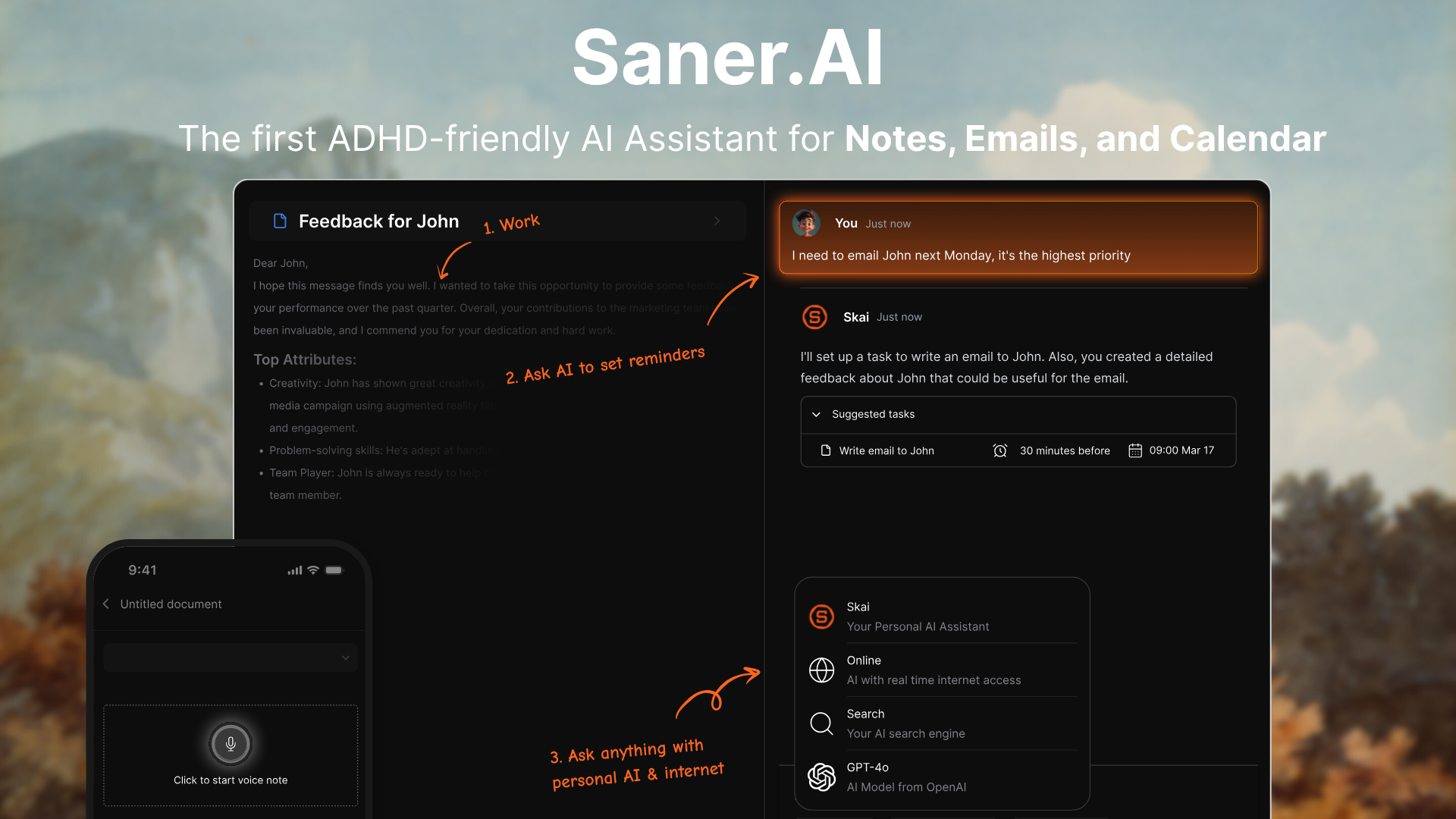
- The 23-minute recovery tax gets worse if you're also trying to remember what your afternoon was supposed to look like. This is why I use an AI tool: something like Saner.AI can take a voice note the second you get interrupted ("moving the deck review to 3, need to call the vendor first") and replan the rest of your day around it, instead of you trying to hold the new plan in your head on top of everything else. It's a fix for the part where a re-shuffled day falls apart because nobody, ADHD or not, can hold a moving schedule in working memory all day.
A few things that sound helpful but usually aren't
- "Just wear headphones and ignore everyone" doesn't hold up long term if it damages how your team perceives you as collaborative. Pair it with the explicit signal conversation above.
- White noise machines at your desk help some people and do nothing for others. The multi-talker research above suggests it's specifically overlapping speech that's brutal, so masking speech with speech-shaped noise sometimes backfires. Test it for a week before buying anything expensive.
- "Power through it" isn't a strategy, it's what you do while waiting for an actual strategy. The research is pretty clear that this isn't a discipline problem.
FAQ
Is it actually harder for ADHD brains to focus in open offices, or does it just feel that way? Both. It feels harder because it measurably is. Working-memory-load studies on adults with ADHD show a specific breakdown in filtering background sound that gets worse exactly when you need to focus most. (Frontiers in Human Neuroscience)
How long does it really take to get back on task after an interruption? Research on knowledge workers found an average of 23 minutes and 15 seconds to fully return to a task after an interruption, with people typically drifting through two other tasks first. (UC Irvine study)
Can I ask for accommodations for noise sensitivity if I have ADHD? Yes. Noise-related accommodations, like noise-cancelling headphones or a quieter desk assignment, are among the more commonly granted ADHD accommodations in workplaces with 15 or more employees under US law. See ADHD accommodations at work for how to ask.
Does background music help or hurt? It depends on the person and the task. Speech and lyrics compete with your brain's language processing, so instrumental or consistent low-variation sound (brown noise, ambient tracks) tends to work better than anything with words, but this is genuinely individual. Test before committing.
This post reflects my own experience managing ADHD in office environments and cites peer-reviewed and academic research where noted. It's not medical advice. If you're struggling significantly with focus, sensory overload, or workplace performance, talk to a doctor or an ADHD-informed therapist. See my medical disclaimer for more.